
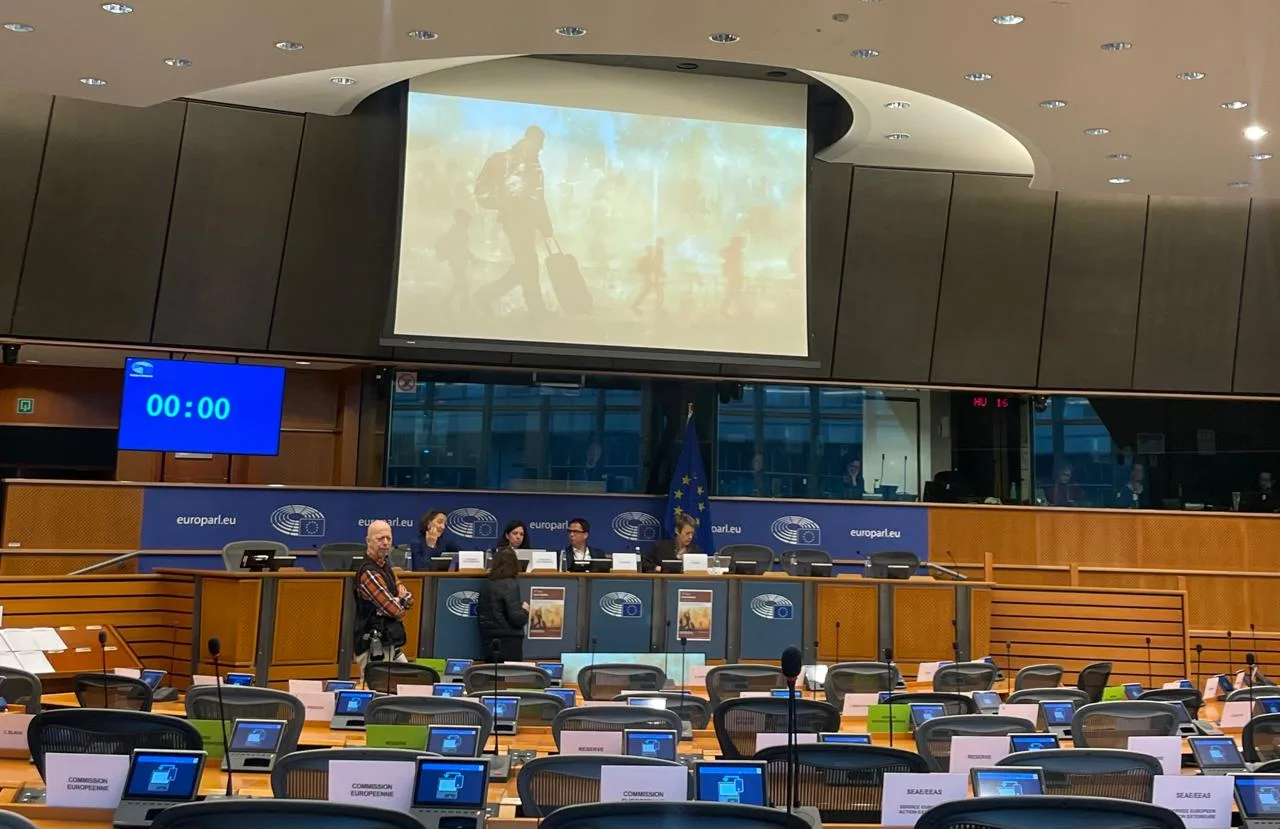
On May 6th, 2026, the European Parliament’s (EP) Subcommittee on Human Rights (DROI) convened a public hearing to address the global challenges of forced exile, removal of nationality, and statelessness. The hearing brought together a diverse range of perspectives from affected individuals, academics, policymakers, and civil society representatives, highlighting the urgent need for stronger international and European action to protect the rights and dignity of stateless and displaced persons.
Key Highlights
- According to the UNHCR, statelessness remains one of the major global challenges, often leading to the removal of the right to nationality, which is recognised as a fundamental human right. According to the current data, one-third of all stateless persons worldwide are children.
- There are currently approximately 4.5 million stateless people worldwide, though the actual number is believed to be higher as many cases go unrecorded.
- The EP took a strong stance, denouncing practices by authoritarian regimes that contribute to the creation and perpetuation of this issue.
Testimonials
Wendy Floris, a human rights defender and co-founder of the Colectivo Nicaragua Nunca Más (Never Again), described the situation she faced when she left Nicaragua for Costa Rica. She spoke about a deteriorating civic space, where dissenting voices were prosecuted and authoritarian leaders increasingly tightened their control over fundamental freedoms. She also shared the personal impact on those affected, explaining how colleagues were forced to leave their families behind and were sometimes unable to attend the funerals of loved ones. Floris emphasised that refugees are often compelled to rebuild their lives from scratch, stressing that no one leaves their country by choice. She further noted that the revocation of nationality effectively renders individuals “de facto stateless”, leading to serious consequences, including restricted or denied access to essential services such as healthcare. She further pointed to similar situations in other Central American countries, including Honduras, and beyond.
Lucky Karim, a Rohingya representative and founder of Refugee Women for Peace and Justice (RWPJ), highlighted the plight of the Rohingya population in Myanmar and in displacement worldwide. She noted that approximately 1.3 million Rohingya have been displaced, with many having been forced to move more than once. She further stressed that there are now more Rohingya living outside Myanmar than within the country itself. She described the humanitarian situation in Myanmar as dire and deteriorating, with displaced individuals still inside the country facing severe hardship and, in many cases, lacking access to any form of humanitarian assistance. Karim emphasised that the crisis continues to escalate at an increasing rate. She urged the European Union (EU), through the EP, to take stronger action, including strengthening sanctions and supporting international accountability mechanisms. She also called for continued engagement with the case at the International Court of Justice (ICJ), as the Myanmar authorities continue to deny and fail to recognise the Rohingya population both inside and outside the country.
Academic Perspective
Bronwen Manby, lecturer at the University of London, emphasised that the issues discussed are closely interlinked. She explained that statelessness, as defined in the 1954 Convention, refers to a person, who is not considered a national by any state under its law, emphasising that statelessness is a combination of both legal and factual circumstances. She highlighted that there are currently an estimated 4.5 million stateless people worldwide, while the actual number is likely significantly higher due to underreporting and lack of recognition. She explained that statelessness is often caused by systems that deny nationality at birth or by political dissent, and that it can be used as a tool to silence critics, particularly those from minority communities. The speaker further stated that deprivation of nationality and banishment function as mechanisms of exclusion, including through the withholding of documentation or denial of citizenship even when individuals are legally eligible. She pointed to examples including the Rohingya, Nicaragua, certain EU Member State contexts, and Bahrain. She emphasised that under Article 15 of the Universal Declaration of Human Rights (UDHR), everyone has the right to a nationality. For the EU, she suggested that statelessness should be addressed through a rights-based approach, including the need to strengthen and correct shortcomings in digital identity systems.
Civil Society
Amal de Chickera, co-founder and co-director of the Institute on Statelessness and Inclusion, emphasised that deprivation of nationality is permitted only under very limited circumstances under international law. He described statelessness as a fundamental failure of human rights protection. He further stressed that, in the context of migration, responsibility cannot be placed on a single state alone. He also noted that, with increasing violations of the international liberal order, such breaches of human rights are increasingly being normalised. De Chickera called on the EU to adopt a more coherent and assertive foreign policy approach, arguing that foreign policy in one area cannot be separated from policy in others, and warning that failing to take a stronger stance risks weakening the EU’s global position. He put forward several recommendations for the EU: first, to join cases against Myanmar and Israel at the ICJ and to initiate proceedings against Nicaragua; second, to strengthen its sanctions policy regarding Nicaragua and Israel; and third, to use diplomatic channels more consistently while ensuring greater coherence between parliamentary committees in order to reinforce a unified and stronger EU position.
Q&A session: MEPs seek further clarification
The Q&A session was opened with Isabel Wiseler-Lima of the European People’s Party, who called for further clarification on how different parliamentary committees could cooperate more effectively to ensure stronger and more coordinated action on statelessness and forced exile. She was followed by Marco Tarquinio of the Socialists and Democrats, who noted the absence of reference to challenges in Eastern Europe and the Roma community. He called for proposals capable of delivering impact both within and outside Europe. Mattheu Valet of the Patriots for Europe then, stressed the importance of properly implementing parliamentary resolutions. He also referred to concerns in his national context, France, and criticised what he described as a lack of respect for the laws of host countries by some new nationals. He was followed by Bernard Guetta of Renew Europe, who inquired about the status of passports for stateless persons, asking whether they still exist and, if not, whether there are plans at the United Nations level to introduce such documentation. Finally, Catarina Vieira of the Greens/EFA highlighted the responsibility of Member States to protect individuals hosted within their territories. She asked about existing EU initiatives in this field and also inquired with Mr Chickera about a study conducted by his institute on the link between statelessness and climate change.
Ms. Floris opened the response session, calling for a broader case-by-case approach, noting that it is often difficult for refugees to obtain and compile the necessary documentation. She also highlighted that countries responsible for human rights violations have, in some cases, withdrawn from major international forums. She was followed by Ms. Karim, who urged deeper engagement with host governments on the ground and the expansion of humanitarian assistance. She also called for continued involvement in ongoing cases before the International Court of Justice (ICJ). In addition, she recommended sustained engagement with ASEAN countries in order to maintain pressure on Myanmar.
Ms. Manby followed, emphasising the need for the EU to apply its rules and values consistently, both internally and externally. On the issue of passports, she noted that travel documents for stateless persons were first issued after the First World War. These were later replaced by mechanisms under the United Nations Refugee Convention, through which the UN provides identity and travel documentation. However, she noted that only a limited number of countries are signatories to these instruments. Additionally, this framework is primarily suited to individuals who are outside their country of origin. For those who have lived for many years in a country of residence, the appropriate solution is typically the conferral of nationality, which is not always granted in practice. She added that deprivation of nationality is often carried out in an arbitrary manner.
Mr. Chickera concluded the Q&A by highlighting issues related to asylum and migration, stressing the need for greater coherence both within and outside the EU. He noted that overly restrictive border policies can prevent individuals from accessing the right to seek asylum. He reiterated that if human rights are grounded in universal humanity, they should not be made contingent on other considerations. On climate change, he raised concerns about situations in which entire territories, such as island states like the Maldives, could become uninhabitable or disappear due to environmental change, questioning the implications for populations that would effectively be left without a state. Regarding inter-committee coordination, he acknowledged that he could not fully assess institutional arrangements but stressed the importance of greater coherence between the DROI, FEMM, and LIBE committees.
Moving Ahead
The exchange of views concluded with a shared understanding that there is a clear need for further action by the EU. To achieve these objectives, there is a strong need for greater coherence and consistency in the application of EU values and principles, in a clear and uniform manner both internally and externally.