
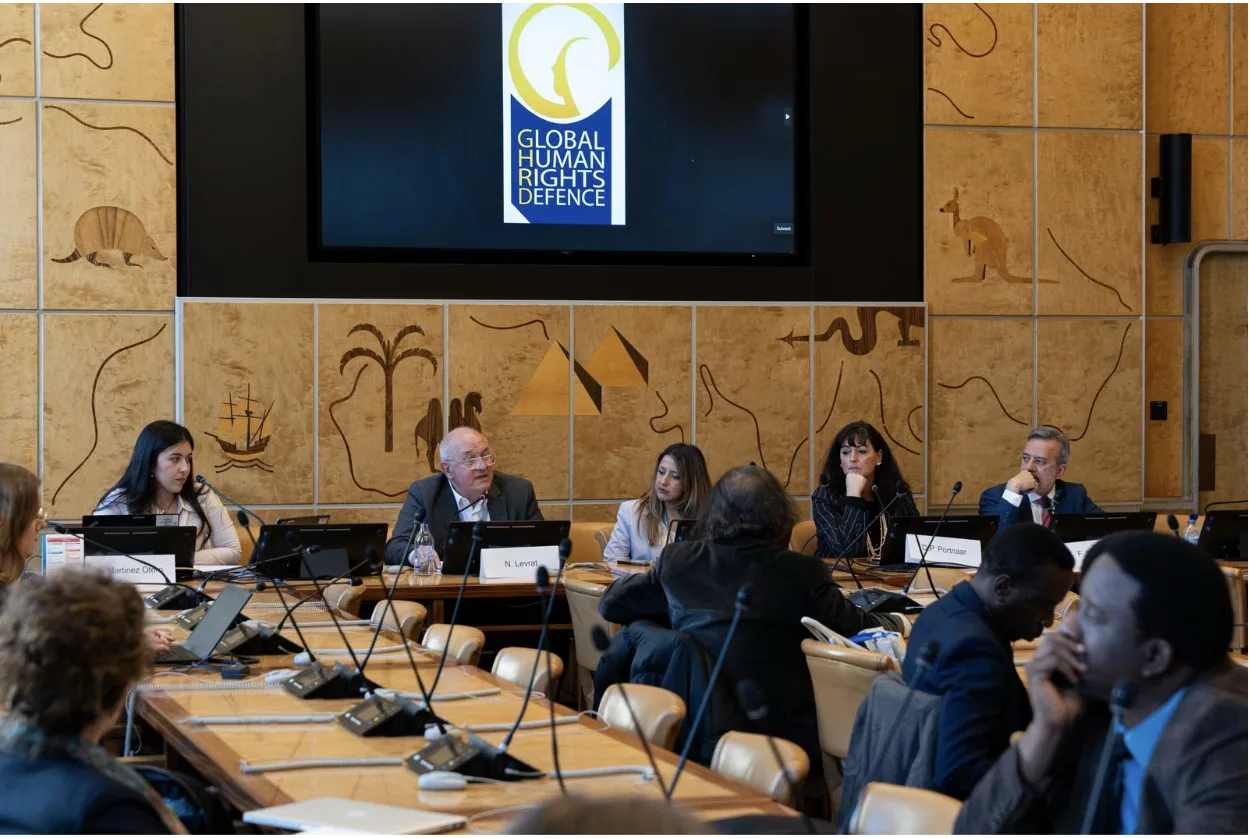
Geneva, 27 February 2026 – During the 61st Session of the United Nations Human Rights Council, Global Human Rights Defence (GHRD) hosted a well-attended side event examining the human rights implications of blasphemy laws for minority communities across Asia. The event brought together approximately 50 participants, including representatives from Germany, Belgium, the European Union, and Peru, alongside civil society and UN stakeholders.
Opening the discussion, GHRD’s Alejandra Martinez Otero underscored that blasphemy laws remain a prominent human rights concern across Asia, particularly for Ahmadiyyas, Christians and Hindus in Pakistan and Bangladesh, the Baha’i community in Iran, and women and girls in Afghanistan. These laws disproportionately affect minorities, women, and human rights defenders and continue to be used as tools of repression.
Blasphemy Laws and International Human Rights Law
The UN Special Rapporteur on Minority Issues, Professor Nicolas Levrat, provided a comprehensive legal overview. He noted that blasphemy laws continue to exist in approximately 100 countries worldwide. In seven countries, blasphemy is punishable by death; in 97, it carries prison sentences; and in 19 countries such laws remain on the books but are not implemented.
Professor Levrat clarified the distinction between freedom of religion and freedom of expression under international human rights law. Freedom of religion, protected under Article 18 of the International Covenant on Civil and Political Rights (ICCPR), safeguards the freedom to hold beliefs internally, which is absolute. However, it does not create a right for religion itself to be shielded from criticism through criminal legislation such as blasphemy laws. He further noted that Article 20 of the ICCPR requires prohibition of incitement to discrimination, hostility or violence, but according to General Comment No. 34 of the Human Rights Committee, blasphemy laws do not fall within this scope.
Referring to the Rabat Plan of Action, he emphasized that freedom of expression and freedom of religion are mutually dependent and reinforcing rights. Blasphemy laws, he cautioned, are counterproductive to freedom of religion and belief and risk reintroducing outdated “black letter law” approaches rooted in the 18th and 19th centuries. As he concluded, such laws are incompatible with international human rights standards.
The Baha’i Community in Iran
Simin Fahandej addressed the systemic persecution of the Baha’i community in Iran, the country’s largest non-Muslim religious minority. She highlighted how blasphemy and religion-based charges are used not to protect religion, but to protect those in power, eroding the rights of religious minorities.
Since 1979, Baha’is have faced systematic persecution, including abductions and executions of community leaders, exclusion from education and public employment, and discriminatory policies embedded in law. The Baha’i faith is not recognized under the Iranian constitution, and the Islamic Penal Code provides legal compensation only to Muslims. Baha’is have been labeled “impure” and portrayed as enemies of the state, narratives that have justified discrimination and violence.
Following recent protests in Iran, persecution has intensified, with forced confessions and accusations that Baha’is instigated unrest. Former UN Special Rapporteurs on Freedom of Religion or Belief and Human Rights Watch have characterized the situation as amounting to crimes against humanity, with indications of genocidal intent.
The Ahmadiyya Community in Pakistan and Bangladesh
Fareed Ahmad, Secretary of Foreign Affairs of the UK Ahmadiyya Council, described the uniquely severe legal framework targeting Ahmadis in Pakistan. The 1974 Constitution declared Ahmadis non-Muslim, and a 1984 amendment to the Penal Code criminalized their self-identification as Muslim and the exercise of their faith. Blasphemy accusations can carry the death penalty, and in practice, mere allegations often suffice to trigger prosecution.
Ahmadi schools have been nationalized, teaching their faith is effectively prohibited, and cyber laws restrict online religious expression. Ahmadis are denied the right to vote unless they renounce their faith. In 2025 alone, three Ahmadis were killed, one died in custody, mosques were demolished, graves desecrated, and approximately 250 Ahmadis were charged with blasphemy, many simply for offering prayer. Prisoners of conscience, he stressed, must be released.
Turning to Bangladesh, Ahmad noted rallies calling for Ahmadis to be officially declared non-Muslim. Although Bangladesh’s secular constitution has so far prevented such changes, mob violence against those accused of blasphemy remains a serious concern, with individuals beaten to death and homes burned.
A Broader Human Rights Dilemma
Closing the panel, author and analyst Dina-Perla Portnaar framed the discussion within a broader moral and governance dilemma. She emphasized that the issue is not belief, but coercion. While freedom of religion protects internal belief absolutely, freedom of expression may only be restricted under strict conditions of legality, necessity, and proportionality.
She cautioned against vague and selectively enforced laws that enable discrimination against women, minorities, and dissenting voices through literal interpretations of centuries-old scriptures. “The freedom to believe is not the freedom to dominate,” she noted, adding that pluralism is not the enemy of faith, accountability is not the enemy of belief, and human rights are not the enemy of religion.
Portnaar urged the international community to affirm clearly that freedom of religion does not mean shielding religion from scrutiny. She called for continued support to UN mandate holders, strengthened accountability mechanisms, and amplification of the voices of affected communities. Blasphemy laws, she concluded, are ultimately about power – and the purpose of human rights law is to restrain the abuse of power.
Interactive Dialogue
During the Q&A session, Belgium reaffirmed its principled opposition to the death penalty and raised the difficulty of obtaining reliable data on its application in blasphemy cases. Responding, Professor Levrat agreed, noting that in some countries official data is unavailable or sentences are changed retroactively. Nonetheless, he reiterated that seven countries retain the death penalty for blasphemy.
A Call for Legal Reform and Principled Leadership
As discussions at HRC61 made clear, the persistence of blasphemy laws represents not only a legal inconsistency with international human rights standards, but a lived reality of fear, discrimination, and violence for minority communities. GHRD urges Member States to take principled leadership by repealing or amending legislation that criminalizes belief and expression in violation of the ICCPR, ensuring that laws addressing incitement are precise and compliant with international standards, and strengthening protection mechanisms for vulnerable minorities. Safeguarding freedom of religion or belief must never come at the expense of equality, pluralism, and human dignity. The Human Rights Council has both the mandate and the responsibility to ensure that human rights law remains a shield for the vulnerable – not a tool for the powerful.