
Introduction
On the 17 July 2025, protests outside the Bell Hotel in Epping, which housed asylum seekers, escalated into violent disorder after anti-migrant tensions in the town were inflamed by the criminal case of a hotel resident (Quinn, 2025). Protesters hurled projectiles at police, damaged police vehicles and injured officers; yet, like earlier anti-asylum-hotel unrest in Knowsley in 2023 (Crown Prosecution Service, 2024) and the racially charged riots of summer 2024 (Home Affairs Committee, 2025), the violence was principally addressed through the vocabulary of violent disorder, arson, assault and other public-order offences.
In contrast, in Kent, a protester holding a ‘Free Gaza’ sign is questioned by armed officers (Casciani, 2025). The woman did not cause damage or disrupt public order but was questioned due to her solidarity with a group that, weeks earlier, was designated as a terrorist organisation by the Home Secretary.
This juxtaposition demonstrates a troubling asymmetry plaguing the policing of protest in the United Kingdom. Nationalist demonstrators who assault police officers or engage in violent disorder are, of course, arrested; after the September 2025 “Unite the Kingdom” march in London, police reported 26 injured officers and arrests linked to assaults and public-order offences, while the Metropolitan Police’s subsequent investigation continued to focus on public-order offences and assaults on officers (Reuters, 2025). Simultaneously, the UK’s public messaging has continued to distinguish that kind of violence from the broader right to engage in peaceful anti-immigration protests.
Contrastingly, left-wing and pro-Palestinian activism is increasingly scrutinised. In the context of non-governmental organisation Palestine Action, the threshold for intervention has extended to the peaceful expression itself. Charges under the Terrorism Act have been brought for acts as simple as displaying articles that arouse reasonable suspicion that one is a supporter of Palestine Action or organising meetings in support of the group (Crown Prosecution Service, 2025; Crown Prosecution Service, 2025). As the Equality and Human Rights Commission (ECHR) has cautioned, such an approach risks chilling peaceful protest that is not itself linked to unlawful conduct, with Chairwoman Baroness Kishwer Falkner issuing the following statement “The right to peaceful protest is fundamental to our democracy and must be protected even when dealing with complex and sensitive issues. We recognise the genuine challenges the police face in maintaining public safety, but we are concerned that some recent responses may not strike the right balance between security and fundamental rights” (Equality and Human Rights Commission, 2025). Taken together, this suggests that while nationalist protest is generally policed once it has crossed into the elaboration of violence or public disorder, pro-Palestinian activism is more quickly drawn into the counter-terrorism sphere at the level of expression and association alone.
Political polarisation in the UK is at an all-time high, with the topic of irregular migration being a particularly divisive issue. In that background, the July 2025 proscription of Palestine Action raises numerous questions about the right to protest, proportionality and equality before the law under both the Human Rights Act, in particular section 6 and the Convention rights incorporated through Schedule 1, notably Articels 10 and 11 of the European Convention on Human Rights. While the Home Secretary maintained that proscription would not affect lawful protest (House of Commons, 2025), the EHRC has stressed that any restriction on protest rights must be lawful, necessary and proportionate (EHRC, 2025). The more expansively the state deploys counter-terrorism powers in this area, the greater the risk that political dissent will be constrained in ways that are difficult to reconcile with a democratic society.
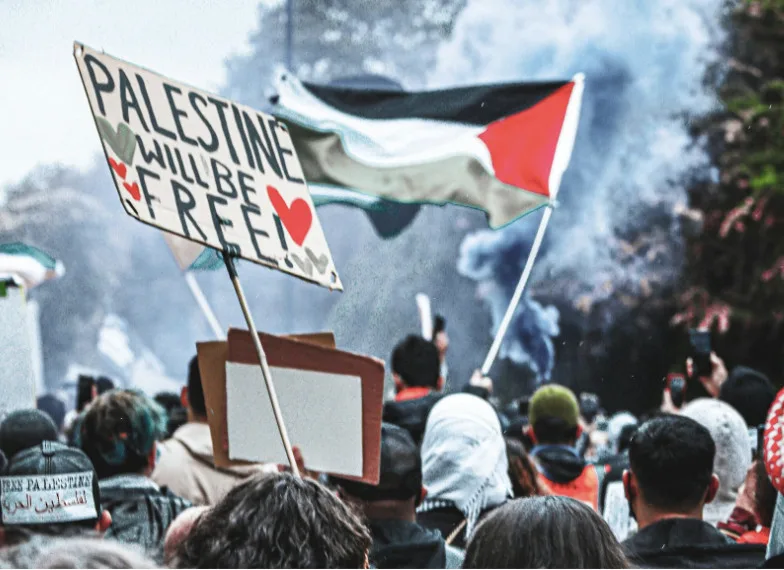
The Proscription of Palestine Action
Founded in 2020, Palestine Action presents itself as a network of political activists committed to ending the UK’s role in supplying weapons to the state of Israel (Home Office, 2025). From its creation, the organisation has centred its strategy around direct action targeting defence firms, government buildings and other institutions. This range is broad and could potentially include the occupation of factories, spray-painting offices, and trespassing on defence facilities. These actions, according to the explanatory memorandum issued by the UK government, long ago crossed the line from valid protest into terrorism, characterising the activities of the group as “direct criminal action tactics” and stating that their frequency and severity have increased from 2024, with methods becoming more aggressive and demonstrating a willingness to use violence (Home Office, 2025).
The Home Secretary’s decision to proscribe Palestine Action under the Terrorism Act 2000, announced on 23 June 2025 and implemented through the Terrorism Act 2000 (Proscribed Organisations) (Amendment) Order 2025, rested on three principal grounds. First, the Government considered that the group had committed or participated in acts of terrorism by carrying out serious damage to property in pursuit of a political cause and with the aim of influencing the Government. In support of that conclusion, the Home Secretary referred to attacks on Thales in Glasgow in 2022, and on Instro Precision in Kent and Elbit Systems UK in Bristol in 2024, stating that the damage caused by those attacks ran into the millions of pounds. Secondly, the Government stated that Palestine Action had prepared for terrorism through a publication called The Underground Manual, which encouraged the creation of cells, identified targets and provided practical guidance on how to carry out covert activity and evade arrest. Thirdly, the Government maintained that Palestine Action had promoted and encouraged terrorism by publicising attacks involving serious property damage, celebrating their perpetrators, and encouraging supporters to express solidarity with those imprisoned for such acts (House of Commons, 2025).
The guidance referred to by the Home Secretary came in the form of Palestine Action’s Underground Manual, a document which encouraged supporters to form autonomous “cells”, avoid detection by authorities through covert methods, and deliberately target “security and defence” firms linked to the supply of support to Israel (Palestine Action, n.d). Its content provides practical advice and instructions for reconnaissance, how to disguise oneself and sabotage. It also sets out a list of tactics including the smashing of windows, blocking pipes, breaking into sites and spray-painting essential equipment belonging to the targeted corporation. For the legislators voting on the proscription of Palestine Action, the manual was a decisive piece of evidence: a handbook for clandestine operations, a document that pushed it over the line from protest movement to an organisation actively preparing members to commit crimes (House of Commons, 2025).
The legal repercussions of this decision are substantial. It is now a criminal offence not only to participate in Palestine Action’s activities, but to be a member, to provide funding, or even to express support for the organisation in public spaces. Under Section 13 of the Terrorism Act, even the display of an item, for example, a placard or a badge, that is likely to arouse “reasonable suspicion” of support is punishable by up to 14 years imprisonment (Lankester, 2025; Haidar, 2025). In practice, this legal move has resulted in mass arrests. In a single demonstration in London in July 2025, nearly 900 individuals were detained, the vast majority for the mere act of displaying solidarity with Palestine Action (Faulkner, 2025). Elderly protesters have been charged for merely holding signs that read “I support Palestine Action”, while others face trial for little more than wearing watermelon-patterned earrings (Sky News, 2025) .
This approach has prompted crucial criticism at home and abroad. The UN High Commissioner for Human Rights, Volker Türk, warned that the UK was misusing and effectively undermining the “gravity and impact of terrorism” by expanding it to encompass conduct that international law does not perceive as being of a terrorist nature (UN Office of the High Commissioner for Human Rights, 2025). The government, he argued, already has adequate mechanisms under criminal law to prosecute criminal damage without needing to resort to counter-terror powers. Former UK head of counter-terror policing, Neil Basu, also expressed that he was “very surprised” at the decision to proscribe Palestine Action and that he would be “amazed if there were not more intelligence on Palestine Action to justify the proscription” (Gardham, 2025). The High Court has now granted permission for a judicial review of the proscription, having accepted that the decision raises “a serious question to be tried” about whether the ban would fail the proportionality test and amount to a disproportionate interference with Articles 10 (freedom of expression) and 11 (freedom of peaceful assembly and association) of the European Convention on Human Rights (Greenhall and Mogan, 2025; High Court of Justice, 2025). However, Mr Justice Chamberlain refused the group’s appeal to lift the ban temporarily (Casciani, 2025).
The government’s argument is clear. Palestine Action has apparently moved beyond a disruptive protest movement to organised criminality, with the publication of its underground manual placing it squarely within the statutory definition of terrorism. Yet, the consequences of proscription extend far beyond the unlawful actions it purports to prevent. The Human Rights Act 1998 mandates that governmental decisions must properly balance an individual’s rights proportionately against the public interest (The Conversation, 2025). By criminalising symbolic expression and ordinary association, the decision has increasingly blurred the boundary between average dissent and terrorism, bolstered the risk of unfounded or arbitrary detentions, and narrowed the scope of lawful protest in the United Kingdom.
The Rise of Nationalist Protest Culture
The proscription of Palestine Action comes against a backdrop of a very different type of political mobilisation within the UK: the quick rise of nationalist protest culture. Although actors such as Tommy Robinson and other street-based nationalist movements are not formally affiliated with Reform UK (Reuters, 2025), they have emerged in a broader political environment in which anti-immigration rhetoric has gained increasing prominence. Since its breakthrough in the polls and local elections, Reform has proven largely successful at shifting the political centre of gravity towards the right, mainstreaming slogans regarding sovereignty, “stopping the boats” and reclaiming the national identity of the British people (Taylor, 2025). This rhetoric has spread beyond the legislative and executive realms, feeding into street-level demonstrations that too often blur the line between legitimate political activism and xenophobic intimidation. The Institute for Strategic Dialogue, in their 2025 analysis of anti-migrant narratives targeting the UK found more than 300,000 posts on X featuring anti-migrant narratives on X, with over a quarter of posts portraying the UK as under “invasion” by migrants (Venkataramakrishnan, 2025). UK Prime Minister Keir Starmer has pledged to fight back against the division fuelled by the proliferation of the far-right narrative in the UK, stating in an opinion for The Sun newspaper that while the population’s frustration with the economy and migrations did hold merit “a small minority see instead an opportunity to whip up hatred … to follow an old and dangerous playbook that sets people against one another.” He continued to condemn “loutish behaviour on the streets. And people made to feel like they are not welcome or safe here because of their heritage, religion or colour of their skin” (Elgot, 2025). These remarks are significant because they acknowledge, at the highest political level, that far-right street mobilisation can be racially charged, intimidating and harmful to minority communities. Yet the phenomenon is still framed principally as a matter of hatred, disorder and social division rather than terrorism. The implication is not that nationalist violence goes unpoliced, but that it remains conceptually and legally located within the framework of public-order offences and assaults on officers, whereas pro-Palestinian activism has more readily been drawn into the language and machinery of counter-terrorism.
To make rising tensions worse, a 2025 study by the University of Oxford’s Bonavero Institute of Human Rights revealed that a large majority of news articles centred around the European Convention on Human Rights orientated around immigration and deportation, issues central to the rise of far-right violence in the UK. The report found that,
[…] immigration tribunal cases are frequently misreported…These misrepresentations risk eroding public confidence in the legal system and are fuelling calls to leave the ECHR based on misleading portrayals of the role and operation of the ECHR in the UK (University of Oxford, 2025).
This is significant because it suggests that anti-immigration rhetoric is not merely politically prominent but amplified by distorted information environmentS in which human rights law is repeatedly portrayed as an obstacle to border control. In that sense, narratives associated with actors such as Reform UK are able to acquire a degree of salience and legitimacy that exceeds their formal institutional footprint.
Over the course of the summer 2025, nationalist protests associated with figures such as Tommy Robinson, founder of the now-defunct movement the English Defence League (EDL), drew momentous crowds. The “Unite the Kingdom” rally in London, with over 100,000 attendees, became one of the largest far-right demonstrations in recent British history (Grierson, 2025). British and English flags covered Whitehall, chants echoing through the streets that targeted migrants and Muslims. Footage emerged of men tearing down Palestinian flags, harassing women of colour, and assaulting counter-protestors (Adesanya, 2025). Police officers reported being met with “unacceptable violence” when attempting to manoeuvre protesters back onto the approved route of the march, with officers describing instances of being punched, kicked and having to dodge flares, bottles and other projectiles (Yalahuzian, 2025). The Metropolitan Police have since confirmed that 26 officers were injured, four of them seriously, and dozens were arrested (Adesanya 2025; Yalahuzian, 2025). CNN noted that these violent attacks “happened after demonstrators at the Unite the Kingdom march breached a “sterile area” put in place to keep protesters and counter-protesters apart” (Nicholl, 2025).
Unfortunately, these events are not isolated. In towns and cities across the country, anti-migrant marches have escalated into racially-charged riots. The riots that followed the Southport murders in 2024 were described by the Home Affairs Committee as the worst disorder since 2011, marked by attempts to break into asylum hotels and attacks on mosques, community centres and libraries (Home Affairs Committee, 2025). The Institute for Strategic Dialogue found that in the 10 days following the Southport attack, “posting activity on far-right Telegram channels rose by 327% compared to the 10 days before”, overwhelming evidence that harmful and misleading online content continues to play a key role in driving violence, demonstrating how far-right digital networks rapidly converted anti-migrant narratives into offline mobilisation.(Institute for Strategic Dialogue, 2024). Religious and racially motivated crimes surged in 2024, with religious hate crimes increasing by 25 percent (Home Office, 2024) compared to the year prior, and recent events indicate no sign of it slowing down. Hotels harbouring asylum seekers have been attacked, and instances have been recorded of protestors hurling bricks at police enforcement and looting shops (Kirka, 2024). This behaviour has persisted in the summer of 2025, as anti-immigration protests swept the country, following the arrest of an Ethiopian man, later convicted for the sexual assault of a 14 year old girl in London (The Associated Press, 2025). Some of the most serious disturbances were linked to networks descended from the EDL, a group whose membership is notorious for having faced convictions for violent public disorder. In that context, the contemporary significance of the EDL lies less in whether it remains a coherent formal organisation than in the continuing influence of the anti-Muslim and anti-migrant street politics it helped normalise. In this way, anti-migrant messaging overstates the scale of criminal threat associated with migrants, misrepresents their intentions and creates a climate in which intimidation of minorities can be recast as a legitimate political grievance. Yet even when this mobilisation has involved targeted intimidation, assaults on police officers and attacks on sites associated with migrants and minorities, it has predominantly been addressed through the language of public order, violent disorder, arson and hate crime, rather than through the terrorism framework.
Comparing the Treatment of Protest Movements
The United Kingdom’s divergent responses to Palestine Action and to the resurgent far-right street movement show a marked asymmetry in the application of public order and counter-terrorism powers in the UK. While nationalist protestors do not escape policing, the asymmetry lies in classification of offences. Once Palestine Action was proscribed, criminal liability extended beyond property damage or trespass to membership, the invitation of support, the public display of supportive articles and the organisation of meetings in support of the group. By contrast, anti-migrant mobilisation, even when racially charged and accompanied by serious violence, has generally remained within the frame of ordinary criminal and public-order law.
The proscription of Palestine Action is reflective of a legal strategy that collapses the distinction between violent criminal conduct and mere symbolic association. To date, Palestine Action is the only organisation to be proscribed as a terrorist organisation solely under Article 1(2)(b) of the Terrorism Act, which provides that action falling under “terrorism” may consist of causing serious damage to property. This is a remarkable shift in the standard of conduct required to justify proscription, which has traditionally centred around physical violence directed towards people, or serious cases of endangerment to life. The state’s approach thereby extends the reach of counter-terrorism law into domains usually protected by Articles 10 and 11 of the European Convention on Human Rights. The consequence of this is a climate where dissenting expression is stigmatised as terrorism, even when the UK already possesses a robust body of criminal law that is capable of addressing serious offences such as criminal damage and trespass. Offences under the Criminal Damage Act 1971 cover destruction or damage to property, including forms where life is endangered (Article 1). Where this conduct further escalates, the Public Order Act 1986 provides for the prosecution of violent disorder and affray (Articles 2 and 3). Conspiracies and preparatory acts may be addressed under the Serious Crime Act 2007. The tools to address unlawful direct action already exist. The decision to recast such conduct within the framework of terrorism is representative of a discretionary and overly-expansive use of that legal mechanism, rather than legal necessity.
Nationalist movements paint a different picture. The “Unite the Kingdom” marches, as aforementioned, included direct confrontations with police and directly compromised their safety. Elsewhere, anti-migrant riots in recent years have involved arson, looting and attacks on hotels housing asylum seekers. These events meet several of the statutory criteria under Section 1 of the Terrorism Act including serious violence against persons, property and an intent to intimidate a section of the public. Yet, the government has abstained from reaching for the terrorism framework. Calls for proscription of the English Defence League, whose earlier protests resulted in a multitude of criminal convictions for violent disorder, have been left unanswered for years (Sky News, 2024).
Political context matters in shaping how counter-terrorism powers are deployed. Palestine Action targets the arms trade and, by extension, aspects of the United Kingdom’s foreign policy and defence relationships. Nationalist mobilisation, instead, often advances themes of border control, sovereignty and migration that already occupy a core place in mainstream political debate, even where more radical street-based actors go considerably further than formal party politics. The resulting distinction is not that one form of protest is unlawful and the other lawful, but that they are framed differently by the state: one is more readily treated as a matter of national security, while the other is generally addressed through the ordinary language of public order and criminal law.
From a human rights perspective, this mismatch undermines the principle of proportionality and state neutrality. To escalate one set of offences into the counter-terrorism space while leaving the other within the framework of ordinary criminal law creates an unusual hierarchy of protest that is quite difficult to reconcile with the state’s duty of neutrality. This raises the risk that terrorism legislation, initially designed to counter existential threats such as the IRA and Al-Qaida, is arguably being utilised against one ideology of political dissent.
Conclusion
The effect of this divergence pushes past the symbolic. For Palestine Action and those who support it, proscription imposes a stark chilling effect: individuals risk arrest and imprisonment for holding a badge or placard. For nationalist activists, participation does not carry the same stigmatisation or far-stretching liability of terrorism offensives. The law’s wrath is apparently reserved for one set of dissenters, while others continue to exercise their fundamental rights within the political sphere.
This application is selective and breaks the coherence of the UK’s human rights framework. Equality before the law demands its equal application, irrespective of political alignment. Yet, similar conduct is not treated alike. By securitising one form of dissent and normalising another, the state risks entrenching a double standard that critically narrows civic space and corrodes the public’s trust in institutions in the United Kingdom.
Bibliography
Adesanya Imani, ‘Unite the Kingdom: How Tommy Robinson’s Nationalist Protest Was Anything But Unifying’ (ShoutOut UK, 24 September 2025) <https://www.shoutoutuk.org/2025/09/24/unite-the-kingdom-how-tommy-robinsons-nationalist-protest-was-anything-but-unifying/> accessed 27 September 2025.
Ammori v SSHD [2025] EWHC 2013 (Admin).
Ault Richard, Mills Kelly-Ann, ‘Racist Attacks and Hate Crimes on Rise in UK- Use Interactive Map to See How Your Area Compares’ (Mirror, 13 May 2024) <https://www.mirror.co.uk/news/uk-news/racist-attacks-hate-crimes-rise-32797363> accessed 27 September 2025.
Casciani Dominic, ‘Palestine Action Can Challenge UK Ban, Court Rules’ (BBC, 30 July 2025) <https://www.bbc.com/news/articles/cqlerg1n67no> accessed 27 September 2025.
Crown Prosecution Service, ‘Organisers Charged Over Arranging and Managing Meetings in Support of Proscribed Palestine Action’ (The Crown Prosecution Service, 3 September 2025) <https://www.cps.gov.uk/cps/news/organisers-charged-over-arranging-and-managing-meetings-support-proscribed-palestine> accessed 27 September 2025.
Crown Prosecution Service, ‘Rotherham Rioter Sentenced for Arson and Violent Disorder’ (The Crown Prosecution Service, 12 December 2024) <https://www.cps.gov.uk/yorkshire-and-humberside/news/rotherham-rioter-sentenced-arson-and-violent-disorder-0> accessed 27 September 2025.
Crown Prosecution Service, ‘Three Charged for Displaying Support for Proscribed Terrorist Group’ (The Crown Prosecution Service, 7 August 2025) <https://www.cps.gov.uk/cps/news/three-charged-displaying-support-proscribed-terrorist-group> accessed 27 September 2025.
Crown Prosecution Service, ‘Violent and Hostile Protestors Sentenced’ (The Crown Prosecution Service, 18 March 2024) <https://www.cps.gov.uk/mersey-cheshire/news/violent-and-hostile-protestors-sentenced> accessed 27 September 2025.
Elgot Jessica, Crerar Pippa, ‘Keir Starmer to Launch Progressive Fightback Against ‘Decline and Division’ Fuelled By Far Right’ (The Guardian, 23 September 2025) <https://www.theguardian.com/politics/2025/sep/23/keir-starmer-to-launch-progressive-fightback-against-decline-and-division-fuelled-by-far-right?utm_source=chatgpt.com> accessed 27 September 2025.
Equality and Human Rights Commission, ‘EHRC Calls for Proportionate Policing to Protect Fundamental Protest Rights’ (EHRC, 15 August 2025) <https://www.equalityhumanrights.com/media-centre/news/ehrc-calls-proportionate-policing-protect-fundamental-protest-rights> accessed 27 September 2025.
Faulkner Doug, ‘Arrests at Rally Against Palestine Action Ban Rise to 890’ (BBC, 7 September 2025) <https://www.bbc.com/news/articles/c8rvly00440o> accessed 27 September 2025.
Gardham Duncan, ‘Protest or Terrorism? Palestine Action Wins Right to Challenge Ban in Britain’ (The Observer, 3 August 2025) <https://observer.co.uk/news/national/article/protest-or-terrorism-palestine-action-wins-right-to-challenge-ban-in-britain> accessed 27 September 2025.
Greenhall Owen, Mogan Audrey Cherryl, ‘Palestine Action Granted Permission to Challenge Proscription as Terrorist Organisation’ (Garden Court Chambers, 5 August 2025) <https://gardencourtchambers.co.uk/palestine-action-co-founder-granted-permission-to-challenge-decision-to-proscribe-group-as-terrorist-organisation/> accessed 27 September 2025.
Grierson Jamie, ‘Who Were the Key Figures at the ‘Unite the Kingdom’ Rally in London?’ (The Guardian, 15 September 2025) <https://www.theguardian.com/politics/2025/sep/15/who-were-the-key-figures-at-the-unite-the-kingdom-rally-in-london> accessed 27 September 2025.
Haidar Nour, ‘Home Secretary v Palestine Action: The Constitutional Implications of Widening the Legal Understanding of Terrorism’ (UK Constitutional Law Association, 8 July 2025) <https://ukconstitutionallaw.org/2025/07/08/nour-haidar-home-secretary-vs-palestine-action-the-constitutional-implications-of-widening-the-legal-understanding-of-terrorism/> accessed 27 September 2025.
Home Affairs Committee, ‘Police Response to the 2024 Summer Disorder’ (House of Commons, 14 April 2025) <https://publications.parliament.uk/pa/cm5901/cmselect/cmhaff/381/report.html> accessed 27 September 2025.
Home Office, Explanatory Memorandum to the Terrorism Act 2000 (Proscribed Organisations) (Amendment) Order 2025, 2025 No 803 <https://www.legislation.gov.uk/uksi/2025/803/pdfs/uksiem_20250803_en_001.pdf> accessed 27 September 2025.
Home Office, ‘Proscribed Terrorist Groups or Organisations’ (GOV.UK, updated 11 July 2025) <https://www.gov.uk/government/publications/proscribed-terror-groups-or-organisations–2/proscribed-terrorist-groups-or-organisations-accessible-version#list-of-proscribed-international-terrorist-groups> accessed 27 September 2025.
Home Office, ‘Hate crime, England and Wales, Year Ending March 2024’ (GOV.UK, 10 October 2024) <https://www.gov.uk/government/statistics/hate-crime-england-and-wales-year-ending-march-2024/hate-crime-england-and-wales-year-ending-march-2024> accessed 27 September 2025.
House of Commons, HC Deb, 23 June 2025, vol 769, col WS729 (Palestine Action: Proscription) <https://hansard.parliament.uk/commons/2025-06-23/debates/25062337000014/PalestineActionProscription> accessed 27 September 2025.
Institute for Strategic Dialogue, ‘Quantifying Extremism: A Data-Driven Analysis of UK Riot-Related Far-Right Telegram Networks’ (Institute for Strategic Dialogue, 13 September 2024) <https://www.isdglobal.org/digital-dispatch/quantifying-extremism-a-data-driven-analysis-of-uk-riot-related-far-right-telegram-networks/> accessed 27 September 2025.
Kirka Danica, ‘What’s Behind the Anti-Immigrant Violence That Has Exploded Across Britain? Here’s a Look’ (AP, 5 August 2024) <https://apnews.com/article/britain-riots-unrest-social-media-misinformation-attack-5824d3136675e10d6a25c9e17287c994> accessed 27 September 2025.
Lankester Vicky, ‘The Chaos From Proscribing Palestine Action’ (The Law Society Gazette, 16 September 2025) <https://www.lawgazette.co.uk/practice-points/the-chaos-from-proscribing-palestine-action/5124478.article> accessed 27 September 2025.
Nicholls Catherine, ‘Far-Right Anti-Immigration Protests in London Lead to Clashes with Police’ (CNN, 13 September 2025) <https://www.cnn.com/2025/09/13/europe/far-right-anti-immigration-protests-london-intl> accessed 27 September 2025.
Palestine Action, ‘The Underground Manual’ (TargetMap, n.d).
Quinn Ben, ‘Far-Right Supporters Attack Police After Protest Against Essex Hotel for Asylum Seekers’ (The Guardian, 17 July 2025) <https://www.theguardian.com/uk-news/2025/jul/17/essex-police-warn-against-violence-as-far-right-exploit-asylum-hotel-tensions> accessed 27 September 2025.
Taylor Diane, ‘UK Party Leaders Urged to End ‘Pernicious Currents’ of Hatred Fuelling Anti-Migrant Protests’ (The Guardian, 11 August 2025) <https://www.theguardian.com/world/2025/aug/11/uk-party-leaders-urged-end-pernicious-currents-racism-hatred-fuelling-anti-migrant-protests> accessed 27 September 2025.
The Associated Press, ‘Police Clash with Far-Right Protesters, Make Arrests After More Than 100,000 Rally in London’ (CBC, 13 September 2025) <https://www.cbc.ca/news/world/far-right-london-protest-march-unite-kingdom-tommy-robinson-1.7633393> accessed 27 September 2025.
The Conversation, ‘Palestine Action Arrests: What Happens Next, and What it Tells About the Breadth of Britain’s Counter-Terrorism Laws’ (The Conversation, 15 August 2025) <https://theconversation.com/palestine-action-arrests-what-happens-next-and-what-it-tells-us-about-the-breadth-of-britains-counter-terrorism-laws-263080#:~:text=The%20proscription%20of%20Palestine%20Action%20%E2%80%93%20banning%20membership,the%20state%20of%20protest%20rights%20in%20the%20UK.> accessed 27 September 2025.
University of Oxford, ‘Misrepresentations Around Human Rights and Immigration Fuelling Calls to Quit ECHR, Oxford Report Finds’ (University of Oxford, 4 September 2025) <https://www.ox.ac.uk/news/2025-09-04-misrepresentations-around-human-rights-and-immigration-fuelling-calls-quit-echr> accessed 27 September 2025.
UN Office of the High Commissioner for Human Rights, ‘UK: Palestine Action Ban ‘Disturbing’ Misuse of UK counter-terrorism legislation, Türk Warns’ (United Nations Human Rights Office of the High Commissioner, 25 July 2025) <https://www.ohchr.org/en/press-releases/2025/07/uk-palestine-action-ban-disturbing-misuse-uk-counter-terrorism-legislation> accessed 27 September 2025.
Sky News, ‘Does the English Defence League Still Exist, and Could it be Banned in the UK?’ (Sky News, 4 August 2024) <https://news.sky.com/story/does-the-english-defence-league-still-exist-and-could-it-be-banned-in-the-uk-13190517> accessed 27 September 2025.
Sky News, ‘First People Charged with Supporting Palestine Action Plead Not Guilty’ (Sky News, 16 September 2025) <https://news.sky.com/story/first-people-charged-with-supporting-palestine-action-due-in-court-today-13431998> accessed 27 September 2025.
Yalahuzian Vitalii, Tessier Yann, McDill Stuart, ‘Police and Protestors Scuffle as 110,000 Join Anti-Migrant London Protest’ (Reuters, 13 September 2025) <https://www.reuters.com/world/uk/police-protesters-scuffle-110000-join-anti-migrant-london-protest-2025-09-13/> accessed 27 September 2025.