
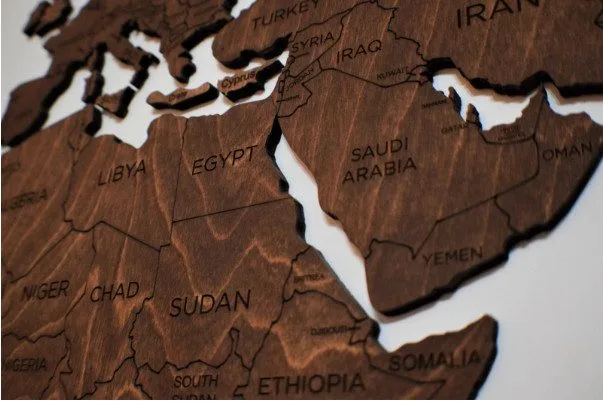
Ethnic violence in the south-west region of Sudan, primarily the Darfur region, has resulted in at least 900 deaths and 300.000 displaced people in 2022, according to the United Nations Office for the Coordination of Humanitarian Affairs. Ethnic clashes mainly occur over access to and control over land and resources.
United Nations Officer for the Coordination of Humanitarian Affairs, ‘Sudan Situation Report’ (22 December 2022) <https://reports.unocha.org/en/country/sudan/> accessed 27 January 2023.
Ibid.
The ethnic clashes in Sudan are not a new phenomenon. The country has been confronted with inter-ethnic group conflicts for decades. Although the entire history of the conflicts the country has been suffering is far too comprehensive to set out in this article, a brief summary will be provided here.
Decades of civil war and inter-ethnic conflict between North and South
The country of Sudan has been troubled by ethnic conflict for decades. Much of the history of conflict in the country can be deduced to ethnic, religious, and linguistic diversity. In many aspects, Sudan is a heterogeneous country. The composition of its population, as well as its ecological diversity, is extremely diverse. The first divide can be seen in religion, as the northern part of the country is predominantly Muslim, and is often self-identified as part of the Arab world, whereas the most southern part is mainly Animist and Christian. Especially following the succession of South-Sudan from Sudan in 2011, the overwhelming majority of the population is Muslim. However, the Sudanese population is diverse in many more aspects, such as mode of livelihood and language. Moreover, its population consists of many different ethnic groups, and many indigenous beliefs.
The roots of the conflict are argued to lie in the country’s history of enslavement during the Turco-Egyptian rule in 18th century, which left prejudice towards the south, and resent towards the north. During the colonialist era, in which the British and Egyptian government ruled Sudan, the divide between north and south was further established and turned the south into an isolated area. In that time, development policies were unequal between the north and the south, eventually leading to a civil war that started in August 1955, in which the south rebelled against British colonial policies that were responsible for the political and
Ankush B Sawant, ‘Ethnic Conflict in Sudan in Historical Perspective’ (2016) 25 (3) International Studies 343.
Ibid.
Ibid.
Economist Intelligence Unit, Robert O Collins, Jay L Spaulding, Ahmad Alawad Sikainga, Mohy el Din Sabr and Ahmed S Al-Shahi, ‘Sudan’ (Encyclopedia Brittanica, 17 January 2023) <www.britannica.com/place/Sudan/Plant-and-animal-life> accessed 27 January 2023.
Ibid.
Ibid.
Dina Badri, ‘Religion and Peace in Sudan: Inter-Religious Dialogue and Peaceful Co-Existence’ (2010) 12 Sudanese Journal for Human Rights’ Culture and Issues of Cultural Diversity 1.
Britannica, ‘Anglo-Egyptian Condominium’ (Encyclopedia Brittanica, 17 April 2018) <www.britannica.com/place/Anglo-Egyptian-Condominium> accessed 27 January 2023.
Dina Badri (n 9).
social divide between the north and the south. Sudan gained independence from the United Kingdom on January 1st of 1956, but the civil war continued in 1962.
The Addis Abba Agreement of 1972 marked an important turn in the history of the northern oppression of southern Sudan and ensured a relatively peaceful and stable country for several years. However, the dissatisfaction in southern Sudan resurfaced when poverty, disease, and illiteracy remained persistent in the south, and no meaningful economic development occurred. Further, ethnic disorder erupted when oil was discovered in southwest Sudan in 1978, and tribes present in the area aimed to claim control over the resources.
In the early years of the 1980’s, the dissatisfaction escalated, and the established peace between North and South vanished. In 1983, ruling President Jaafar Numayri broke the Addis Ababa Agreement and proclaimed Arabic to be the only official language of the whole country, instigating opposition from the south. As a result of the marginalization perceived by the south, another civil war erupted, lasting from 1983 until 2005, when the Comprehensive Peace Agreement was signed. The civil war was primarily fought between the Sudan People’s Liberation Army, a southern Sudanese rebel group, and the Sudanese government. It was the longest civil war recorded worldwide and had the highest death toll in any war since the Second World War.
The second civil war ended with the Comprehensive Peace Agreement (CPA) signed on 9 January 2005. The terms of the CPA included the autonomy of the south, to be followed by a referendum on independence in order to ensure their right to self-determination. Further, the CPA paid close attention to the cultural, ethnic, racial, religious, and linguistic diversity of the people of Sudan, and aimed to ensure the rights and freedoms of the population despite these differences. The promised referendum took place in January 2011, and an
Ibid.
Ibid.
Girma Kebbede, ‘Sudan: The North-South Conflict in Historical Perspective’ (1997) 15 Contributions in Black Studies 15.
Ibid.
Dina Badri (n 9).
Ibid 7.
Ibid 8.
The Comprehensive Peace Agreement Between the Government of The Republic of The Sudan and The Sudan People’s Liverationn Movement/Sudan People’s Liberationn Army 2005.
Ibid.
Ibid 2.
Ibid.
overwhelming majority of 98.83 percent voted in favor of independence. On July 9, 2011, the Republic of South Sudan gained independence and became its own nation.
The Darfur War
During the second civil war, a separate war broke out in the region of Darfur in the (south-)west of Sudan. It started in February 2003, when the Sudan Liberation Army (SLA) and the Justice and Equality Movement (JEM), two rebel movements fighting for autonomy for the region and equal distribution of economic resources and political power, started attacking government targets. Jointly, the SLA and JEM raided a Sudanese air base in April 2003, in response to which the Sudanese government provided arms and equipment to the Janjaweed, a Sudanese Arab militia. The following years of conflict resulted in thousands of deaths, victims of rape, assault, and displacement of civilians.
Like the entire history of conflict in Sudan, the violent conflict in Darfur was very complex in its nature and cause. It was a product of several factors, such as environmental, political, and economic factors. Long before the attacks by the SLA and JEM that started the Darfur war in 2003, the region has been plagued by communal conflict. Much of this can be attributed to competition over resources and the question of land ownership, which has been part of several different allocation systems over the centuries, creating a hybrid set of practices.
United Nations Mission in the Sudan, ‘Independence of South Sudan’ (United Nations Mission in the Sudan n.d.) <https://peacekeeping.un.org/sites/default/files/past/unmis/referendum.shtml> accessed 27 January 2023.
United Nations Office of the High Commissioner, ‘Ten Years After Gaining Independence, Civilians in South Sudan Still Longing for Sustainable Peace, National Cohesion, and Accountability – UN Experts Note’ (United Nations Office of the High Commissioner 9 July 2021) <www.ohchr.org/en/press-releases/2021/07/ten-years-after-gaining-independence-civilians-south-sudan-still-longing> accessed 27 January 2023.
BBC News, ‘Q&A: Sudan’s Darfur Conflict’ BBC News (23 February 2010) <http://news.bbc.co.uk/2/hi/africa/3496731.stm> accessed 27 January 2023.
Michael Ray, ‘Janjaweed’ (Encyclopedia Brittanica, 30 October 2018) <www.britannica.com/topic/Janjaweed#ref1115268> accessed 27 January 2023.
Ibid.
Human Rights Watch, ‘Targeting the Fur: Mass Killings in Darfur: Summary’ (Human Rights Watch January 2005) <www.hrw.org/legacy/backgrounder/africa/darfur0105/1.htm> accessed 27 January 2023.
Ahmad Sikainga, ‘The World’s Worst Humanitarian Crisis: Understanding the Darfur Conflict’ (Origins February 2009) <https://origins.osu.edu/article/worlds-worst-humanitarian-crisis-understanding-darfur-conflict?language_content_entity=en> accessed 27 January 2023.
Ibid.
Ibid.
Complemented by a long history of ethnic marginalization and diminishing resources due to environmental impacts, the Darfur region is prone to communal clashes.
The Darfur conflict, otherwise referred to as the “Darfur Genocide”, has made hundreds of thousands of victims of various crimes. The Sudanese government and Janjaweed have been accused of (mass) rapes, mass executions, use of chemical weapons as a means to attack civilians, and many more horrifying crimes against humanity.
At the end of 2018, and beginning of 2019, protesters took to the street against the government. The protests started off against economic hardship, but quickly turned into anti-government protests. On April 11, 2019, the military performed a coup d’état, ousting Sudan’s President Omar al-Bashir, who had been in power for nearly 30 years. Later that year, a civilian government was set up, and the Draft Constitutional Declaration was signed, referring to a 39-month transition period to a democratic civilian government. As part of the 39-month transition period, on October 3, 2020, a peace deal, the Juba Agreement for Peace in Sudan, was signed by the Sudanese transition government and several rebel groups.
However, on October 25, 2021, after several days of pro-military protests during which protesters called for a military coup, the Sudanese military seized power through a coup d’état.
Ibid.
Human Rights Watch, ‘Sudan: Mass Rape by Army in Darfur’ (Human Rights Watch 11 February 2015) <www.hrw.org/news/2015/02/11/sudan-mass-rape-army-darfur> accessed 27 January 2023.
Human Rights Watch, ‘Targeting the Fur: Mass Killings in Darfur: Summary’ (n 28).
James Rothwell, ‘Darfur Conflict: ‘Hundreds of Children Gassed to Death Since January by Government in Sudan’’ Telegraph (29 September 2016) <www.telegraph.co.uk/news/2016/09/29/darfur-conflict-sudanese-government-has-gassed-hundreds-of-child/> accessed 27 January 2023.
The Guardian, ‘Sudanese Police Fire on Protesters Demanding President Step Down’ The Guardian (17 January 2019) <www.theguardian.com/world/2019/jan/17/sudanese-police-fire-on-protesters-demanding-president-step-down> accessed 27 January 2023.
Ibid.
BBC News, ‘Omar al-Bashir: Sudan Military Coup Topples Ruler After Protests’ BBC News (11 April 2019) <www.bbc.com/news/world-africa-47891470> accessed 27 January 2023.
Draft Constitutional Charter for the 2019 Transitional Period.
Zaid Al-Ali, ‘The Juba Agreement for Peace in Sudan: Summary and Analysis’ (International Institute for Democracy and Electoral Assistance 2021) 7.
BBC News, ‘Sudan: Protesters Demand Military Coup as Crisis Deepens’ BBC News (17 October 2021) <www.bbc.com/news/world-africa-58943013> accessed 27 January 2021.
Dubanga, ‘Sudan Military Seizes Power, Detains PM, Ministers in Dawn Coup’ Dubanga (2021) <www.dabangasudan.org/en/all-news/article/sudan-military-seizes-power-arrests-pm-and-civilian-ministers-in-dawn-coup> accessed 27 January 2023.
Events Since the 2021 Coup d’État
Although inter-communal violence in Darfur was already taking place, the coup d’état that took place on October 25, 2021, has further intensified the violent clashes between ethnic groups. In December 2021, the United Nations Refugee Agency raised alarm that reports were received concerning the destruction of villages, sexual violence, and the rustling of livestock. According to Human Rights Watch, government forces let inter-communal attacks go undeterred, and members of the government forces reportedly participated in attacks.
Throughout 2022, many reports of deadly attacks during inter-communal clashes have been published. In April, 2022, violence broke out in several towns in Darfur when armed men attacked non-Arab villages in retaliation, leaving at least 213 people dead in just three days. The violence includes complete destruction of towns, killings, and attacks on hospitals, including on its medical workers. Many more violent outbreaks between Arab and non-Arab groups have taken place, each resulting in burned-down villages, deadly victims and many more wounded. In November 2022 alone, approximately 32.800 people were displaced due to the conflict.
Conclusion
Inter-communal violence in the Darfur region has intensified since the October 25, 2021, coup d’état. According to the United Nations Office for the Coordination of Humanitarian Affairs, at least 300.000 people were displaced due to the conflict, at least 900 people were killed, and many more were injured. The coup d’état has reduced the chances of successful
ACAPS, ‘Sudan Increased Violence in Darfur Region’ (ACAPS 12 August 2022) <www.acaps.org/sites/acaps/files/products/files/20220812_acaps_briefing_note_rapid_analysis_team_sudan_darfur_0.pdf> accessed 27 January 2023.
United Nations High Commissioner for Refugees, ‘Darfur Clashes Displace Thousands’ (7 December 2021) <www.unhcr.org/61af220d4> accessed 27 January 2023.
Human Rights Watch, ‘Sudan: New Wave of Attacks in Darfur’ (Human Rights Watch 14 December 2021) <www.hrw.org/news/2021/12/15/sudan-new-wave-attacks-darfur> accessed 27 January 2023.
France 24, ‘Hundreds Killed in Tribal Clashes in Sudan’s West Darfur’ France 24 (27 April 2022) <www.france24.com/en/africa/20220427-hundreds-killed-in-tribal-clashes-in-sudan-s-west-darfur> accessed 27 January 2023.
Ibid.
United Nations Officer for the Coordination of Humanitarian Affairs (n 1).
completion of the country’s transition to a peaceful, democratic civilian government, and has led to even more crime and violence. Sudan still faces the continuation of a history plagued by ethnic violence and death, despite attempts to return to peace.