
Introduction
Right-wing mobilisation and xenophobic attacks have risen across Europe. This is often linked to the belief that European history and culture must be protected from religious or racial groups regarded as foreign (Adamcová & Burrell, 2022).
On July 29th, 2024 a stabbing in Southport, England, left three children dead and several others injured. The identity of the perpetrator was initially withheld because he was a minor. During the absence of official information, false news quickly spread on social media alleging that the perpetrator was a Muslim asylum seeker (Marchant, 2025). This instigated protestors, mainly members of the English Defence League, a UK-based far-right and Islamophobic organisation, to mobilise in Southport to incite riots. They clashed with police officers, injuring several of them, torched police vehicles, looted local shops and businesses, and attacked both a mosque and a hotel sheltering asylum seekers (Walsh, 2024).
Over the following days, the unrest spread across several cities in the UK. Far-right extremists used the Southport incident to justify attacks on ethnic minorities and asylum shelters, whilst hurling racial slurs and committing acts of violence. Counter-protestors gathered in huge numbers in support of migrant communities, which escalated the tensions (Marchant, 2025). Online misinformation and inflammatory rhetoric from right-wing politicians turned some peaceful demonstrations into violent confrontations (Horwood, 2024).
More recently, on June 17th, 2025 allegations against two Romanian teenagers in Ballymena, Northern Ireland, led to another wave of anti-immigrant riots. The violence spread to several Irish towns, targeting people from immigrant backgrounds (Angelovski et al., 2025; France24, 2025). Rioters threw petrol bombs and launched fireworks at authorities, prompting the police to respond with water cannons, and plastic baton rounds (Sutherland, 2025). For three consecutive nights, ethnic minorities were subject to violent assaults (Ross & Ahmed, 2025). Despite widespread claims that grievances over immigration and housing were the main cause of the riots in Ballymena, several politicians were complicit in encouraging the violence, with one even revealing the location of one of the leisure centres that was attacked during the unrest (Marsi, 2025).
Though these two incidents occurred almost a year apart and in different regions of the UK, they expose a recurring and increasingly alarming pattern of weaponising triggering events to fuel far-right mobilisation, incite riots, and terrorise minority communities. This article argues that the racial violence is not incidental, but rather systemic. It is rooted in British colonial history, embedded in racial hierarchies, now amplified through digital hate, and enabled by political complicity.
Colonial Legacy and the History of Racial Violence in the UK
To understand the roots of racial violence in the UK, it is important to examine the legacy of the British Empire, which extended across South Asia, Africa, and the Caribbean. Colonial ties created enduring cultural, economic, and legal links between Britain and its former colonies, which facilitated migration between the UK and them (El-Enany, 2020). The British Nationality Act of 1948 established a legal framework that allowed all subjects of the empire, whether residing in Britain or in its colonies, to freely move to and reside in Britain (Morris, 2025).
Scholars like El-Enany (2020) strongly believe that individuals with personal, geographical, or ancestral links to colonialism have every right to migrate to Britain and claim rights to Britain’s resources and wealth. She emphasises that colonialism was not just a historical event but continues as an ongoing structure, and that the immigrants from colonised countries have legitimate claims rooted in imperial history. Following this reasoning, racial violence against immigrants is inherently contradictory, given that Britain’s imperial history legitimises their migration and claim to its resources.
Additionally, in the post-World War II period when Europe was rebuilding and was facing a labour shortage, the UK also needed an increased supply of labour, and deemed migration necessary to the country’s economic growth. Migration was especially encouraged from former colonies in the Caribbean, Africa, and South Asia (Hampshire, 2005).
Despite the economic need, the migrants were wrongfully labelled as ‘illegal’, which reinforced xenophobia and legitimised exclusion. Immigrants played a critical role in rebuilding post-war Britain, especially in the transportation and National Health Service sectors, yet they faced abhorrent living conditions upon arrival (Gentleman, 2019). The British Empire’s ‘Divide and Rule’ tactics, which were historically used to maintain colonial rule, were employed domestically to scapegoat and blame immigrants and deflect governmental accountability (Sandhu, 2009). Immigrants not only faced racism, but also encountered barriers in housing, employment, and social exclusion. These practices laid the foundation for structural racism, racial inequality, and hostility towards immigrant communities in Britain today (Kundnani, 2007).
Racial violence is not a new phenomenon in the UK; in fact, it long predates 2024. Almost ten years after the arrival of the first Caribbean migrants to the UK in 1958, white working-class groups and others attacked the Caribbean community in Notting Hill in racially motivated riots. Besides facing daily discrimination and hardships, they had to endure these racially motivated riots (Staveley‑Wadham, 2022).
In 2001, tensions broke out again between the British South Asian and white communities in Bradford. The British South Asian and Muslim community, which resided in large numbers in Bradford, was stereotyped as unwilling to integrate into British culture, and accused of creating no-go zones that affected the white population in the area (Trilling, 2021). Far-right extremists had already attacked Oldham and Burnley in the same year, so when the National Front, a far-right political party, was rumoured to be coming to Bradford, defying a governmental ban on marching, the South Asian youth gathered to protect their city and families. During the rioting, many shops and businesses were vandalised, and hundreds of police officers were injured (BBC News, 2021).
These episodes of racial violence against minorities, from Notting Hill in 1958 to Bradford in 2001, demonstrate the UK government’s continued failure to address deeply rooted and widely tolerated racial exclusion.
Digital Misinformation and Hate
As previously discussed, racial violence in the UK is rooted in imperial and structural inequality. However, in the contemporary era, these issues have manifested digitally, particularly in the dissemination of hate speech and misinformation against ethnic minorities (Shah, 2024). Unfortunately, this phenomenon is not unique to the UK, but is part of a broader European trend, where right-wing actors engage in recruitment, networking, propaganda, and strategic communication online. Social media has been strategically used by the far-right to reproduce racial hierarchies and amplify xenophobic and Islamophobic narratives, often under the guise of free speech or public concern (Darmstadt et al., 2019). Online spaces have the ability to incite violence, and are not just abstract forums (Shah, 2024).
The riots that erupted across the UK streets in the summer of 2024 were clearly linked to the rapid spread of misinformation online. Several high-profile far-right accounts falsely claimed that the alleged perpetrator was a Muslim asylum seeker. This digital narrative became the catalyst for the far-right agitators to flood the streets, targeting minorities and asylum seekers through physical violence and verbal abuse (Hall, 2024; Krusch, 2024).
Investigations later traced the false news to Channel3Now, a media outlet that was frequently quoted by far-right actors. The outlet’s writers were based outside the UK, which complicated the UK government’s efforts to take legal action. Ofcom, the regulatory and competition authority in the UK for the communications industry, acknowledged the severity of the situation and emphasised the need to study the findings of the Southport case to identify gaps in current legislation (Ofcom, n.d.; Hall, 2024).
Even though there are regulatory shortcomings in addressing misinformation and online hate, it is important to consider that these issues do not emerge in a vacuum. Digital misinformation builds on pre-existing racial stereotypes and structural inequalities, rooted in the legacy of the British Empire. Educational institutions must play a crucial role in confronting these legacies. The UK must promote a transparent discussion of Britain’s imperial history and the institutionalised xenophobia and Islamophobia that are perpetuated through political rhetoric and inaction (Bakare, 2025). The Ballymena riots are a clear example of how racial violence can be incited by political failings and state complicity (Bakare, 2025).
Political Complicity
While digital misinformation has undeniably played a huge role in inciting racial unrest in the UK, it is not the only factor. Political institutions and public figures are also complicit in enabling far-right violence, either by actively promoting nationalist sentiment or through their silence during the rise of extremism (Bakare, 2025). The 2024 Southport and 2025 Ballymena riots represent a wave of far-right extremism, fuelled by racist stereotypes, online misinformation, and nationalist rhetoric, strategically used to provoke street-level violence and terrorise ethnic and religious minorities (Trilling, 2021).
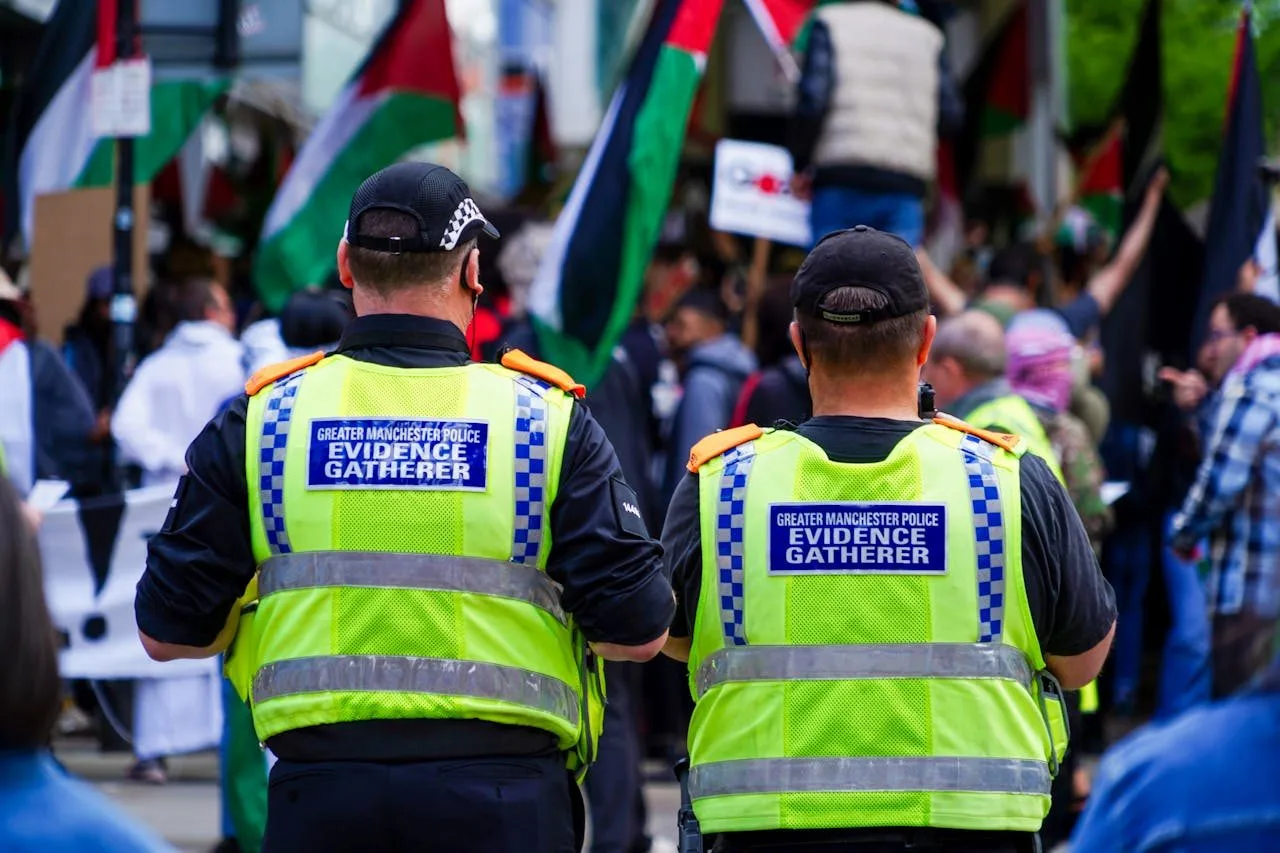
One of the clearest examples of political complicity was the labelling of Palestine solidarity marches as ‘hate marches’, despite their peaceful nature, calling for peace and protection of all civilians, and urging the UK government to end its support for the bombing campaign in Gaza (Bakare, 2024). The framing of protests as hate marches heightened already-existing racial tensions in the country. Rather than recognising these protests as humanitarian concerns, many politicians, mainly right-wing figures, framed them as a threat to British identity and creeping Islamisation (Malik, 2023). This stoked resentment among certain white British communities, furthering the ‘us vs them’ narrative, and contributing to a hostile environment in the country for immigrants and Muslims.
Far-right political leaders like Nigel Farage have been accused of exploiting the Southport incident, and portraying the rioters as victims, to serve their political goals (Chouliaraki & Bale, 2025). Tommy Robinson, an anti-Islam activist and founder of the English Defence League, also played a central role in inciting hate and violence online and enabling an environment in which riots became acceptable (White, 2024).
Despite the violence and hostilities faced by minority groups in the UK during the Southport riots, Elon Musk, owner of X (formerly Twitter), publicly criticised the UK government’s response to white far-right protestors, and claimed that the government responded strictly towards them (Elgot & Mason, 2024). This diverted attention away from victims of racial violence to far-right grievances. Had the government taken decisive actions after the Southport riots, by addressing regulatory gaps and political complicity, the 2025 Ballymena riots might have been prevented. The Irish Times (2025) further criticised the government’s failure to prevent the real-life consequences that immigrant communities faced.
Impact on Migrants and the Future in the UK
The political complicity has enabled an environment in the UK that has normalised racial violence, with devastating consequences for immigrant communities and asylum seekers. While some members of the British public might have supported the unrest in the UK in 2024 and 2025, many actively opposed the violence (Difford & Smith, 2024). This is evident through numerous counter protests across various cities where far-right protests emerged in response to the Southport incident (Manning & Moench, 2024).
The unrest after the Southport and Ballymena incidents has contributed to a pervasive climate of fear and insecurity among immigrant communities in the UK. Imam Ibrahim Hussein, who was present in the Mosque attacked during the Southport riots, described how the Muslim community has been experiencing growing social isolation, and reluctance to leave their homes (Gohil et al., 2024). Hussein also shared the lasting trauma that the event has had on him: ‘‘I have nightmares. It comes to me while I’m asleep and I wake up three, four times a night’’ (Gohil et al., 2024). Additionally, the Mental Health Foundation reported that asylum seekers in the UK are scared due to the insecurity in town (Taylor, 2025b). Since the Ballymena riots, almost 50 households in Northern Ireland have been receiving support following the disorder, and many immigrant families have moved from Ballymena due to the ongoing unrest (Bakare, 2025; Logan & Glynn, 2025).
According to the UK Home Office, an average of ten assaults on asylum seekers were reported daily in their own accommodations in 2023-2024 (Taylor, 2025a). Victims of hate crimes are often diagnosed with mental health conditions such as anxiety, chronic fear, and sleeping disorders (Kazi, 2025). The Guardian reported that after the Southport riots, the victims have continued to face enduring nightmares, feelings of insecurity, social withdrawal, etc (Gohil et al., 2024).
These experiences indicate how the impact of the racial violence extends far beyond isolated incidents, it leaves lasting psychological scars on individuals and communities. Whilst the local communities have mobilised in response, these efforts remain insufficient to address the scale and depth of the issue (Gohil et al., 2024). Therefore, systemic political, and legal reforms are essential to prevent further racial violence in the UK and protect immigrant communities and asylum seekers. Such steps could include tightening restrictions and accountability mechanisms for far-right members, including in online spaces. And as suggested earlier, implementing education programs that teach the history of the British Empire and its colonial legacy.
Conclusion
Racial violence in the UK is not incidental, it is systemic, digitalised, and politically enabled. It is deeply rooted in the imperial history of Britain, reproduced in contemporary online spaces, and has been enabled by political institutions and leaders. The imperial structures have evolved into forms of structural racism in the UK that are evident through law, politics, and society. The direct consequences of this hatred are suffered by immigrant communities and asylum seekers and are a threat to the multicultural British society.
Political leaders must be held accountable for promoting nationalist sentiment that enables racial violence. The UK must confront the roots of the hatred towards immigrants and asylum seekers by integrating education on British imperialism into public discourse. It must also launch meaningful reforms to combat hate speech and digital misinformation. These measures are essential to preserve the multiculturalism that the UK claims to value.
Bibliography
Adamcová, K., & Burrell, R. (2022). The rise of far‑right violence in Europe [Policy paper]. European Liberal Forum.
Angelovski, I., Paas‑Lang, C., Pearson, J., & Young, N. (2025, June 11). How a Northern Irish town descended into 3 days of anti‑immigrant violence. CBC News. https://www.cbc.ca/news/world/north-ireland-riots-1.7558861
Bakare, L. (2024, April 8). “These are crazy stories!” Riz Ahmed on the south Asian Britons who fought off the far right. The Guardian. https://www.theguardian.com/tv-and-radio/2024/apr/08/riz-ahmed-on-the-south-asian-brits-who-fought-off-far-right
Bakare, L. (2025, June 19). ‘The racial violence in Ballymena repeats a pattern that’s blighted Britain for years. We must wake up to that’. The Guardian. https://www.theguardian.com/commentisfree/2025/jun/19/ballymena-violence-migrants-nothern-ireland-race-issues
BBC News. (2021, July 7). Bradford riots 2001: What has changed 20 years on? BBC News. https://www.bbc.com/news/uk-england-leeds-57667812
Chouliaraki, L., & Bale, J. (2025, January 22). How the far right weaponizes victimhood. British Politics and Policy at LSE. https://blogs.lse.ac.uk/politicsandpolicy/how-the-right-weaponizes-victimhood/ (Accessed on 13 July 2025)
Darmstadt, A., Prinz, M., & Saal, O. (2019). The murder of Keira: misinformation and hate speech as far-right online strategies.
Difford, D., & Smith, M. (2024, August 6). The public reaction to the 2024 riots. YouGov. https://yougov.co.uk/politics/articles/50257-the-public-reaction-to-the-2024-riots (Accessed on 13 July 2025)
Elgot, J., & Mason, R. (2024, August 6). Elon Musk calls PM ‘two‑tier Keir’ over police response to UK riots. The Guardian. https://www.theguardian.com/technology/article/2024/aug/06/elon-musk-calls-pm-two-tier-keir-over-police-response-to-uk-riots
France24. (2025, June 10). Racially motivated attacks spark second night of unrest in Northern Irish town. https://www.france24.com/en/europe/20250610-racially-motivated-attacks-spark-second-night-of-unrest-in-northern-irish-town
Gentleman, A. (2019). The Windrush betrayal: Exposing the hostile environment. Faber & Faber.
Gohil, N., Mohdin, A., & Vinter, R. (2024, September 27). “We wake up with anxiety”: victims of far‑right riots on lingering fear and an uncertain future. The Guardian. https://www.theguardian.com/politics/2024/sep/27/victims-far-right-riots-lingering-fear-uncertain-future
Hall, R. (2024, October 22). Social media algorithms need overhaul in wake of Southport riots, Ofcom says. The Guardian. https://www.theguardian.com/media/2024/oct/22/social-media-algorithms-must-be-adjusted-to-prevent-misinformation-ofcom
Hampshire, J. (2005). Citizenship and belonging: Immigration and the politics of demographic governance in postwar Britain. Springer.
Hansen, R. (2000). Citizenship and immigration in postwar Britain. Oxford University Press, USA.
Horwood, C. (2024, October). Fake news‑driven anti‑migrant riots and protests in the UK. Mixed Migration Centre. https://mixedmigration.org/fake-news-driven-anti-migrant-riots-and-protests-in-the-uk/
Kazi, T., (2025). Restorative justice, hate crime and migrant integration. European Forum for Restorative Justice. https://www.euforumrj.org/restorative-justice-hate-crime-and-migrant-integrati (Accessed on 13 July 2025)
Krusch, M. (2024, August 29). Fomenting civil war?: Disinformation narratives after the Southport attack. GNET Research. https://gnet-research.org/2024/08/29/fomenting-civil-war-disinformation-narratives-after-the-southport-attack/ (Accessed on 12 July 2025)
Logan, D., & Glynn, N. (2025, June 13). Families in emergency accommodation after days of unrest. BBC News. https://www.bbc.com/news/articles/clyq72kpy9yo
Malik, N. (2023, November 6). Pro‑Palestine rallies aren’t ‘hate marches’ – they’re an expression of solidarity, helplessness and frustration. The Guardian. https://www.theguardian.com/commentisfree/2023/nov/06/pro-palestine-rallies-hate-marches-solidarity-helplessness-frustration
Manning, L., & Moench, M. (2024, August 8). Anti‑racism protesters rally after week of riots. BBC News. https://www.bbc.com/news/articles/czxlgwl28gyo
Marchant, L. (2025, April 15). UK far‑right protests (2024): A dangerous blend of misinformation, technology, and extremism. Legal Advice Centre, Queen Mary University of London. https://www.qmul.ac.uk/lac/our-legal-blog/blogs/uk-far-right-protests-2024-a-dangerous-blend-of-misinformation-technology-and-extremism.html
Marsi, F. (2025, June 13). Why have anti‑immigration riots broken out in Northern Ireland? Al Jazeera. https://www.aljazeera.com/news/2025/6/13/why-have-anti-immigration-riots-broken-out-in-northern-ireland
Morris, A. (2025). British Nationality Act 1948. DavidsonMorris. https://www.davidsonmorris.com/british-nationality-act-1948/#elementor-toc__heading-anchor-0 (Accessed on 11 July 2025).
Kundnani, A. (2007). The End of Tolerance: Racism in 21st Century Britain. Pluto Press.
Ofcom. (n.d.). What Ofcom does. GOV.UK. https://www.gov.uk/government/organisations/ofcom (Accessed on 11 July 2025).
Ross, A., & Ahmed, J. (2025, June 12). What is behind the riots in Northern Ireland? The Independent. https://www.independent.co.uk/news/uk/crime/northern-ireland-riots-why-ballymena-b2768642.html
Sandhu, A. H. (2009). Reality of’Divide and Rule’in British India. Pakistan Journal of History & Culture, 30(1).
Shah, M. (2024, August 28). Fanning the flames: Online misinformation and far‑right violence in the UK. GNET Research. https://gnet-research.org/2024/08/28/fanning-the-flames-online-misinformation-and-far-right-violence-in-the-uk/ (Accessed on 12 July 2025)
Staveley‑Wadham, R. (2022, May 12). Exploring the Notting Hill race riots of 1958. British Newspaper Archive Blog. https://blog.britishnewspaperarchive.co.uk/2022/05/12/exploring-the-notting-hill-race-riots-of-1958/ (Accessed on 11 July 2025)
Sutherland, C. (2025, June 11). What to know about the Northern Ireland riots as police use water cannon amid petrol bombs and chaos. Time. https://time.com/7293105/northern-ireland-riots-ballymena-petrol-bombs-police-racist-attacks/
Taylor, D. (2025, April 15). UK riots led to deterioration in asylum seekers’ mental health, says report. The Guardian. https://www.theguardian.com/society/2025/apr/15/uk-riots-led-to-deterioration-in-asylum-seekers-mental-health-says-report
Taylor, D. (2025a, April 21). Ten assaults a day on asylum seekers in Home Office care, figures reveal. The Guardian. https://www.theguardian.com/politics/2025/apr/21/assaults-on-asylum-seekers-in-home-office-care
Telford, L., & Page, C. (2025b, June 10). Disorder after alleged sex assault was ‘racist thuggery’, say police. BBC News. https://www.bbc.com/news/articles/ckg4v04p008o
The Irish Times. (2025, June 19). The Irish Times view on the riots in Ballymena: Unequivocal political response essential [Editorial]. The Irish Times. https://www.irishtimes.com/opinion/editorials/2025/06/19/the-irish-times-view-on-the-riots-in-ballymena-unequivocal-political-response-essential/
Trilling, D. (2021, June 15). How the 2001 northern riots boosted the far right – and reshaped British politics. The Guardian. https://www.theguardian.com/commentisfree/2021/jun/15/race-riots-far-right-britain-stereotypes-nationalist-politics
Walsh, A. (2024, July 31). Clashes in Southport after town mourns in vigil for victims of stabbing attack [Live updates]. BBC News. https://www.bbc.com/news/live/cevwgqz0x41t
White, N. (2024, August 5). Tommy Robinson stokes far‑right riots on social media from outside UK. The Independent. https://www.independent.co.uk/news/uk/home-news/tommy-robinson-uk-riots-edl-twitter-b2591161.html