
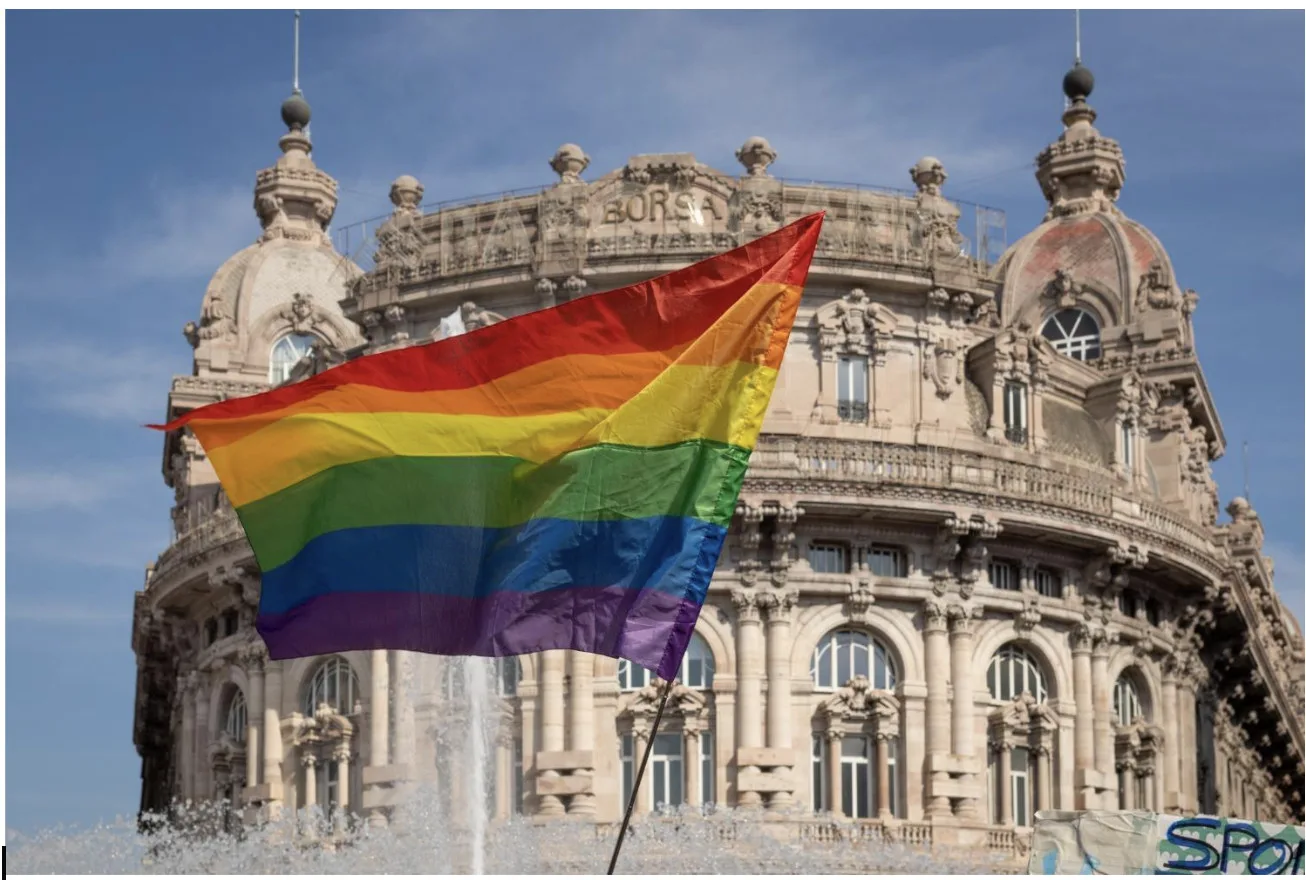
Introduction: the Italian framework for LGBTQ+ rights
The ILGA-Europe’s Rainbow is an annual report that displays the legal and policy situation of LGBTQ+ people in Europe, ranking 49 European countries. Following a series of criteria (equality and non-discrimination; family; hate crime and hate speech; legal gender recognition; intersex bodily integrity; civil society space; and asylum) the report investigates legal and policy practices for LGBTQ+ people in the 49 European countries (ILGA Europe, 2022a). According to a 2022 report, Italy ranked at the 33rd position, making the country one of the least inclusive European realities in terms of LGBTQ+ rights.
In 2018, member of Parliament and LGBTQ+ activist Alessandro Zan, a member of the Italian Democratic Party, drafted a law which sanctioned discrimination and heinous crimes against LGBTQ+ people, and included the offence of misogyny and hatred against women. With the 1993 “Legge Mancino”, only hate crimes for racial, ethnic and religious reasons, along with neo-Nazi and neo-fascist activities and slogans, are severely punished. With the new law, known in Italian as “Zan”, discrimination against gay and transgender people could be sentenced to up to four years imprisonment. On June 25th, 2021, a 25-year-old student was attacked by seven people in the city of Pescara, Abruzzo, only for holding hands with his partner. After surviving the aggression, the young student urgently undertook jaw surgery with a recovery period of 30 days. This episode underlined the urgency of concrete punishments against hate crimes of this kind. In the last 25 years, there have been numerous attempts to create a law that would punish acts and crimes of homophobia and transphobia. Yet, the biggest opponents of such laws, include the Italian episcopal conference (CEI) and pro-life groups (Dominioni, 2020). The Holy See has made an unprecedented intervention requesting the Italian government to change the proposed law against homophobia over concerns it will violate the Catholic Church’s “freedom of thought” (Giuffrida, 2021).
In October 2021, the Italian Senate voted against the Zan bill. A proposal to halt the law passed by 154 votes to 131 after being submitted by right-wing parties Lega Nord and Fratelli d’Italia (Fdl). The Zan bill has been accepted by its supporters as a welcome and long-awaited change in a country perceived as lagging far behind its Western European neighbours on LGBTQ rights. However, its continuous reference to gender identity made it unwelcomed amongst right-wing politicians and Catholics, in particular the Vatican (Carlo, 2021a).
For many in Italy’s LGBTQ+ community, the rejection of the Zan bill reflected a retrogression on the already-steep path to equality. Fabio Perna, a 33-year-old gay man living in Rimini, declared he was left feeling deeply distraught by the rejection of the Zan bill. He added, “I was sitting with my partner on the sofa [when it happened] and we weren’t able to utter a single word. He simply looked at me and gave me a hug”, he told Euronews. “Once again, they’ve deprived [people like] me of the chance of being recognised and protected as an equal to others”. In this case, after suffering from severe myeloid leukaemia (AML) a few years ago, Perna is now dependent upon a wheelchair, finding himself dealing with a permanent disability. He is a part of another group of persons that the Italian statute had aimed to safeguard from any form of discrimination. “I am gay and disabled which for my country means I don’t exist #ZanBill_Law_Straightaway”. He shared this message on social media, hoping that these important platforms could represent the means through which his voice could be heard and spread (Carlo, 2021b).
Homophobia, transphobia and misogyny in Italy
In the meantime, anti-LGBTQ+ hate crimes continued. According to the Italian LGBTQ+ association Arcigay, the press reports approximately one anti-LGBTQ+ hate crime every three days. In February 2021, a gay couple was assaulted in the subway in Rome. In March, police forces hit several sex workers in Catania, some of whom are trans women and migrants. A young lesbian was thrown out of her home by her family after coming out and receiving death threats from them. A Rome-based NGO declared that they received nearly 60 calls on their hate crime helpline each week in 2021, asking for legal or psychological support (ILGA Europe, 2022b).
In the case of J.L. v. Italy regarding allegations of gang rape of the applicant who identifies as bisexual, the European Court of Human Rights (the Court) held in its judgment of May 27th, 2021, that Italian authorities failed to appropriately protect the applicant’s rights under Article 8 (Right to respect for private and family life), particularly from secondary victimisation throughout the entire legal process (ILGA Europe, 2022b). Among other things, the Court deemed the comments regarding the applicant’s bisexuality, her relationships and casual sexual relations before the events in question, to have been unjustifiable. The Court found that the language and arguments used by the Italian Court of Appeal reported existing prejudices in Italian society concerning the role of women. These observations were likely to be a hindrance to providing efficient protection for the rights of victims of gender-based abuses, despite a satisfactory legislative framework (European Court of Human Rights, 2021).
LGBTQ+: some data
According to the 2020-2021 Istat-UNAR (Ufficio Nazionale Antidiscriminazioni Razziali), one in five people felt that their sexual orientation has disadvantaged them throughout their working life in terms of career development, professional growth, recognition and appreciation of their professional abilities. Moreover, approximately one in five people, employed or formerly employed in Italy, said they had experienced a hostile climate or aggression in their working environment, with a slightly higher incidence amongst women – 21.5 percent against 20.4 percent of men – both lesbian and bisexual (Istat-UNAR, 2022). Among persons in a civil union who commonly live in Italy and have defined themselves as homosexual or bisexual, the incidence of those who asserted to have suffered threats on sexual orientation grounds, excluding incidents in the workplace, is 4.1 percent among men and 3.3 percent among women. Lastly, more than 68.2 percent avoid holding hands in public with a same-sex partner out of fear of being assaulted, threatened or harassed; this behaviour is more common among men (69.7 percent), albeit the percentage is high for women as well (65.0 percent).
Going back to the ILGA-Europe’s Rainbow Report, Italy is one of the least inclusive and respectful European countries for LGBTQ+ rights, with only 25 percent of achieved LGBTQ+ rights implemented throughout the country. In addition, Italy is the 26th out of 27 countries for equality and non-discrimination, one of the lowest ranking countries for hate speech, also having no law against homo- and transphobia; 20th out of 24 countries for legal recognition of the so-called “famiglie arcobaleno” which is a family of same-sex couples who have children (Grazi, 2022). The ILGA-Europe recommended a series of actions that could help improve both the legal and policy situation of the LGBTQ+ community in Italy. First, introducing a hate crime law will help improve all bias-motivated offences based on sexual orientation, gender identity and expression and sex characteristics. Second, marriage parity for all and third allows for automatic co-parenting acknowledgement “so that children born to couples (regardless of the partners’ sexual orientation and/or gender identity) do not face any barriers in order to be recognised legally from birth to their parents and joint adoption available for same-sex couples” (Rainbow Europe, 2022). In addition, to improve the inclusion of LGBTQ+ people in the working environment, most people believe that it is important to spread training and awareness-raising campaigns on LGBTQ+ diversity in both public and private institutions.
Additionally, 52.6 percent of people root for legislative measures while 44.6 percent for actions promoted by the European Union or other supranational bodies. Furthermore, the importance of implementing education, information and awareness-spreading campaigns on LGBTQ+ issues in the schools has been recalled. Among other desirable actions reported by respondents emerges medically assisted procreation and the possibility of adoption for singles, and notably the legal recognition of both parents for children of same-parent couples (Istat-UNAR, 2022).
The road to reaching equality in Italy is still fraught and uphill. It is important to keep fighting by sharing the voices of those who face oppression and discrimination. The rejection of the Zan bill should not be seen as a defeat, but only the first step to achieving the enjoyment of LGBTQ+ rights, which represent basic human rights everyone should be entitled to.
Sources
Carlo, A. (2021a, October 27). Italy’s senate rejects divisive bill aimed at fighting homophobia. Euronews. Retrieved on 27 May 2022 from https://www.euronews.com/2021/10/27/italy-s-senate-rejects-divisive-bill-aimed-at-fighting-homophobia
Carlo, A. (2021b, November 11). ‘I’m tired of feeling invisible’: LGBT anger after Italian bill to fight homophobia is rejected. Euronews. Retrieved on 27 May 2022 from https://www.euronews.com/my-europe/2021/11/02/i-m-tired-of-feeling-invisible-italian-bill-s-rejection-leaves-lgbt-community-in-anger
Dominioni, I. (2020, June 30). Italy Towards Its First Law On Hate Crimes Against LGBT People. Forbes. Retrieved on 27 May 2022 from https://www.forbes.com/sites/irenedominioni/2020/06/30/italy-towards-its-first-law-on-hate-crimes-against-lgbti/?sh=3f6a003d4e38
European Court of Human Rights. (2021, May 27). Allegations of gang rape: certain passages in the appeal court’s judgment breached the presumed victim’s private and intimate life.
Giuffrida, A. (2021, June 22). Vatican urges Italy to stop proposed anti-homophobia law. The Guardian. Retrieved on 27 May 2022 from https://www.theguardian.com/world/2021/jun/22/vatican-urges-italy-to-stop-anti-homophobia-law
Grazi, M. (2022, May 13). Diritti Lgbtq+? No grazie. Anche i dati dimostrano che l’Italia non è un Paese “queer friendly”. Luce! Retrieved on 27 May 2022 from https://luce.lanazione.it/italia-queer-ilga-europe-diritti-lgbtqia/#:~:text=L%E2%80%99%20Italia%2C%20con%20il%20suo%2025%25%20per%20il,in%20Europa%20occidentale%2C%20dietro%20tutti%20gli%20altri%20big.
ILGA-Europe. (2022a). Rainbow Europe 2022. ILGA-Europe. Retrieved on 27 May 2022 from https://www.ilga-europe.org/rainboweurope/2022
ILGA-Europe. (2022b). Annual Review of the Human Rights Situation of Lesbian, Gay, Bisexual, Trans and Intersex People in Europe and Central Asia. ILGA-Europe. Retrieved on 27 May 2022 from https://www.ilga-europe.org/sites/default/files/2022/full_annual_review.pdf
Istat-UNAR. (2022, March 24). L’indagine Istat-UNAR sulle discriminazioni lavorative nei confronti delle persone LGBT+ (in unione civile o già in unione). Istat-UNAR. Retrieved on 27 May 2022 from https://www.istat.it/it/files//2022/03/REPORTDISCRIMINAZIONILGBT_2022.pdf
Rainbow Europe. (2022). Italy. Rainbow Europe. Retrieved on 6 June 2022 from https://rainbow-europe.org/#8640/0/0.