
Introduction
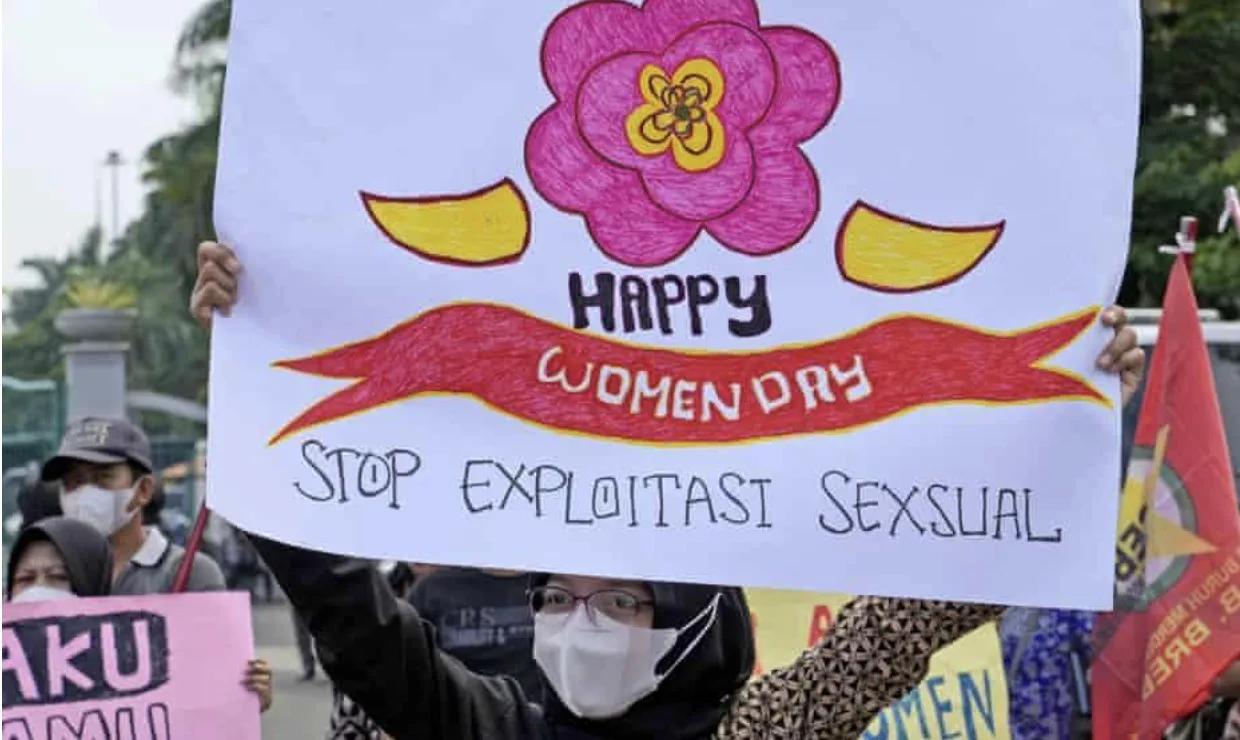
Indonesia has long waited for a legal framework regarding sexual and gender-based crimes. Women and women’s activists have been fighting for the past 10 years for this specific bill to come into force. As Bintang Puspayoga, the minister of woman empowerment and child protection, said: “This law is a real manifestation of the country’s efforts to prevent any form of sexual violence and to care, protect and rehabilitate the victims as well as to enforce justice;” (Le Monde, 2022). The Bill also acknowledges that children and men can be victims of sexual violence crimes as the previous criminal code only included rape and lewd crimes by men against women as crimes and didn’t have any sort of reparations for the victims. This new bill incorporates physical and non-physical sexual harassment, sexual torture, sexual slavery, forced marriage as well as cyber sexual harassment, sexual exploitation, forced contraception, or forced sterilization (ABC News, 2022).
The long-expected Sexual Violence Bill
A landmark case, important for all women across Indonesia, was passed in the country’s courts not long ago (France 24). The case of Mr. Herry Wirawan, the schoolteacher who raped 13 students between the ages of 11-16, was just one of many which came to the surface last December (de Guzman, 2022). An alarming spike in gender-based and sexual violence cases occurred around the country during the pandemic, and victims can finally have hope of receiving justice (France 24). The number of cases of violence against women jumped from 2020 by over 50% in the country in 2021 (Permatasari and Rahadiana, 2022). Many Indonesian women’s activists have for years condemned the country’s lack of a legal framework for crimes of sexual violence (France 24).
The country has mostly discouraged victims from filing reports and viewed cases of sexual violence as a private matter more than a legal affair. Therefore, it was a positive surprise when the bill passed through and overcame the opposition of more conservative groups in the parliament (Widianto, 2022). The bill has been in the making for a long time, starting 10 years ago as a proposed law by the National Commission on Violence Against Women and some civil society groups. After another 4 years, it made it to the House of Representatives in 2016. The President of Indonesia, Jokowi Widodo, made the final push in getting the bill accepted. The conservative opposition disagreed with the proposed bills as in their view it would bring especially liberal concepts that encourage inappropriate sexual behavior (Cahya, 2022).
The bill will be one of the first legal frameworks on sexual violence to be passed among the Muslim majority countries in the world. Even though the law has been in some ways weakened, this was a way to be able to win over more conservative lawmakers (Permatasari and Rahadiana, 2022). As the law expert Asfinawati said they should have included rape in the bill, but it is a step in the right direction (Widianto, 2022). Victims can finally take immediate action in case of sexual harassment and the pieces of evidence, that have to be submitted to make a claim, went down from three to one piece (Permatasari and Rahadiana, 2022). Even if the watered-down bill wasn’t as complete as promised, it was very hard to push the bill through Indonesians’ religious identity. Most of the population is Muslim (86%) and the more conservative lawmakers believe that the state should be governed by Islamic law in the first place (de Guzman, 2022).
How is it different from the existing law on sexual violence?
The passing of this bill does not mean that Indonesia had no law dealing with sexual crimes before. However, Indonesia has, as a legacy of Dutch Colonial rule, the Criminal Code. This law beyond any doubt recognizes some sexual crimes such as only rape and lewd crimes committed by men against women, but it fails to provide any restitution or other remedies for victims and survivors. These existing domestic violence laws were too weak, thus Various human rights NGOs had advocated for a more comprehensive law with ‘effective mechanisms and solutions for women whose human rights have been violated in the light of Convention for Elimination of Discrimination of Women (CEDAW) to which Indonesia is not only a signatory but has ratified the same since 1984. Legal professionals such as Nur Setia Alam Prawiranegara, pointed out that the human rights of victims are not sufficiently represented under the current law. This bill had the support from not only the human rights activists and advocates by the establishment as well. The former minister of women’s empowerment and child protection, Yohana Yembise, and Coordinating Minister of Politics, Law and Security Affairs Mahfud MD have been both strong defenders of the bill. The new Sexual Violence Bill addressed many of the concerns. It is seen as an appropriate instrument to augment the number of cases that are reported and taken to court. The current situation of convictions was clearly not proportionate to the numbers of sexual violence cases as per Garlach (2020). These circumstances made it an urgent need to pass a more effective law.
What does the new law offer?
The new law is quite comprehensive and broad in its scope compared to the existing criminal code when it comes to dealing with sexual violence crimes.
Broader scope
The law defines sexual violence more broadly than before, expanding its scope beyond more obvious offenses like rape, to physical and nonphysical sexual harassment, forced contraception and sterilization, and forced marriage, among others. (Maulia, 2022). It sets out nine different kinds of sexual abuse which include physical and non-physical sexual abuse, forced sterilization, forced contraception, forced marriage, sexual torture, sexual slavery, sexual exploitation, and sexual abuse through electronic means. (Llewellyn, 2022).
Restitution for victim
In addition to acknowledging various kinds of sexual violence as punishable criminal acts, the law has provisions for protection and recovery for the victims which were absent in the existing criminal code besides it being restrictive in its scope. The law also mandates that a trust fund for restitution and counseling services to help victims recover be established and regulated by the government.
Elizabeth Ghozali, a lecturer in criminal law at Santo Thomas Catholic University in the city of Medan, told Al Jazeera describing this bill as a landmark piece of legislation for prioritizing victim’s rights, “Previously, Indonesian law was only focused on punishment in sexual violence cases. That was seen as the entire scope of the law and a sign that it had done its job.” She added, “We need progressive law in Indonesia that thinks about the victims and accommodates their rights.” (Llewellyn, 2022)
Punishments in the law
Karmini (2022) analyzes this new law and sheds some light on the punishment it fixes for the perpetrators of such violent acts. ‘Under the new law, perpetrators of electronic-based sexual violence could face up to 4 years imprisonment and a 200 million rupiah ($13,920) fine. If such crimes are committed with the intent of extorting, coercing and deceiving victims, the punishment would be up to 6 years and a 300 million rupiahs ($20,880) Perpetrators of sexual exploitation face up to 15 years in prison and a fine of 1 billion rupiahs ($69,600).’
Those convicted of making inappropriate comments can now receive a nine-month prison sentence, while a conviction on physical harassment charges, including by a spouse, can send the offender to prison for 12 years. Recording or online distribution of sexual acts without consent can land perpetrators behind bars for four years. (Maulia, 2022)
Who does it affect?
The focus of this new legislation besides punishing the offender is the restitution and rehabilitation of the victim. Sexual assault and violence are a big problem in Indonesia of which women are mostly the victims. Consequently, this law fundamentally targets women victims and survivors of sexual crimes and violence. At the same time, it does not exclude men and children. It recognizes other forms of sexual abuse such as rape, obscenity, sexual violence against children, pornography, and forced prostitution, although these are also included in Indonesia’s Criminal Code and other specific laws such as Indonesia’s Child Protection Law.
The UN in Indonesia in its press release on 12 April 2022 welcomed the Parliament’s approval of the Sexual Violence Crime Bill into law. These gestures showed the UN’s dedication to supporting and standing with all survivors of sexual violence, especially women and girls in Indonesia who are struggling for their rights. The press release marked that day as a promising step towards the ultimate goal of creating a world free of gender-based violence. However, at the same time recognized that it is not the end of the job and prominently highlighted how much it is needed especially now that multi-sectors among national stakeholders and the public come together to support and monitor the new law’s full implementation. A world free of violence where everyone lives with dignity is what is an integral part of the 2030 (Sustainable Development Goals) agenda adopted by all member states.
Conclusion
Undoubtedly, the Sexual Violence Crime Bill delivered a long-awaited legal framework for handling sexual violence. The law became effective as soon as the bill was passed despite minor opposition on the parliamentary benches. Now is the test of how far this law is implemented across the archipelago amid clashes of values and politics, as well as pushing for further revisions to existing legislation. This would definitely serve as a welcoming piece of legislation but that does not guarantee it being perfect with the rape and abortion clues ruled out. It remains a question mark on the protection of victims. Although the bill has its shortcomings, it is an important step in the right direction.
References:
De Guzman, C.,2022. After a Teacher Was Convicted of Raping 13 Girls, Indonesia Finally Passed Sexual Violence Reform, Time. Retrieved from 18th April 2022. https://time.com/6166853/indonesia-sexual-violence-law/
France 24.,2022. Indonesia passes long-awaited sexual violence bill, France 24. Retrieved 18th April 2022. https://www.france24.com/en/live-news/20220412-indonesia-passes-long-awaited-sexual-violence-bill Gelrach, R. 2020. The fight to outlaw sexual violence in Indonesia. Inside Indonesia. Retrieved from 25 November 2020. https://www.insideindonesia.org/the-fight-to-outlaw-sexual-violence-in-indonesia
Holliani Cahya, G.,2022. Joy as Indonesia passes bill outlawing sexual abuse and forced marriage, The Guardian. Retrieved from 18th April 2022. https://www.theguardian.com/global-development/2022/apr/13/indonesia-passes-bill-outlawing-sexual-abuse-gender-violence-forced-marriage
Karmini, N., 2022. ‘Long-awaited law’: Indonesia passes law against sexual violence. The Christian Science Monitor. Retrieved from 12 April 2022. https://www.csmonitor.com/World/Asia-Pacific/2022/0412/Long-awaited-law-Indonesia-passes-law-against-sexual-violence
Le Monde with AFP.,2022. Indonesia passes landmark sexual violence bill, Le Monde. Retrieved 18th of April 2022 https://www.lemonde.fr/en/international/article/2022/04/12/indonesia-passes-landmark-sexual-violence-bill_5980352_4.html
Llewellyn, A. 2022. Explainer: Why is Indonesia’s sexual violence law so important? AlJazeera. Retrieved from 14 April 2022. https://www.aljazeera.com/news/2022/4/14/explainer-why-is-indonesias-sexual-violence-law-so-important
Maulia, E., 2022. New law in Indonesia offers hope in ‘sexual violence emergency.’ Nikkei Asia. Retrieved from 14 April 2022. https://asia.nikkei.com/Politics/New-law-in-Indonesia-offers-hope-in-sexual-violence-emergency
Permatasari, S and Rahadiana, R.,2022. Indonesia Passes Sex Abuses Law in a Win for Woman, Jokowi, Bloomberg. Retrieved from 18th April 2022. https://www.bloomberg.com/news/articles/2022-04-12/indonesia-passes-sex-abuse-law-in-a-win-for-women-and-jokowi
The United Nations in Indonesia welcomes the Indonesian Parliament’s approval of the Sexual Violence Crime Bill (RUU TPKS) into law on 12 April 2022. The United Nations Indonesia. Retrieved from 12 April 2022. https://indonesia.un.org/en/177437-united-nations-indonesia-welcomes-indonesian-parliaments-approval-sexual-violence-crime-bill
Widanto, S.,2022. Indoesia’s parliament passes landmark bill on sexual violence. Reuters. Retrieved from 18th April 2022. https://www.reuters.com/world/asia-pacific/indonesias-parliament-passes-landmark-bill-sexual-violence-2022-04-12/