
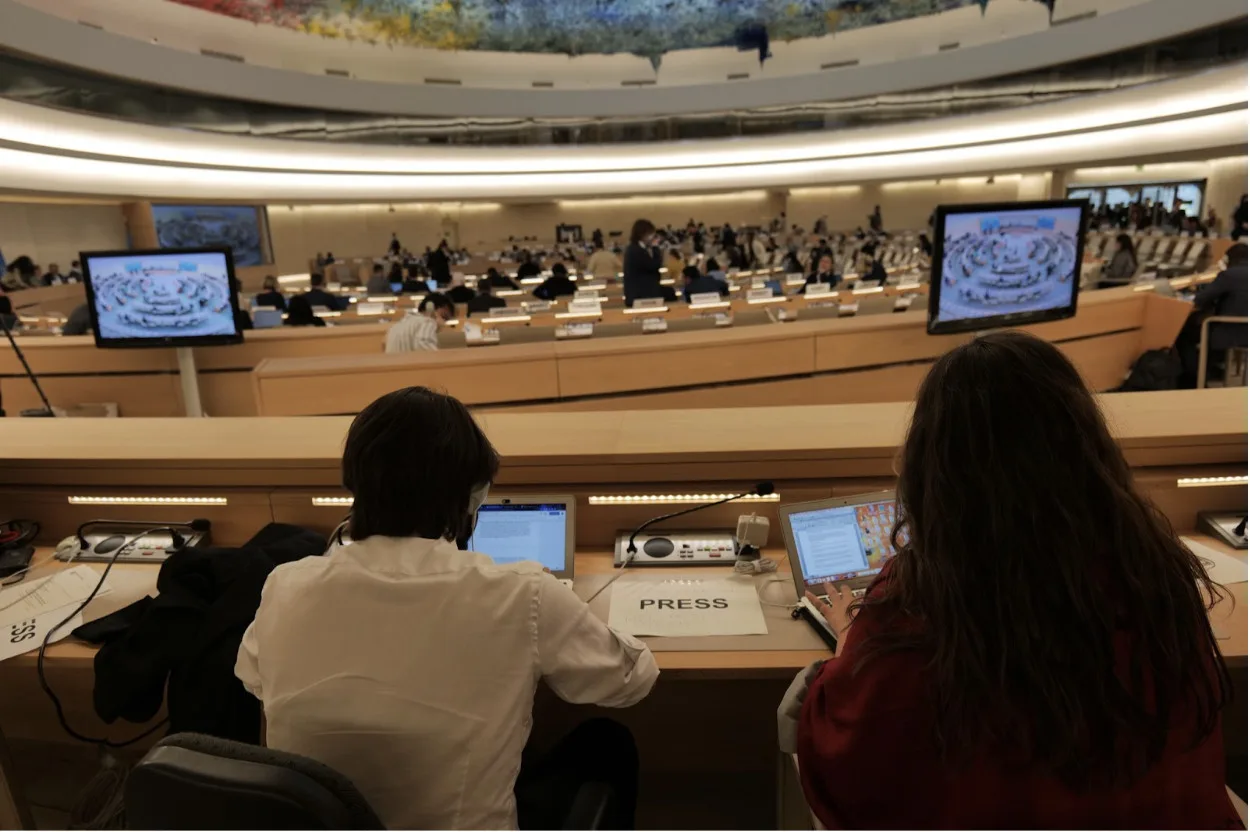
On September 20th 2022, at the 51st Session of the UN Human Rights Council, Mr. Luciano Hasar, Chair of the Working Group on enforced Disappearance, presented the findings of the latest study and warned the international communities of the main challenges ahead.
Over the past 30 years, the Working Group (WG) on Enforced Disappearances has tirelessly contributed to the fight against the horrific practice of enforced disappearances. The WG has also pushed for the implementation of the Declaration on the Protection of all Persons from Enforced Disappearance. With 355 cases collected in the WG’s Report, the President warned that the reality of the situation is harsher than what the figures suggest.
On August 30th 2022, the International Day for the Victims of Enforced Disappearances, experts highlighted how the practice has been changing over time. This issue therefore requires new responses and approaches to prevent, prosecute and eradicate new forms of enforced disappearances. This concern led to a thematic report on new technologies and their relation to human rights. On one hand, technology can be a means to target human rights defenders and activists. On the other hand, modern day technology can be fundamental for investigating cases of enforced disappearance such as accelerating the identification and return of victims.
The WG has three main objectives in its study: (a) how such technologies are used to target human rights defenders, civil society organizations (CSOs); (b) how they can be utilized for the searching of disappeared persons and investigations; (c) and how their use can serve to obtain evidence of enforced disappearances. For these three objectives to be fulfilled, intra-state cooperation to prioritize victims’ narratives is key.. The report will be published in September 2023.
The President of the WG stressed the importance of country visits, as they are the most effective tool to monitor progress. Therefore, all countries are encouraged to: take action and advance cooperation in uncovering the truth, advocate for justice, andratify the International Conventions that serve as a framework for the protection of victims.
The case of Cyprus
The President of the WG expressed concerns over the cases of enforced disappearance in Cyprus, as there has been a notable decline in efforts to search for victims over the past years. While time obscures evidence, and witnesses and relatives pass away, investigation operations have become more challenging. That is why cases of enforced disappearances must be set away from the political discourse. Cooperation must be fostered to protect the rights of all victims and their families to ultimately provide justice.
Cyprus is aware that as time goes on, the prospect of finding those who are missing becomes more remote, making the search is even more challenging. The same goes for identifying corpses. The activities of the committee on missing persons are slowing down due to site reconstruction, so the search for remains extremely complicated: what was once a field burial site, it is now an apartment. Cyprus labeled such reconstruction as intentional acts to cover evidence, and required the Turkish government to implement its obligations to assist in the search for the missing, and provide access to relevant archives. There is a strong suspicion that additional evidence may be found.
State Intervention and Contribution to the Interactive Dialogue with the WG
30 years have passed since the Declaration of Enforced Disappearance, but this issue continues to affect thousands of lives worldwide. The recent Russian invasion on Ukraine has seen hundreds of individuals disappeared, with a great risk of them being subjected to torture, degrading treatment, and extrajudicial executions. Thousands of Armenians were victims of enforced disappearance in 2022, with technology utilized illegally to target dissidents and opponents. The Taliban takeover in Afghanistan has exposed women, human rights defenders, journalists, and minorities to great risk with a high number of enforced disappeared individuals having no access to justice. The limited access to areas of the country make it difficult to obtain information on victims.
According to international humanitarian law, acts of enforced disappearance may amount to war crimes and/or crimes against humanity. Preventing families to know the whereabouts of their beloved ones may also amount as torture according to certain studies, making access to justice nearly impossible. That is why States are urged to increase efforts in preventing such a practice, conduct investigation and prosecutions, while guaranteeing victims and families access to legal remedies to bring truth, justice and reparation. As stressed during the Interactive Dialogue, enforced disappearance is a phenomenon that has an impact not only on victims and families, but on the community and society as a whole.
Despite realizing that the eradication of the practice is a long term endeavor, the majority of states are worried that the phenomenon is growing once again. The adoption of the International Convention for the Protection of all Persons from Enforced Disappearance had significantly contributed to the fight, but its ratification by all states is crucial to achieve greater protection. While only 68 states ratified the Convention so far, a policy of zero tolerance against the practice and its criminalization under national legislations is necessary.
NGOs Intervention and Concerns
NGO representatives also made statements during the session. According to human rights defenders from the Republic of Armenia, individuals still face high risks of torture, inhuman treatment and extrajudicial killings. Enforcement disappearance is often used as a weapon of informational war to spread terror within families and society at large. Ongoing armed conflicts around the world have created a favorable environment for enforced disappearances. According to ICRC, 303 Armenians are still considered missing persons since the war of 2020. The Azerbaijani policy of providing distorted or no information at all on missing persons and of using this issue to gain political advantages is a continuous human rights violation. It is significant on regional and global levels to strengthen the international framework and collaborate with the Working Group on the issue of forced disappearance.
In the conflict between Syria and Yemen, 110,000 people have disappeared including women and children. Over the past 7 years of war, hundreds of civilians disappeared, but perpetrators have escaped accountability and parties to the conflict have refused to investigate or cooperate with calls from the international community. In response to similar dangerous phenomena, a new mechanism needs to be established. The international community should also provide more help to these vulnerable individuals and their families.
According to the International Organization of Elimination of All Forms of Discrimination. There are still a large number of cases of enforced disappearance in Iraq. The record shows that there are 16,427 cases, but according to the investigation of international organizations the real number is much closer to 1 million people. There is also evidence that some groups have been buried en masse. However, since 2003, the official lack of Iraqi records has also created great challenges for families and victims to defend their rights.
Conclusion
The reality of systematic enforced disappearance still widely exists in different parts of the world. Not only is it used as a political issue, but also as a major government security policy as well. Some countries refuse or fail to collaborate with the international legal framework.
International institutes and organizations pushed for states to take every possible measure to protect individual’s freedom and security. It is also a state obligation to support technology and carry on effective investigation to rescue disappeared individuals. Combating enforced disappearances is a shared responsibility of the international community All international parties need to build more trusting relationships and strengthen cooperation to overcome this challenge.