Reports
Sexual Violence as a Weapon of War From 1971 to The Present: A Critical Analysis of The Bangladesh Genocide and Ongoing Conflicts in Palestine, Ukraine and Sudan
- Bangladesh Campaign
- 16 November 2024
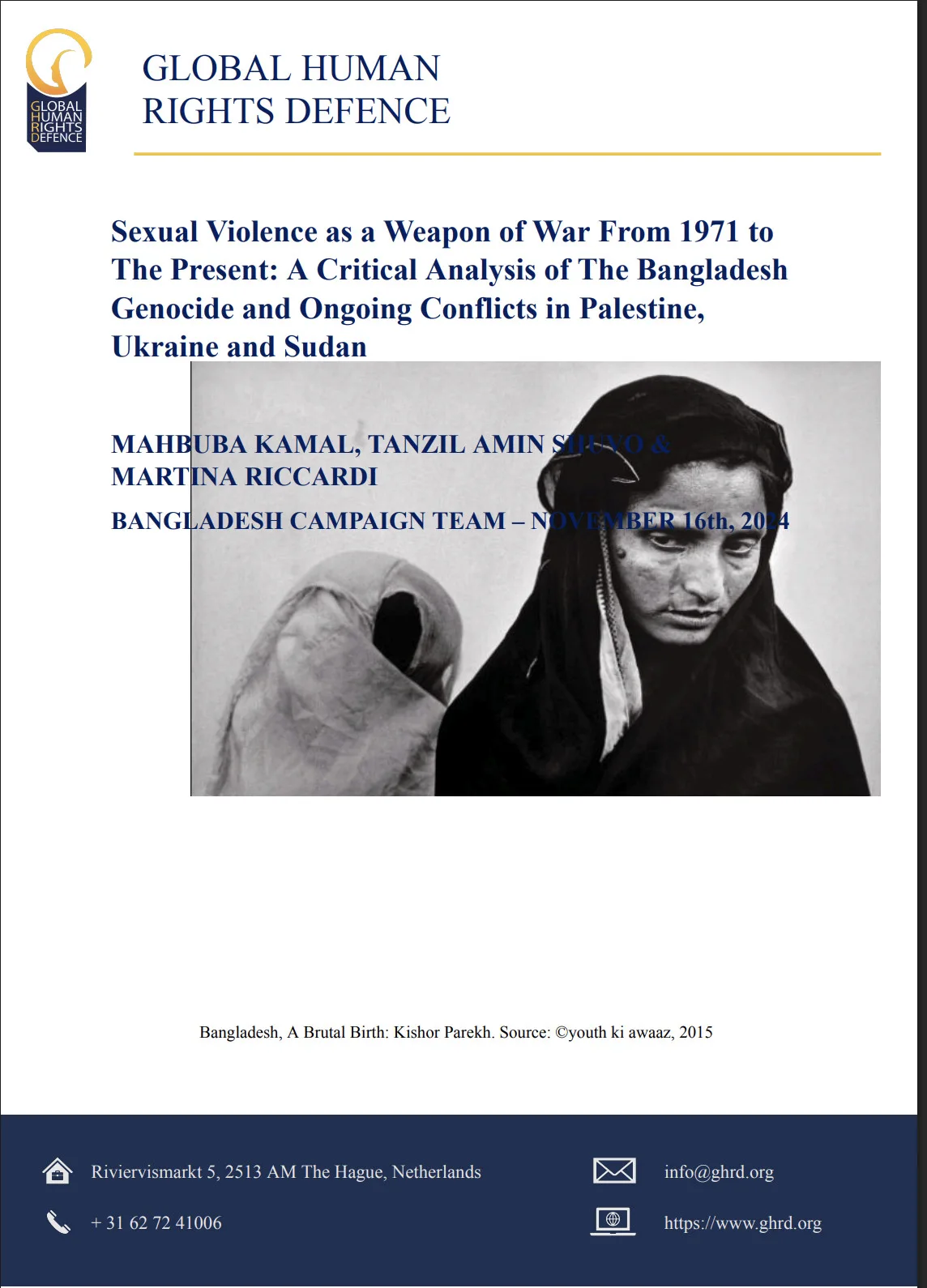
Sexual violence has emerged as one of the most horrific atrocities during conflicts around the world. Despite being explicitly prohibited by international human rights, humanitarian, and criminal law, it continues to be used as a weapon of war, underscoring its devastating impact across history. It is not only used as an act of terror and a form of reward during wartime but also a strategy to move opponents off the land and shame them. It serves not only as an instrument of terror and control but also as a means to displace populations and inflict deep psychological and social harm on communities. During the 1971 Bangladesh genocide, the Pakistani Army systematically raped and sexually abused Bengali women as part of a broader strategy of subjugation.
Similarly, in ongoing conflicts such as those in Palestine, Ukraine, and Sudan, sexual violence remains a cruel reality. This report undertakes a critical study of the Bangladesh genocide and the current conflicts in Palestine, Ukraine, and Sudan, analysing the contexts in which sexual violence is used as a weapon of war and focusing on the motives, patterns, and impact on the survivors and their communities in each case. The report also evaluates the international responses and accountability in this matter. Finally, the research critically examines the existing international legal framework and protection measures for wartime sexual violence and its challenges. A doctrinal, qualitative, and analytical methodology has been employed to explore these issues comprehensively.
Similarly, in ongoing conflicts such as those in Palestine, Ukraine, and Sudan, sexual violence remains a cruel reality. This report undertakes a critical study of the Bangladesh genocide and the current conflicts in Palestine, Ukraine, and Sudan, analysing the contexts in which sexual violence is used as a weapon of war and focusing on the motives, patterns, and impact on the survivors and their communities in each case. The report also evaluates the international responses and accountability in this matter. Finally, the research critically examines the existing international legal framework and protection measures for wartime sexual violence and its challenges. A doctrinal, qualitative, and analytical methodology has been employed to explore these issues comprehensively.
✨ AI summary
Sexual violence has emerged as one of the most horrific atrocities during conflicts around the world. Despite being explicitly prohibited by international human rights, humanitarian, and criminal law, it continues to be used as a weapon of war, underscoring its devastating impact across history. It is not only used as an act of terror and a form of reward during wartime but also a strategy to move opponents off the land and shame them. It serves not only as an instrument of terror and control but also as a means to displace populations and inflict deep psychological and social harm on communities. During the 1971 Bangladesh genocide, the Pakistani Army systematically raped and sexually abused Bengali women as part of a broader strategy of subjugation.
Similarly, in ongoing conflicts such as those in Palestine, Ukraine, and Sudan, sexual violence remains a cruel reality. This report undertakes a critical study of the Bangladesh genocide and the current conflicts in Palestine, Ukraine, and Sudan, analysing the contexts in which sexual violence is used as a weapon of war and focusing on the motives, patterns, and impact on the survivors and their communities in each case. The report also evaluates the international responses and accountability in this matter. Finally, the research critically examines the existing international legal framework and protection measures for wartime sexual violence and its challenges. A doctrinal, qualitative, and analytical methodology has been employed to explore these issues comprehensively.
Similarly, in ongoing conflicts such as those in Palestine, Ukraine, and Sudan, sexual violence remains a cruel reality. This report undertakes a critical study of the Bangladesh genocide and the current conflicts in Palestine, Ukraine, and Sudan, analysing the contexts in which sexual violence is used as a weapon of war and focusing on the motives, patterns, and impact on the survivors and their communities in each case. The report also evaluates the international responses and accountability in this matter. Finally, the research critically examines the existing international legal framework and protection measures for wartime sexual violence and its challenges. A doctrinal, qualitative, and analytical methodology has been employed to explore these issues comprehensively.
Share this report
Facebook
X
LinkedIn
WhatsApp