
Introduction
An exhibition at the European Parliament on 3 March 2026 brought renewed attention to the enduring plight of the Rohingya people, highlighting the role of cultural heritage in preserving identity, dignity, and collective memory in the face of genocide and prolonged displacement.
On 3 March 2026, Global Human Rights Defence had the privilege of attending the opening of the exhibition titled “Rohingya Heritage in Exile: Arar Rosom, Arar Elom (Our Culture, Our Knowledge)”, hosted by Members of the European Parliament Catarina Vieira and Urmas Paet. The exhibition, curated by the Rohingya Cultural Memory Centre of the International Organization for Migration (IOM), highlights the cultural heritage of a resilient people, of which roughly 1.3 million are currently refugees living in Cox’s Bazar, Bangladesh.
The Rohingya people, a predominantly Muslim minority from Myanmar, have been systematically discriminated against and persecuted for decades. The 1982 Citizenship Law effectively rendered the majority of Rohingya stateless, stripping them of nationality and severely restricting their access to education, healthcare, employment, and freedom of movement.
The most severe escalation against the Rohingya occurred in August 2017, when military operations carried out by the Myanmar armed forces in northern Rakhine State led to widespread killings, sexual violence, and the destruction of villages, prompting more than 700,000 Rohingya to seek refuge across the border. These events have been described by United Nations officials and independent investigators as bearing the hallmarks of ethnic cleansing and possible genocide, and they continue to shape the protracted displacement crisis faced by the Rohingya community today.
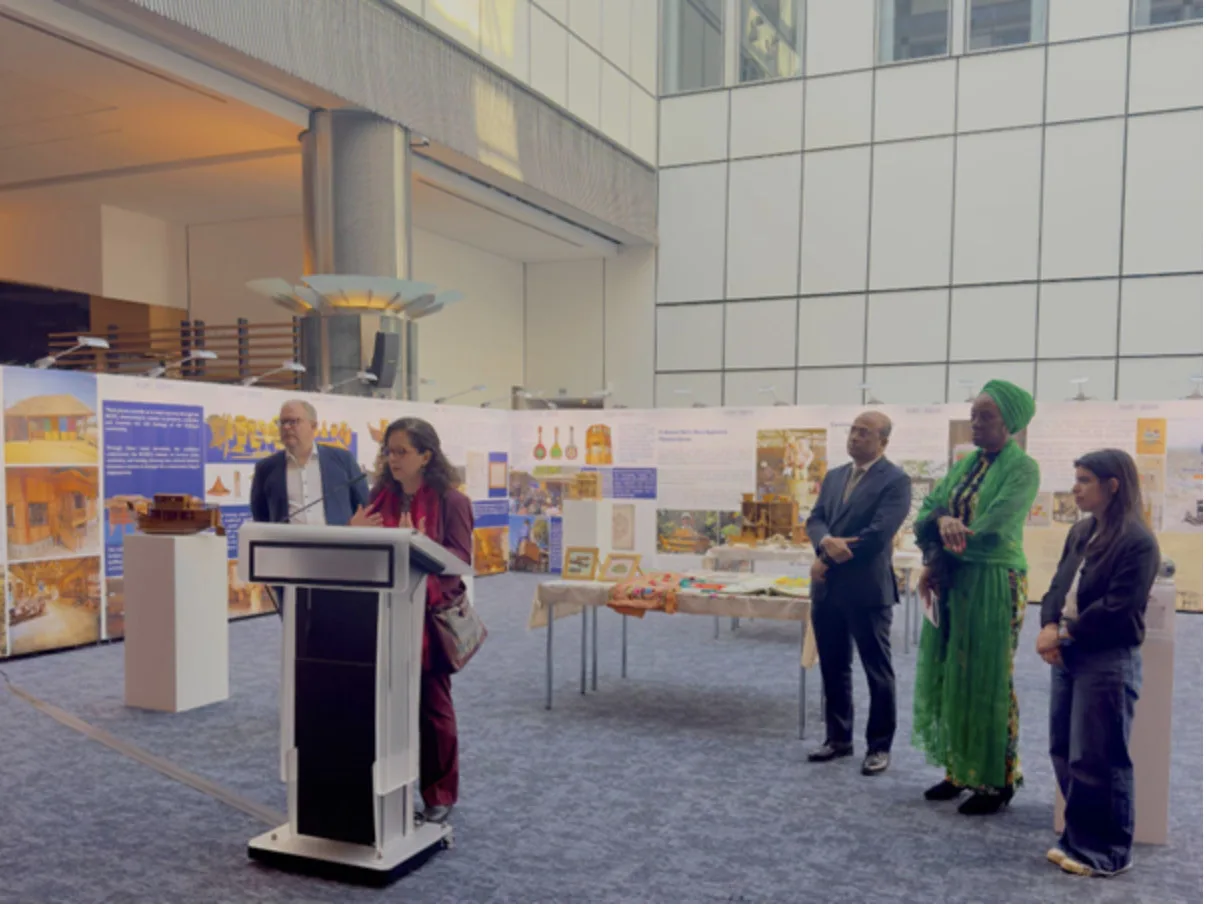
‘We Hear You, We See You, We Are With You’
The exhibition is hosted at the European Parliament (EP) and brought together Members of Parliament, civil society representatives, diplomats, and human rights advocates. Through photographs, traditional artefacts, and educational displays, “Rohingya Heritage in Exile” seeks to preserve and amplify the cultural memory of the Rohingya community.
As the moderator of the event, MEP Urmas Paet pointed out the dire situation of the Rohingya people. Although they are safe from attacks by the military junta of Myanmar, the conditions in the refugee camp in Cox’s Bazar are worsening. MEP Paet’s recent visit to the refugee settlement in September 2025 emboldened him to bring this exhibit to the EP, to ensure that this does not become a forgotten crisis.
MEP Catarina Vieira spoke about the importance of being in solidarity with the Rohingya, a people whose resilience and creative expression, although enduring repression, have continued to thrive and to drive their survival. She recalled her experience visiting Cox’s Bazar alongside MEP Paet, urging her colleagues to advocate for the Rohingya people. The generation of children and youth growing up in the refugee settlement currently have no future prospects, and their fundamental rights are at risk should the international community not act to protect them.
Ugochi Daniels, the Deputy Director-General of the IOM, drew the audience’s attention to the danger of cutting humanitarian aid budgets. Beyond guaranteeing that the basic needs of the Rohingya refugees are met, she warned that lack of funding leads to long-lasting consequences for the children. Schools are closed on certain weekdays, school books are no longer being distributed, and fundamental education is no longer provided. On the other hand, Ms. Daniels sought to highlight the role of the Rohingya Cultural Memory Centre in immersing young Rohingya people in their culture and customs. Grandparents teaching their grandchildren traditional songs, craftsmanship, and techniques is part of what keeps the spirit of this people enduring.
The Ambassador of Bangladesh to Belgium, H.E. Mr. Khandker Masudul Alam underlined that while Bangladesh continues to host more than 1.3 million Rohingya refugees, humanitarian assistance alone cannot provide a lasting solution to this protracted crisis. He called upon the international community to pursue coordinated and decisive action to ensure the safe, dignified, and sustainable repatriation of the Rohingya to their homeland in Myanmar. He further noted the relevance of the event, as it serves as an important reminder that the Rohingya crisis remains unresolved and must not be overlooked.
Director of DG-ECHO Andrea Koulaïmah closed the event by reaffirming her Directorate’s commitment to supporting the Rohingya people and their host country, Bangladesh. She also called for increased engagement from the international communityto guarantee the safety of refugees in Cox’s Bazar and elsewhere in Bangladesh, warning that security threats coupled with climate-triggered disasters are increasingly putting the Rohingya at risk.
The Power and Importance of Safeguarding Culture
The exhibition highlights Rohingya traditions, craftsmanship, music, and oral histories, while drawing attention to the broader realities of displacement faced by the community. By centering narratives of resilience and cultural continuity, it fosters greater understanding of the Rohingya experience and underscores the importance of preserving cultural heritage in contexts of exile and uncertainty.
Rohingya cultural memory stands not only as a reflection of heritage, but as an affirmation of identity, dignity, and collective belonging. Bringing these traditions into a policy setting such as the European Parliament reinforces the importance of informed and inclusive decision making, ensuring that the perspectives and lived experiences of displaced communities remain visible within political discourse.
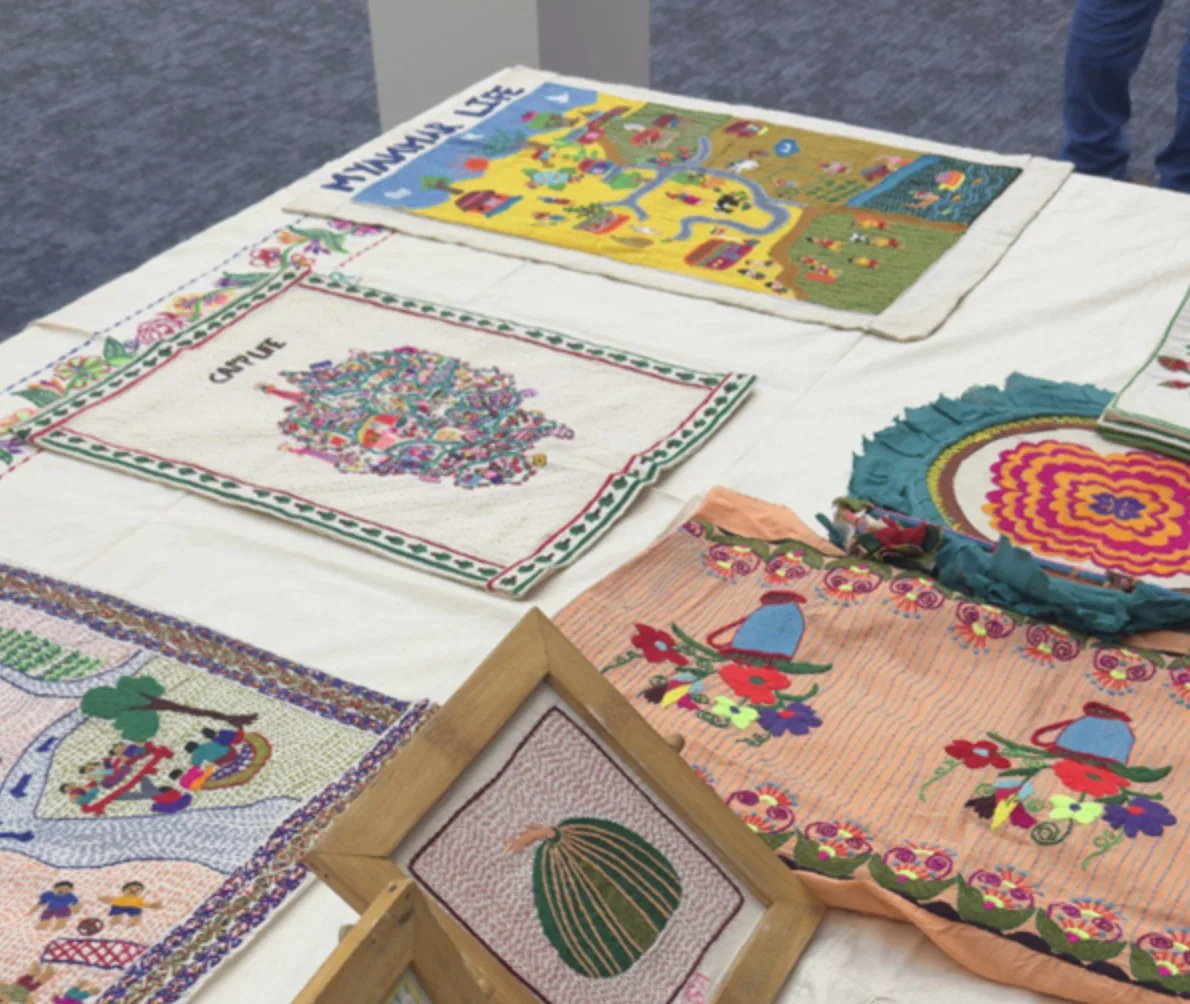
A most striking exhibit is the set of three embroidered tapestries depicting Rohingya life in three instances – in Arakan, now Rakhine State, Myanmar; in the refugee camp; and in the future, in freedom (first two depicted above). These pieces are a true example of the resilience and endurance of a culture persecuted, and confined to living in exile in a settlement that feels like an isolated, forgotten island.
Through this exhibition, however, the Rohingya Cultural Memory Centre ensures that Rohingya heritage is not only remembered, but that it is made present and impossible to overlook. Through initiatives such as this exhibition, the Centre supports artisans, storytellers, and community members in transmitting knowledge across generations, demonstrating that cultural heritage is both a living practice and a source of resilience in the face of prolonged displacement.
Conclusion
The exhibition serves as a reminder that the Rohingya crisis remains both a humanitarian and a human rights emergency. Beyond immediate relief, sustainable solutions require accountability, international solidarity, and a clear commitment to safe and dignified repatriation. By hosting “Rohingya Heritage in Exile,” the European Parliament reaffirmed that cultural preservation and political responsibility are intrinsically linked. Global Human Rights Defence will continue to advocate for sustained international engagement to ensure that the Rohingya people are not forgotten and that their rights, identity, and future are safeguarded.