
Introduction
Since the 1950 invasion of Tibet by Chinese forces, the region has undergone sustained political, cultural, and administrative restructuring aimed at integrating it under Chinese sovereignty to achieve “national unity”(Gurung 2025). Over the following decades, Chinese policies and agreements have progressively restricted Tibet’s autonomy, religion, language, education, and traditional livelihood, undermining self-determination and creating a major risk for cultural preservation. Measures such as military coercion, state oversight of Tibetan Buddhism practices, promotion of Mandarin over Tibetan, forced relocation, and destruction of heritage sites have been tactfully used by the Chinese government to erase the cultural identity of the Tibetan people. This article will examine the impact of Chinese policies on religious and cultural practices, the impact of language restrictions on education, and the ongoing impacts on heritage and preservation.
Historical Context
In October 1950, Chinese armed forces known as the People’s Liberation Army (PLA) invaded Tibet and claimed it as part of China by invoking historical arguments rooted in Qing-era rule and the People’s Republic of China’s (PRC) position that Tibet had always belonged to China. Owing to majority rule and modern weaponry, the PLA was successful in defeating Tibetan forces. China’s military operation led to the capture of the region of Chamdo in mid-October 1950, which gravely affected Tibet’s capacity to resist any further military attacks. Facing military pressure and lacking international support, the Tibetan authorities yielded to negotiation (Goldstein, 1989).
By the spring of 1951, as the Tibetan delegation arrived in Beijing to initiate negotiations, the PLA was positioned to advance its operation towards Tibet’s capital, Lhasa. The Tibetan delegation had no direct lines of communication with Lhasa or the Dalai Lama when they were presented with the Agreement on Measures for the Peaceful Liberation of Tibet, later known as the Seventeen Point Agreement. Under military coercion and the threat of invasion, Tibetan representatives signed the agreement on May 23rd, 1951. Initially, while the Dalai Lama claimed the agreement was signed for the sake of peace, in 1959, he publicly declared the agreement invalid because it had been concluded under military coercion (Goldstein, 2007).
The Seventeen Point Agreement set out specific duties and conditions for Tibet’s “peaceful liberation”. The agreement established strict rules, including the requirement to (The Central People’s Government & the Local Government of Tibet, 1951):
- acknowledge Chinese sovereignty,
- allow the PLA to enter and station in the territory,
- cooperate politically with the Chinese government,
- manage external relations through Beijing, and
- ensure internal physical and economic integration.
While these obligations were part of the 13 provisions China had implemented, primarily through force or coercion, the remaining four, which guaranteed essential rights, were never respected. These commitments included (Seventeen Point Agreement, 1951):
- the right to national regional autonomy,
- the right to keep their existing political system and the status of the Dalai Lama,
- the freedom of religious belief and the protection of lama monasteries and,
- the right to carry out reforms of its own accord.
The Seventeen Point Agreement is a crucial point in understanding the ongoing tensions between China and Tibet, as it laid the foundation for China’s political and military presence in the region and continues to be a point of debate regarding Tibet’s autonomy and cultural and religious freedom. If the Chinese Government cites the agreement as evidence of Tibet accepting the incorporation into the PRC, for Tibetans, it demonstrates how China has failed to uphold the obligations towards ensuring their rights are respected.
Religious Restrictions
Under the 2007 Measures on the Management of the Reincarnation of Living Buddhas, the Chinese government established a legal framework that places the reincarnation process of Tibetan Lamas, including the Dalai Lama, under state supervision. The regulations state that any reincarnate must follow the relevant application procedure and obtain official certification at the provincial and national levels before an individual can be recognised as the next reincarnation. This framework has given the Chinese government decisive influence and control over who may become the next “living Buddha” and what conditions have to be met, constraining Tibetan Buddhism and its traditions and practices (State Administration for Religious Affairs, 2007). These practices remain in force today, and in March 2025, the Chinese government reaffirmed its position, stating that the reincarnation system only operates under the administration of the government (Amnesty International, 2025).
Further restrictions were placed on December 1st, 2024, when China’s State Administration for Religious Affairs, the highest official body that regulates religious practices in China, issued a revised version of the Measures for the Administration of the Tibetan Buddhist Temples. The Regulation came into force on January 1st, 2025, and expanded state control over Tibetan religious practices. The revised Regulation (1) explicitly binds Tibetan monasteries to the ideological framework of the Communist Party, (2) mandates that monastic administration must love and protect the leadership of the Communist Party, (3) mandates political education for monks, (4) imposes strict quotas on monastic populations, and gives the Buddhist Association of China a prominent role in Tibetan Buddhism, and (5) introduces a bureaucratic approval process for monks and nuns who wish to study at another monastery (State Administration for Religious Affairs, 2024). Collectively, the revised measures entrench the Chinese Communist Party’s political authority within the structures of Tibetan Buddhism, subordinating religious institutions to political loyalty. Additionally, the new regulatory reform nominally conflicts with China’s own legal guarantees, including Article 36 of the Constitution, which provides for the freedom of religious belief (Tibet Center for Human Rights and Democracy, 2025).
Language and Education
In 2010, provincial administrations throughout China had formally introduced “bilingual education” programs. Despite using the label, Tibet Autonomous Region (TAR) authorities did not specify whether Chinese or Tibetan would be the medium of instruction in primary schools, and have continued to use the terminology without clarifying it. In practice, Mandarin Chinese has increasingly replaced the Tibetan language as the primary medium of instruction in forms of education such as primary schools and kindergartens. Rural Tibetan schools have been closed down and consolidated into larger institutions based in towns where Mandarin is the primary language.
The number of teachers who do not speak Tibetan has increased in schools, and they are not required to learn it, while Tibetan-speaking teachers are often sent for further training in other provinces and are required to know Chinese. Textbooks, examinations, and administrative classes are often being replaced or heavily taught in Chinese, with Tibetic language classes often being limited to a marginal part of the curriculum. The Chinese Government has attempted to justify such changes by claiming that knowledge of Mandarin Chinese would help with employment. This claim, however, has been disproven by a report claiming that the integration of the language helps eliminate the elements of instability in the Tibetan region (Human Rights Watch [HRW], 2020).
In addition, many Tibetan children are being enrolled in boarding schools run by the Chinese Government, which often leads to them being separated from their families for extended periods of time. Such schools prioritise Mandarin, and classes often prioritise the ideology of national unity or economic progress and Chinese cultural values. Tibetan history, religion, and cultural practices are often excluded or minimised, and students have limited opportunities to use the Tibetan language in their daily lives. Monastic or cultural education is restricted, with mandatory political education and demonstrations of loyalty to the Chinese Communist Party being core elements (Gurung 2025).
As a result of these policies, Tibetan students experience reduced fluency in their native language because of fewer opportunities to study or communicate, and decreased access to language books and to instructions delivered in Tibetan in education (HRW, 2020). Finally, the emphasis on the use of Chinese languages, together with the exclusion of Tibetan history, religion, and culture classes in schools, has affected the children’s connection to their identity and cultural values (Gurung, 2025).
Forced Resettlement and Heritage Destruction
The preservation of Tibetan cultural heritage buildings has been undermined by Chinese state policies. Religious and historical sites have faced destruction or repurposing under the justification that such changes were made for urban development and modernisation. Monasteries and other sacred Tibetan landmarks have either been reconstructed or converted into tourist attractions, where Tibetan culture is often treated as exotic decorations, and the capital Lhasa itself is a theme park.
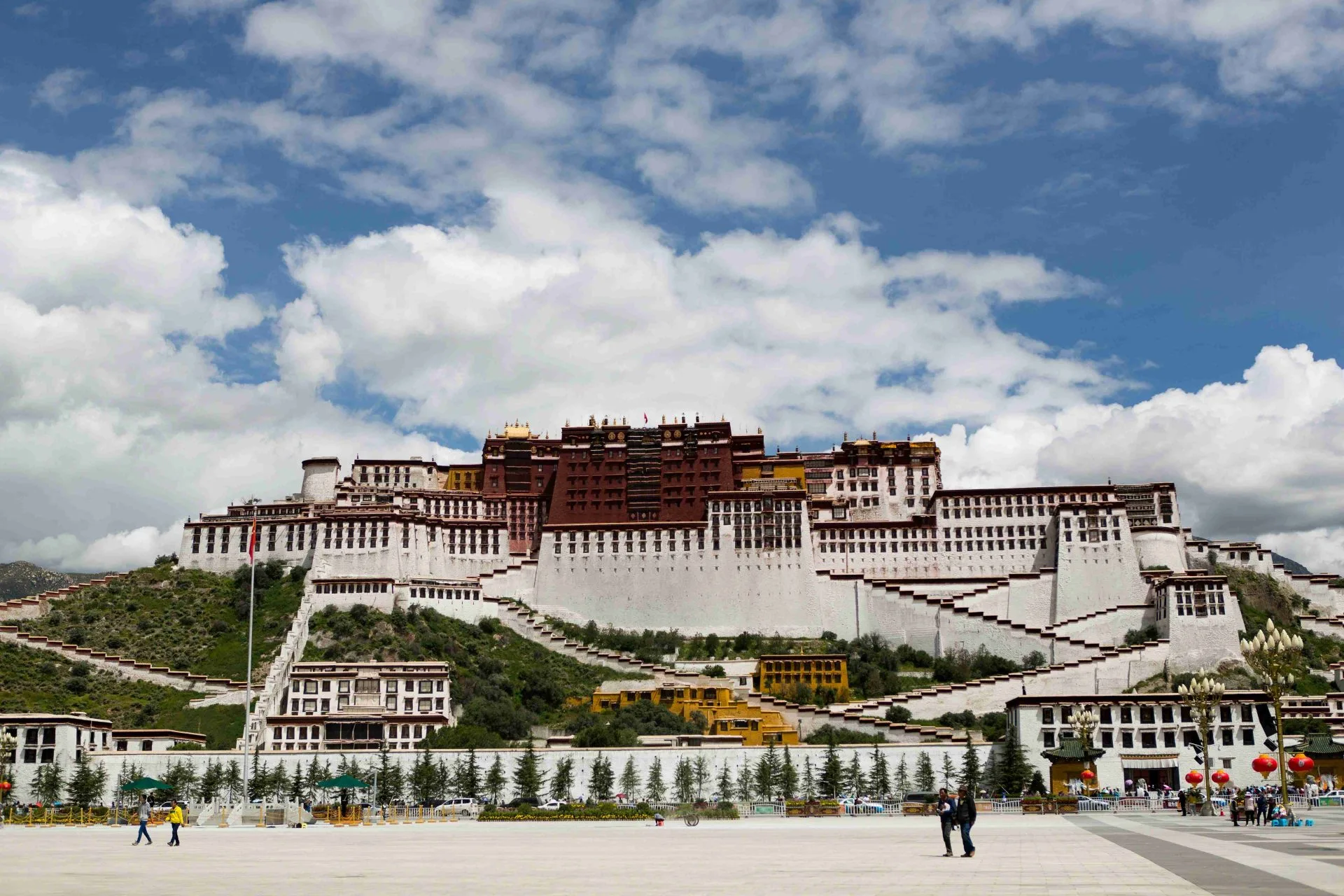
Traditional Tibetan architecture has been replaced with government-approved replicas, such as the imitation Potala Palace, designed to appeal to tourists and present China’s narrative on Tibet, with the aim of rewriting history. In construction plans for urban development, including Lhasa, Tibetan locals, culture, or heritage experts are often excluded, following the policy orientation of the Chinese government for the removal of social and cultural differences among Tibetans and other ethnic minorities within the PRC. Such measures have resulted in historical landmarks being transformed to reflect China’s modernisation and tourism priorities, with limited attention to the preservation of the spiritual and cultural significance of Tibet’s heritage sites (International Campaign for Tibet, 2018).
Since 2016, Chinese authorities have implemented large-scale relocation programmes in Tibet, moving individuals, particularly rural villagers and herders, into government settlements without their consent. Participation is compulsory and enforced through extreme forms of persuasion, such as home visits, insults to their intellectual capacity to make decisions for themselves, and threats of violence or disciplinary action against them. Poorer households are often targeted and misled with incorrect information about the economic benefits of relocation to acquire consent (HRW, 2024).
Many households are relocated far from their traditional lands, which, in the case of herders or pastoralists, prevents them from grazing and continuing to live off the land, requiring them to switch to wage work, where they would need to speak Chinese languagesrather than Tibetic languages. As of 2024, over 700,000 Tibetans have been relocated under these relocation programmes, destroying their life and culture, subject to coercive policy (Dickyi, Lobsang, Damdul, & Pelbar, 2024).
Conclusion
The Seventeen Point Agreement of 1951 promised Tibet the protection of its autonomy, freedom of religion, and cultural preservation. In practice, Chinese authorities have failed to fulfill these commitments, as Tibetan Buddhism faces state oversight and restrictions, the Tibetic languages have been actively erased from education programmes, with rural communities relocated, traditional livelihood and cultural practices disrupted, and historical heritage sites have been destroyed or commercialised. Such policies have gravely affected Tibet’s cultural transmission and self-determination, and constrained Tibetans’ ability to maintain their distinct identity. To address these harms, Chinese authorities need to adopt the proper and necessary reforms that respect cultural and religious rights and recognise Tibet’s state autonomy.
BIBLIOGRAPHY
Amnesty International. (2025, July 2). China: Authorities must end interference in Tibetan religious practices as Dalai Lama announces succession plan. Retrieved 11 November 2025, from https://www.amnesty.org/en/latest/news/2025/07/china-authorities-must-end-interference-in-tibetan-religious-practices-as-dalai-lama-announces-succession-plan/.
Dickyi, T., Lobsang, Damdul, D., & Pelbar. (2024, May 21). Hundreds of thousands of Tibetans forced to relocate, report says. Radio Free Asia. Retrieved 12 November 2025, from https://www.rfa.org/english/news/tibet/forced-relocations-report-05212024160518.html.
Goldstein, M. C., & Rimpoche, G. (1989). A History of Modern Tibet, 1913-1951: The demise of the lamaist state (Vol. 1). Univ of California Press.
Goldstein, M. C. (2007). A History of Modern Tibet, Volume 2: The Calm Before the Storm: 1951-1955 (Vol. 2). Univ of California Press.
Gurung, T. D. (2025, March 12). How China is weaponizing education to erase Tibetan identity. The Diplomat. Retrieved 11 November 2025, from https://thediplomat.com/2025/03/how-china-is-weaponizing-education-to-erase-tibetan-identity/.
Human Rights Watch. (2020, March 5). China’s “bilingual education” policy in Tibet: Tibetan-medium schooling under threat. Retrieved 11 November 2025 from https://www.hrw.org/report/2020/03/05/chinas-bilingual-education-policy-tibet/tibetan-medium-schooling-under-threat.
Human Rights Watch. (2024, May 22). “Educate the Masses to Change Their Minds”: China’s Coercive Relocation of Rural Tibetans. Retrieved 11 November 2025 from https://www.hrw.org/report/2024/05/22/educate-masses-change-their-minds/chinas-forced-relocation-rural-tibetans.
International Campaign for Tibet. (2018, June 25). Destruction, commercialization, fake replicas: UNESCO must protect Tibetan cultural heritage. Retrieved 11 November 2025 from https://savetibet.org/destruction-commercialization-fake-replicas-unesco-must-protect-tibetan-cultural-heritage/.
State Administration for Religious Affairs. (2007, July 18). Measures on the Management of the Reincarnation of Living Buddhas in Tibetan Buddhism.
State Administration for Religious Affairs. (2024, September 15). Measures for the Administration of Tibetan Buddhist Temples.
The Central People’s Government and the Local Government of Tibet. (1951). Agreement of the Central People’s Government and the Local Government of Tibet on Measures for the Peaceful Liberation of Tibet [The Seventeen Point Agreement].
Tibet Center for Human Rights and Democracy. (2025, February 14). China’s revised religious measures tightens state control over Tibetan Buddhism. Retrieved 10 November 2025, from https://tchrd.org/2025/02/14/chinas-revised-religious-measures-tightens-state-control-over-tibetan-buddhism/.