
New York, June 2nd, 2026.
On Monday 1 June 2026, Global Human Rights Defence hosted an event at the Bahá’í International Community, near the United Nations Headquarters. The discussion addressed the ongoing conflict in Sudan with particular attention to conflict-related sexual violence, evidence collection, and pathways to accountability.
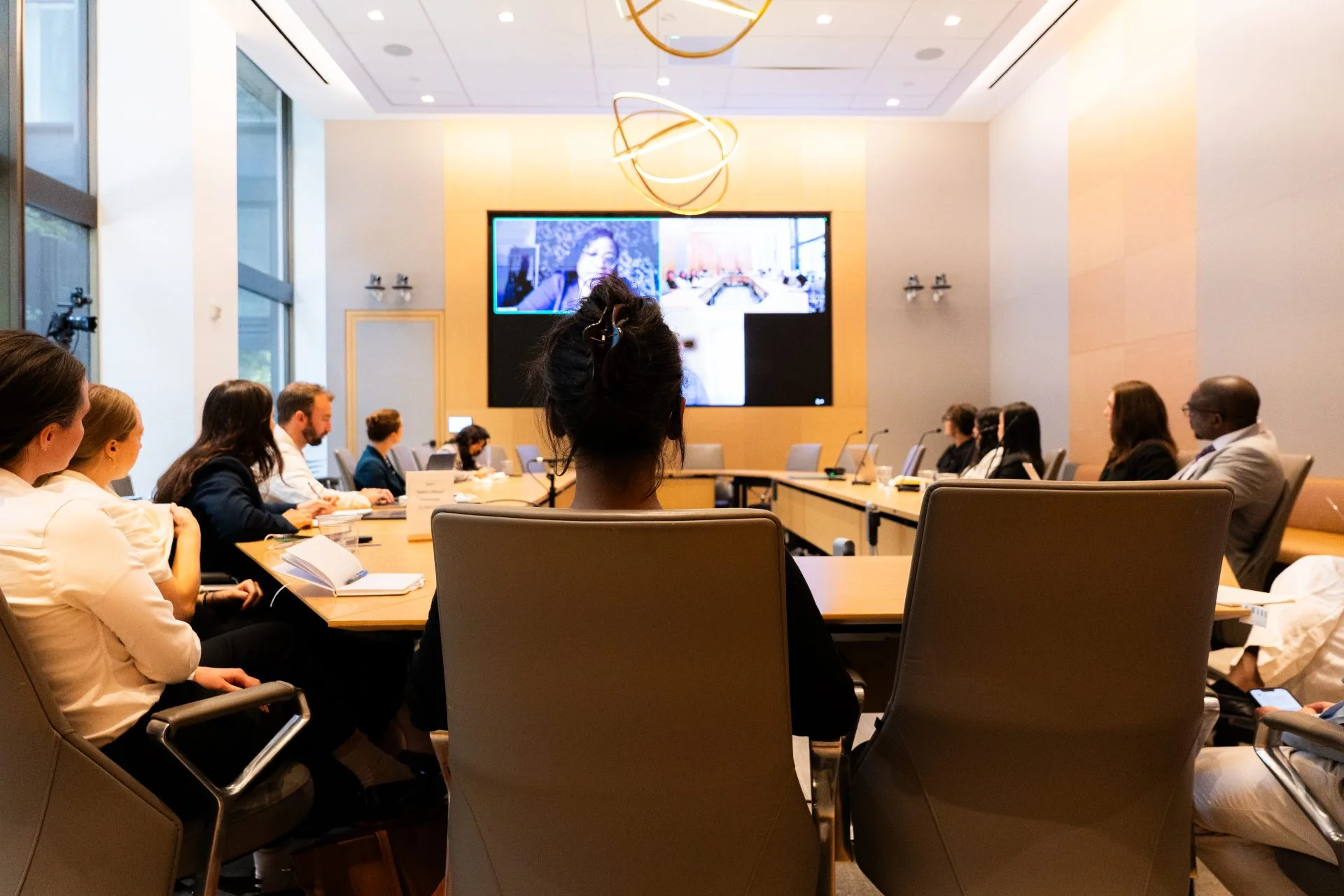
The panel was moderated by Sophie Neiman, an award-winning journalist who had recently reported from South Kordofan, and brought together Neimat Ahmadi (Darfur Women Action Group), Quscondy Abdulshafi (Darfur Network for Human Rights), Olivia Mooney (Yale Humanitarian Research Lab), Nikkie Lyubarsky and Gabriella Tejada (The Soufan Center), and Jehanne Henry (The Reckoning Project).
As the conflict entered its fourth year in April 2026, civilians have increasingly been targeted, including in residential areas, schools, and hospitals. Drones are now the leading cause of civilian deaths, accounting for 80 per cent of civilian casualties in the first three months of 2026 alone, according to the United Nations. Women in particular have been targeted, with gender-based violence becoming a persistent feature of the conflict. Survivors shared accounts of rape, multiple perpetrator rape, and assaults in areas under RSF control, as well as at checkpoints and along displacement routes, including while fleeing after the attacks on El Fasher. As a result, the conflict has driven a major displacement crisis, with more than 9 million people internally displaced and a further 4.4 million forced to flee beyond Sudan’s borders, making it the world’s largest displacement crisis.
Neimat Ahmadi described the violence against women as “the most defining feature of the conflict”, highlighting how women have been abducted en masse, subjected to sexual slavery, tortured, and killed, in an effort to terrorise, humiliate, and control communities. Whilst these crimes are being systematically documented, Ahmadi insisted that perpetrators must be made aware that they “will be held accountable for crimes of a gendered nature”. Facing a humanitarian crisis that disproportionately impacts women and girls, Ahmadi also stressed the importance of supporting local actors to ensure they have the resources to provide lifesaving services, gender-based violence response, and emergency healthcare.
Quscondy Abdulshafi, commenting on the conflict with no sign of easing, stated that “it is not a lack of evidence, but a lack of political will”. He described survivors’ willingness to share their testimonies, noting that the act of documenting crimes often serves “as a form of resistance”, despite profound trauma. He emphasised that local organisations on the ground continue to gather testimony and archive footage under severe resource constraints, stressing that “every testimony collected, every piece of evidence archived, every victim interviewed is an act of accountability”.
Olivia Mooney, explaining the investigative methods used to support accountability mechanisms, detailed that the Yale Humanitarian Research Lab utilises data fusion methodologies combining open-source information and publicly available remote sensing data, in line with international legal standards for use in accountability processes. She mentioned that, in February 2026, according to satellite imagery analysis conducted by the Humanitarian Research Lab, the UN Fact Finding Mission found that the RSF had a “specific intent” to commit genocide in El Fasher and engaged in a pattern of actions consistent with that intent. She added that the Yale Humanitarian Research Lab has also identified the presence of advanced foreign-supplied drone systems in the hands of the RSF, and documented systematic attacks on hospitals, markets, and civilian infrastructure across the country.
Addressing the conflict from a global perspective, Nikkie Lyubarsky and Gabriella Tejada stressed that, in addition to its geographically strategic location in the Red Sea region, Sudan has considerable resources, including land and gold, which are of interest to neighbouring states, including the United Arab Emirates. Gabriella Tejada noted that the relationship between the UAE and the RSF has been growing over the years, and that the RSF would not be able to operate without its support, analysing that the conflict is driven by the political will of the parties involved but is enabled by external actors.
Jehanne Henry, speaking on accountability mechanisms, noted that domestic Sudanese courts “are not equipped to deal with the scale of the atrocities happening now”. She added that the UN Fact-Finding Mission is doing valuable work in collecting and preserving evidence, but has no power to prosecute, and that therefore the International Criminal Court (ICC) remains the primary avenue for crimes perpetrated in Darfur. She stressed that the Court has jurisdiction to investigate and prosecute ongoing crimes in Darfur, based on the 2005 UN Security Council Resolution that granted the Court jurisdiction, as reflected in ongoing investigations. Regarding crimes perpetrated outside Darfur, she noted that while there is ongoing debate, there is a growing trend in support of expanding the ICC’s jurisdiction.
She also highlighted the potential of universal jurisdiction proceedings as a promising avenue for accountability but emphasised that this would require states that have the necessary legal tools to demonstrate practical implementation.
To conclude the discussion, panellists agreed that the international community possesses both the evidence and the legal tools required to ensure accountability. They called on Member States to support organisations operating directly on the ground, to pressure those enabling the conflict to end their support, including financial and logistical assistance, and to strengthen bodies collecting evidence, as this will be crucial in identifying perpetrators.
Neimat Ahmadi closed by affirming that the people of Sudan, especially women, are resilient and determined and “never cease to amaze us”, and that “hope is possible” even in the face of unimaginable adversity.