Reports
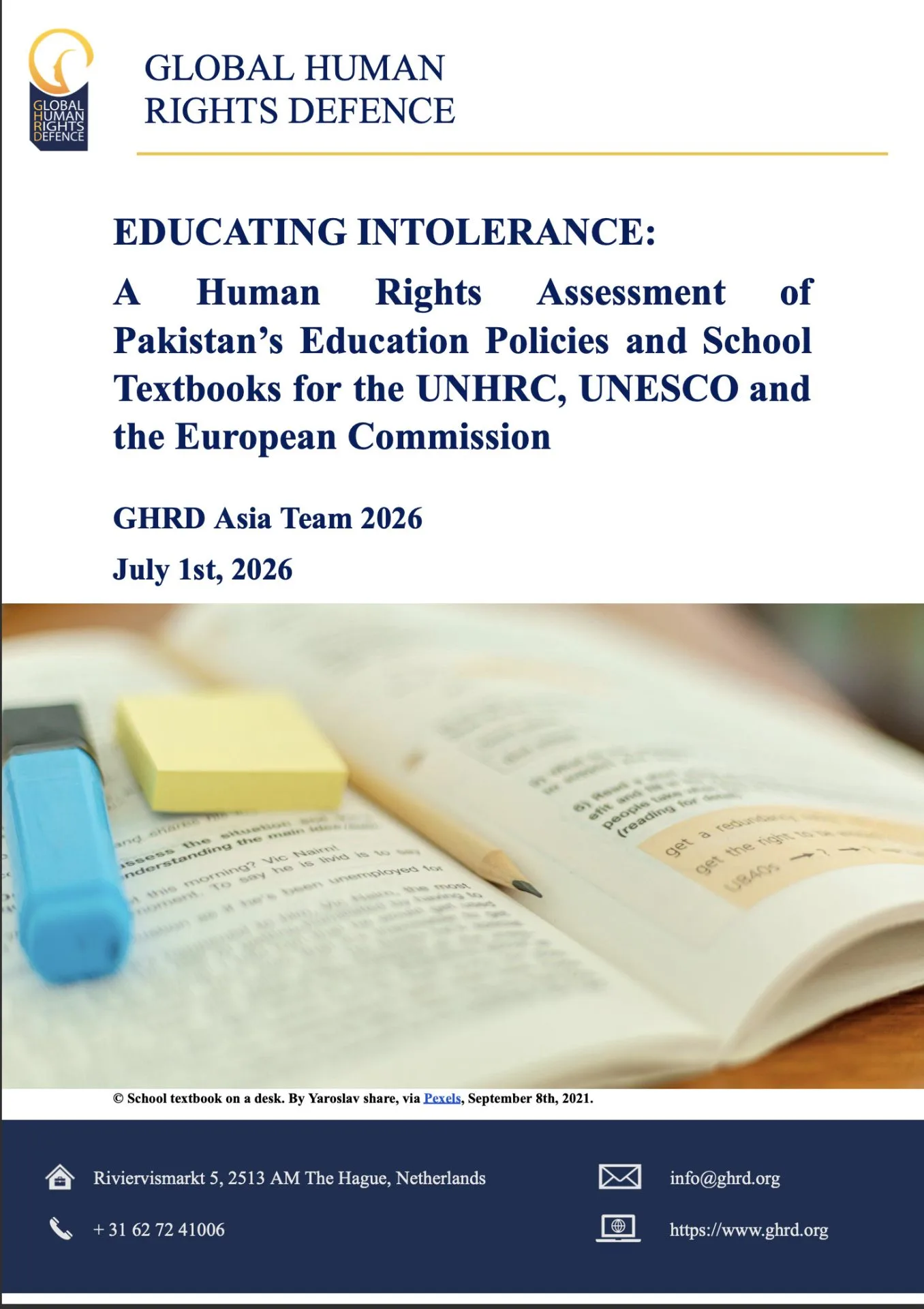
Educating Intolerance: A Human Rights Assessment of Pakistan’s Education Policies and School Textbooks
- GHRD Team
- 29 July 2026
- Education Policy, Pakistan, School Textbooks
This report examines Pakistan’s education policies, curriculum frameworks, and public-school textbooks from a human rights perspective, with particular focus on religious identity, citizenship, minority inclusion, and equality in education.
The report highlights concerns raised by Pakistani researchers and education experts regarding the representation of religious minorities, the link between national identity and dominant religious narratives, and the integration of religious content into compulsory non-religious subjects. It also assesses these issues against Pakistan’s constitutional protections, including freedom of religion, equality before the law, the right to education, and safeguards against compulsory religious instruction.
The report further considers Pakistan’s international human rights obligations under the UDHR, ICCPR, CRC, SDG 4, and UN standards on freedom of religion or belief. It concludes with recommendations for Pakistan, UNESCO, the United Nations Human Rights Council, and the European Commission to support inclusive curriculum reform, human rights education, teacher training, academic freedom, and stronger protections for minority students.
The report highlights concerns raised by Pakistani researchers and education experts regarding the representation of religious minorities, the link between national identity and dominant religious narratives, and the integration of religious content into compulsory non-religious subjects. It also assesses these issues against Pakistan’s constitutional protections, including freedom of religion, equality before the law, the right to education, and safeguards against compulsory religious instruction.
The report further considers Pakistan’s international human rights obligations under the UDHR, ICCPR, CRC, SDG 4, and UN standards on freedom of religion or belief. It concludes with recommendations for Pakistan, UNESCO, the United Nations Human Rights Council, and the European Commission to support inclusive curriculum reform, human rights education, teacher training, academic freedom, and stronger protections for minority students.
✨ AI summary
This report assesses Pakistan’s education policies and school textbooks through a human rights lens, focusing on minority inclusion, religious identity, citizenship, academic freedom, and social cohesion. It finds that although Pakistan has constitutional protections for equality, freedom of religion, minority rights, and free compulsory education, implementation remains inconsistent. The report highlights concerns that national identity is often linked to a dominant religious framework, while religious minorities remain underrepresented in textbooks and educational narratives. It also raises concerns about compulsory or integrated religious content in non-religious subjects, limited human rights and peace education, and insufficient protection for critical thinking and academic freedom. Drawing on research by the Centre for Social Justice, the report recommends curriculum review with minority representation, removal of discriminatory or exclusionary content, compliance with Article 22 of Pakistan’s Constitution, alternative religious education pathways, inclusion of minority contributions in textbooks, teacher training on diversity, and international support from UNESCO, the UNHRC, and the European Commission.
Share this report
Facebook
X
LinkedIn
WhatsApp