
On Monday, June 22ND 2026, Global Human Rights Defence (GHRD) attended a side event at the 62nd session of the UN Human Rights Council in Geneva to introduce a forthcoming set of global guidelines for the investigation of femicide, the gender-related killing of women and girls. The event, co-hosted by the Permanent Missions of Spain and Sweden, was co-led by His Excellency Mr Magnus Hellgren, Permanent Representative of Sweden, and Dr Morris Tidball-Binz, UN Special Rapporteur on extrajudicial, summary or arbitrary executions and a forensic doctor by profession.
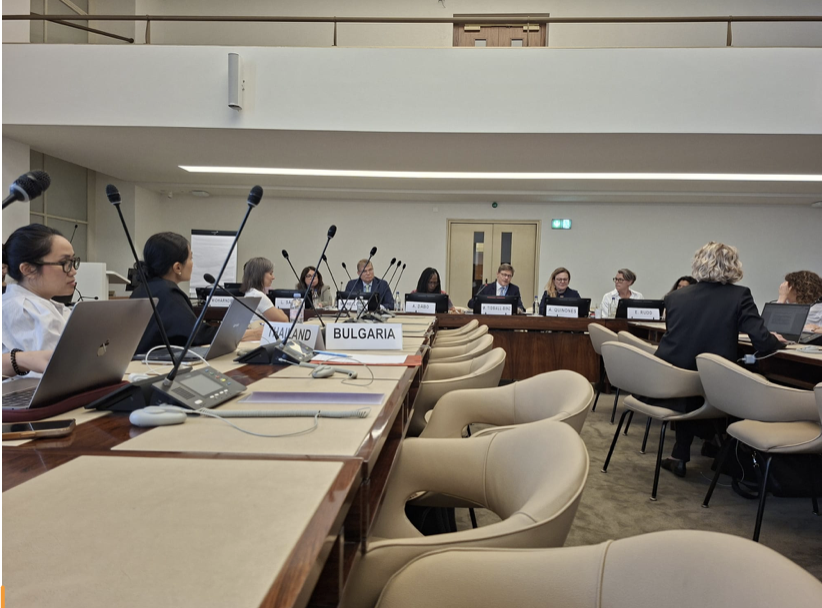
Panel of the HRC62 side event on the investigation of femicide at the Palais des Nations, Geneva, 22 June 2026, with Special Rapporteur Morris Tidball-Binz speaking at the centre of the head table.
The panel brought together:
- Ms Awa Dabo, UN Deputy High Commissioner for Human Rights
- Ms Adriana Quiñones, Chief, Human Rights and Nondiscrimination, UN Women
- Ms Lara Saade, Chief of Staff and Senior Legal and Public Policy Advisor to the Minister of Justice of Lebanon
- Dr Eva Rudd, Swedish specialist in forensic medicine
- Dr. Panjai Woharndee, Director of Forensic Science Services at the Central Institute of Forensic Science
- Ms Anjli Parrin, Kenyan human rights lawyer and Director of the Global Human Rights Clinic at the University of Chicago Law School
- His Excellency Mr Marcos Gómez Martínez, Permanent Representative of Spain
Where the Tool Comes From
The initiative responds to an urgency highlighted by Deputy High Commissioner Dabo: one woman or girl is intentionally killed every ten minutes, most often by a partner, family member, or someone otherwise known to her. Yet many femicides are never recognised as such. Instead, they are often labelled as suicides or domestic accidents and treated as isolated incidents due to a lack of evidence.
As Dr Wonoundee put it:
“In forensic investigation, we say that evidence must speak because the victim can’t. In the case of feminicide, evidence doesn’t seem to speak loudly enough”.
Dr. Soaole recognises the gap in the international framework for death investigations as “not a failure of will but a failure of tool”. Indeed, the existing global standard, the Minnesota Protocol, does not consider the gender dimension and does not refer to femicide as a specific category. While a regional precedent exists, the Latin American Model Protocol for the Investigation of Gender-Related Killings of Women, it is not adapted for a global approach.
The Tool
The new set of global guidelines was directly triggered by Dr Tidball-Binz’s 2023 report to the UN General Assembly on the investigation and documentation of gender-based killings. Its core argument is that applying a gendered lens and specific investigation protocols enables these deaths to be identified, documented, and counted as femicides. The guidelines are designed to be used alongside the Minnesota Protocol, and several states, including Italy, have already asked when the tool will be ready.
Ms Quiñones stressed that for the tool to have a real effect, it must be institutionalised: used by prosecutors and embedded in the training of investigators and police. Dr Rudd expressed her hope that the guidelines would “shed light” on the “blind spots” of gender-based violence, “so that we can investigate something we can see” – a point echoed in the closing remarks on behalf of Spain:
“What is not seen cannot disappear”.
The guidelines, nearly finalised, are expected to be published soon. Deliberately technical and practitioner-oriented, covering matters from evidence collection to the identification of gender-related motives, the tool is written to be read and applied by professionals on the ground: police officers, prosecutors, forensic experts, and judges, in every region of the world.