
On September 25th, the Global Human Rights Defence organized a critical side-event titled “Child and Forced Marriage as Gender-based Violence” during the 63rd session of the UN Human Rights Council. The event assembled international experts to highlight the urgent need for integrated legal and social responses to this important issue.
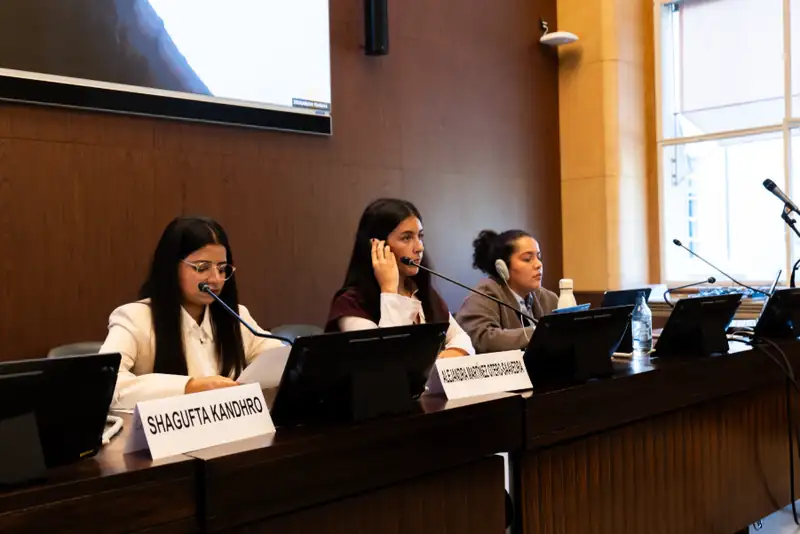
The event gathered international experts to discuss the topic of child and forced marriage, led by moderator Alejandra Martínez Otero-Saavedra. The speakers emphasized that child and forced marriage is not an isolated cultural practice but a manifestation of entrenched gender violence, intensified by digital technologies, poverty, and legal pluralism.
Ai Kihara-Hunt, Special Rapporteur on the sale and sexual exploitation of children, highlighted the intersection with digital developments. She warned that while child marriage is not new, digital environments are fundamentally transforming grooming and manipulation tactics, expanding the scale of exploitation through AI and deepfakes. This creates a broader scope of abuse that traditional protection systems fail to address. A report by UNICEF is mentioned, stating that an estimate of 20 million children, aged 12 to 17, has experienced a form of technology-facilitated sexual exploitation in a single year. And 57 per cent of cases involve someone the child already knew. Kihara-Hunt called for prevention strategies that include the digital environment, looking at the social pressures and dangers for children to remain child-centered.
Professor Haina Lu from Renmin University of China Law School described child and forced marriage as the clearest manifestation of entrenched gender violence, affecting girls disproportionately. Such unions impact someone’s health, independence, right to education, and freedom. Lu argued that child and forced marriage is rooted in structural dominance and cannot be solved by legal reform alone; it requires a transformation of patriarchal power structures within families and communities. Lu presented a six-pillar roadmap for action through an intersectional lens that includes providing economic opportunities, eliminating legal exceptions to the minimum age of 18, and ensuring that girls and women are placed at the center as indispensable agents.
Naveed Walter, President of the Human Rights Focus Pakistan, highlighted the severe crisis in his country where millions of women and children have been affected by child and forced marriages. He explained how religious parties frequently oppose the minimum marriage age of 18, leaving millions of girls without education or basic health protections. He urged the international community to not stop at documentation, but to pressure governments to implement practical, on-the-ground changes that prioritize the life, dignity, and rights of girls and women over ideological disputes.
Lastly, Doctoral Researcher and Sindhi Community Representative Shagufta Kandhro brought attention to the intersectional vulnerability of religious minorities in Sindh, Pakistan. Sharing cases of young Hindu girls being abducted at gunpoint and trafficked into marriage, Kandhro noted how many victims are forced to drop out of school due to early pregnancy and suffer health conditions. She emphasized how these are not isolated incidents, it is a part of a systemic pattern of oppression. A UN report showed how in 2025 75 per cent of the women and girls affected by forced conversion through marriage were Hindu, and almost 80 per cent of incidents occurred in Sindh province. This human rights violation requires immediate legal intervention and robust support systems for survivors who currently lack access to justice.
The panelists agreed that effective solutions must integrate victim-centered approaches across all institutions. They stressed the importance of ensuring that information sharing does not compromise confidentiality while still allowing for comprehensive data analysis to identify patterns and loopholes. The GHRD calls on all states and human rights organizations to adopt these recommendations, ensuring that laws are not only enacted but effectively implemented to protect the rights and future of girls and women worldwide.