
18 September 2026 | Strasbourg, France
Aurélie Michel, Lobbying, Network, and Collaboration team, Global Human Rights Defence.
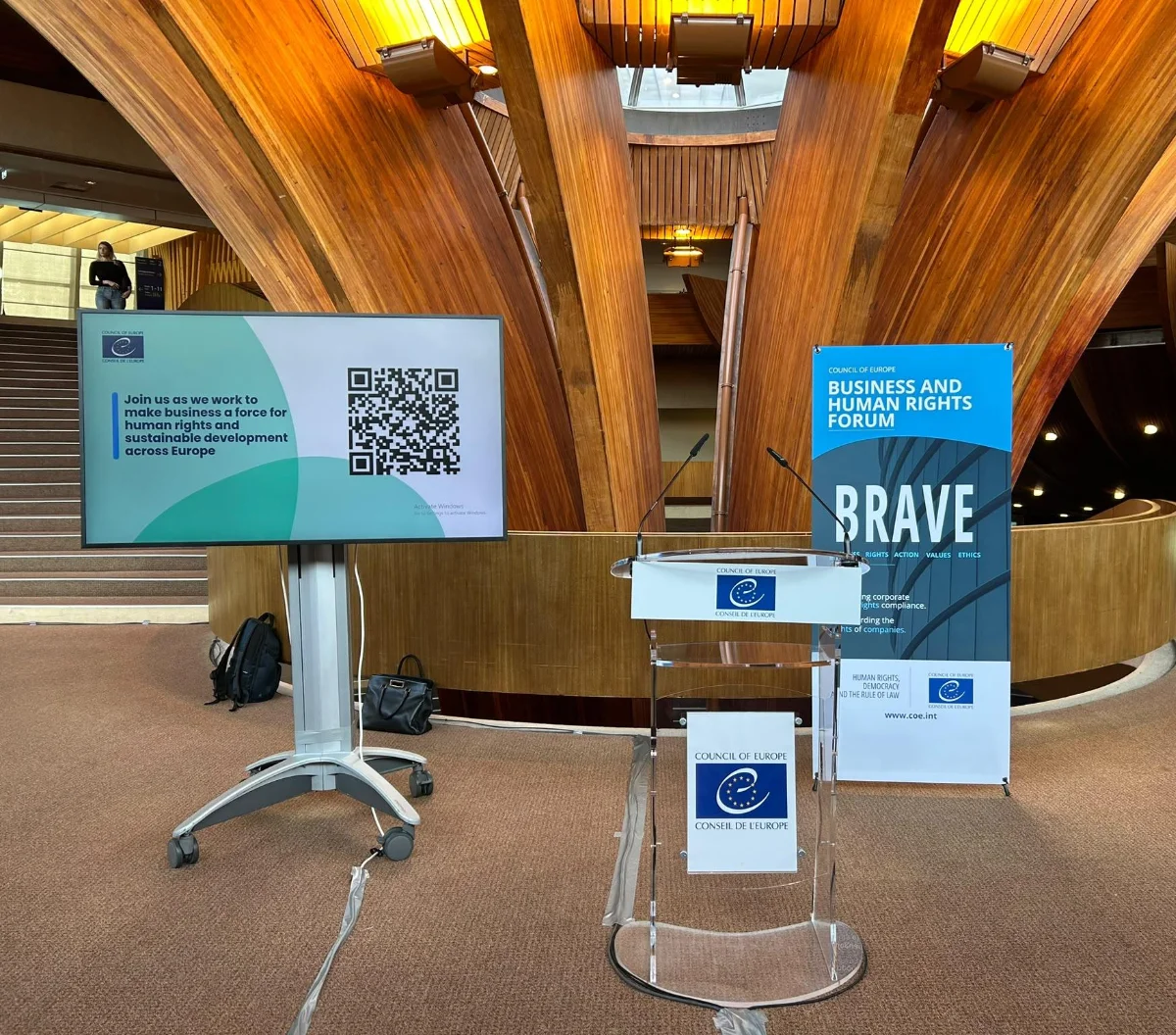
On Friday, 18th of September, GHRD attended the Western Europe Business and Human Rights Forum in Strasbourg, and a particularly interesting side event: “Simplification or Deregulation? The EU Omnibus Agenda, Corporate Accountability, and the Future of Responsible Business in Europe and Beyond”.
The session covered the Corporate Sustainability Due Diligence Directive (CSDDD), an EU law that requires large companies to identify and prevent human rights and environmental harms in their supply chains, and the Omnibus package, an EU legislative initiative that significantly simplifies and scales back the CSDDD.
The panel brought together:
- Richard Howitt (moderator) – Strategic Advisor on Business and Human Rights and Senior Associate at Frank Bold;
- Johannes Blankenbach – Senior EU/Western Europe Researcher, Business and Human Rights Centre;
- Olena Uvarova – Business and Human Rights Specialist, UNDP;
- Jana Hoess – Senior Analyst, EIRIS Foundation;
- Florian Yelin – Strategic Legal and Policy Advisor, Competence Centre for Human Rights Due Diligence.
Omnibus Package – Deregulation or Simplification
Richard Howitt introduced the subject by placing the Omnibus package in the EU political timeline: from the complete agreement on the CSDDD in March 2024, to the June EU election, in which far-right parties won 26 percent of seats in the European Parliament, to November, when the Commission announced the Omnibus simplification initiative.
The main argument for pushing towards “simplification” and deregulation is that the CSDDD and due diligence law represent an important bureaucratic burden for enterprises. Johannes Blankenbach, using Germany’s supply-chain due diligence act as an example, emphasised that “bureaucratic burden” had become a key buzzword in the business lobby, but that the burden often came from how companies implemented the law, not from the law itself.
The researcher then noted that many companies had shown strong support for supply chain due diligence and opposed de-regulatory pressure. Jana Hoess backed this claim, explaining that Omnibus was heavily influenced by trade associations pushing to lower human rights standards, even though many companies represented by those associations are far more progressive and supportive of due diligence regulations. This discrepancy between companies’ preferences and trade associations’ push for the lower common denominator raises the question of companies’ responsibility to speak up more within their trade associations, and in the European context more broadly.
Impact of Omnibus Outside of the EU
The Business and Human Rights specialist, Olena Uvarova, offered important insights about the impact of EU Due Diligence law deregulation in EU candidate countries. She highlighted that deregulation’s main appeal abroad was driven by an unexpected factor – language. Indeed, countries outside the EU bubble often struggle to decipher the technical and “Brussels” terminology and tend to jump on the opportunity EU deregulation processes offer. In line with this argument, the specialist also emphasised the importance of clarifying the distinction between “simplification” and “deregulation” to help non-EU countries apply and understand the regulations with more nuance.
Florian Yelin, from the Competence Centre for Human Rights Due Diligence, closed the session by highlighting the importance of the CSDDD outside of Europe by setting standards for workers and trade unions in the Global South. While the CSDDD process in industries like mining is still unfolding, Omnibus’s negative effects are already visible: companies are less willing to prepare for the CSDDD, and workers and trade unions are the big losers in the equation.
Conclusion
The side event covered the reasons and process behind the push for Omnibus and deregulation, uncovering the myth of “bureaucratic burden” and revealing the discrepancy between trade associations’ actions and the wishes of the companies they represent. It also highlighted the impact Omnibus had outside the European Union, encouraging deregulation and reducing the agency of workers and trade unions whose hopes for the protections promised by the CSDDD had been shattered.
While all panellists seemed to warn about the implications of Omnibus, de facto looking more like a deregulation package than a simplification one, they also proposed several actions to help reverse the recent deregulation trend: push for companies to raise their voices within their trade associations, make EU terminology easier to understand outside of Brussels, and promote evidence-based policy-making.