
26 September 2026 | Strasbourg, France
Simone Starbird, Lobbying, Network and Collaboration Team, Global Human Rights Defence.
On September 17th-18th, 2026, Global Human Rights Defence (GHRD) attended the Opening Plenary of the Western Europe Business and Human Rights Forum at the Council of Europe in Strasbourg, “Navigating the Challenges of Our Times: Driving Action on Business and Human Rights”. The session set the tone for the Forum, bringing together civil society, an international legal expert, a corporate representative, and a government official to reflect on the shifting landscape of business and human rights.
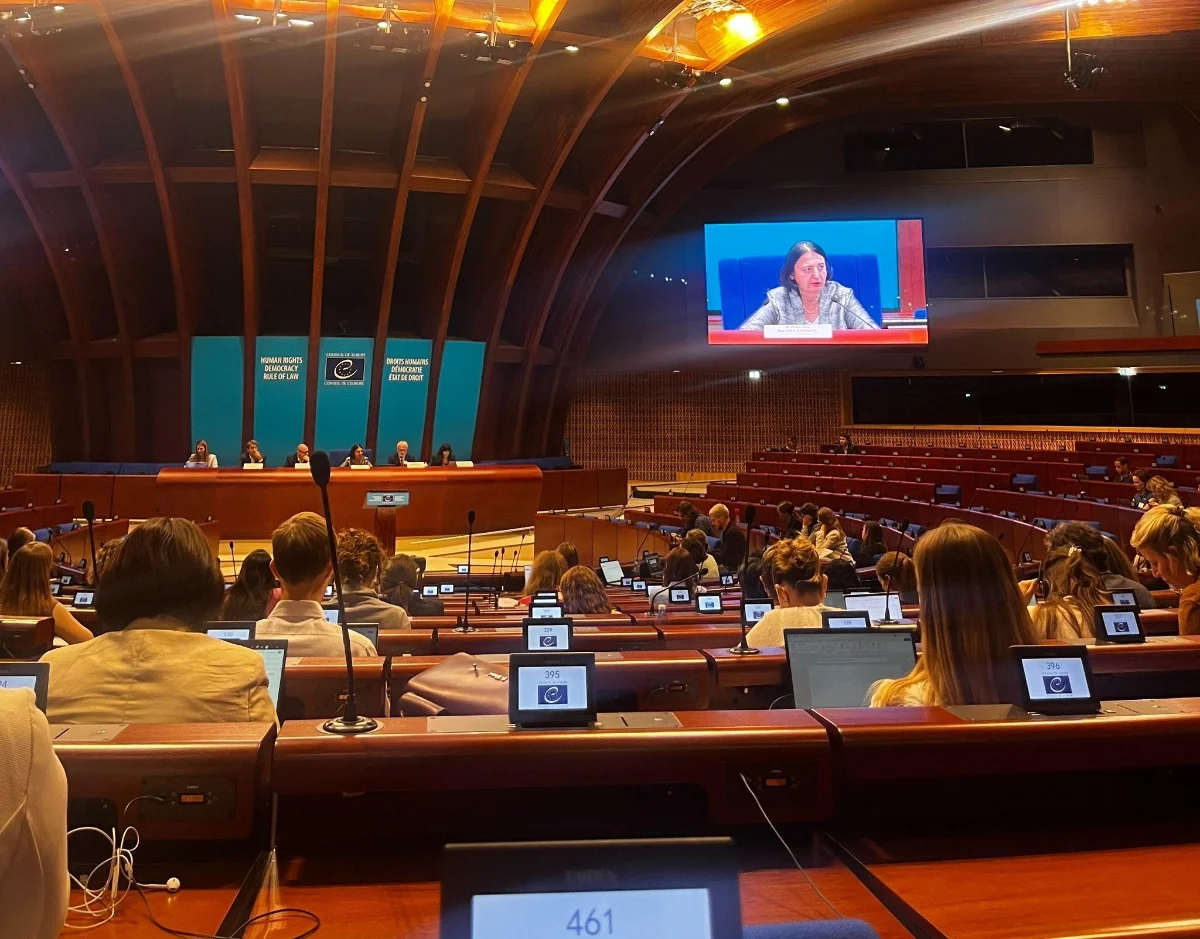
The panel brought together:
- Carolina Rudnick, Libera Foundation against Human Trafficking and Slavery, Chile;
- Robert McCorquodale, UN Working Group on Business and Human Rights;
- Guillaume Schoebel, Senior Vice President, Country President Community, Schneider Electric;
- Dr Carsten Stender, German Federal Ministry of Labour and Social Affairs (BMAS);
- Moderator: Katarina Nedeljkovic, Council of Europe.
Civil Society: Converging Crises
Speaking from a civil society perspective, Carolina Rudnick argued that ecocide and forced labor should not be treated as separate problems. The two, she explained, are bound up in the same underlying issue, and addressing one without the other leaves the root cause untouched. She linked this convergence to a broader political trend, pointing to the rise of radical authoritarian movements as a force reshaping the space in which both environmental destruction and labor exploitation take place.
A Changed Landscape for Business
Robert McCorquodale traced how far the field has moved. Business, he noted, once kept its distance from human rights entirely; today, government, business, and civil society operate in the same space, a shift he has observed directly through his legal work on cases spanning Western Europe and beyond. Drawing on a report he authored on how artificial intelligence affects ordinary businesses, McCorquodale observed that while a growing number of countries have passed laws targeting specific harms such as modern slavery, no single law can serve as a solution to human rights concerns as a whole. He underlined that corporate responsibility for human rights is now an accepted premise, a claim that would have been startling thirty years ago, and argued that the real task ahead is embedding human rights due diligence into ordinary corporate practice rather than treating it as a compliance exercise layered on top.
This point drew responses from both sides of the table. Guillaume Schoebel, representing Schneider Electric and its 160,000 employees, spoke to how a company of that scale approaches the task of translating due diligence commitments into practice. Dr Carsten Stender, speaking for the German Federal Ministry of Labour and Social Affairs (BMAS), situated the discussion within the regulatory efforts national governments are undertaking to push companies in the same direction.
Conclusion
The Opening Plenary framed the questions that would run through the rest of the Forum: how converging crises like ecocide and forced labor should be understood together, how far corporate responsibility for human rights has already travelled, and how much further it still needs to go before due diligence is a genuine part of how businesses operate, rather than a response to legal pressure.