
29 October 2026 | The Hague
Júlia Peña, EU Team, Global Human Rights Defence.
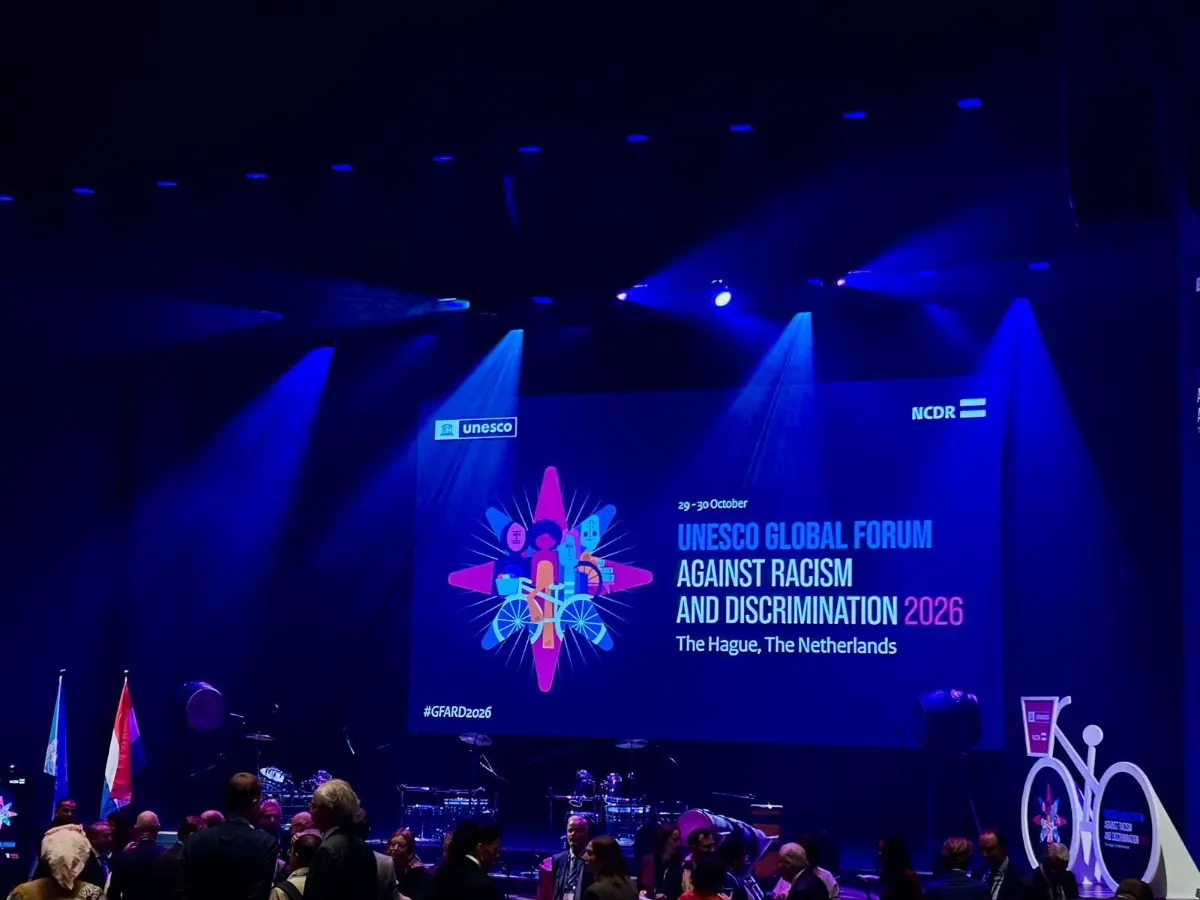
On October 29th, Global Human Rights Defence (GHRD) attended the first day of the Global Forum Against Racism and Discrimination of the United Nations Educational, Scientific and Cultural Organization (UNESCO), held under the theme “From Commitment to Accountability”. The programme opened with a percussion concert welcoming King Willem-Alexander and Prime Minister Rob Jetten, before speakers called on governments and institutions to confront racism together, act on their responsibilities, and turn equality from an aspiration into a reality.
Racism as a System People Can Change
Rabin Baldewsingh (National Coordinator Against Discrimination and Racism) opened his speech by stating, “racism and discrimination are challenges we must confront together”. He argued that racism and discrimination are embedded in systems, and that humanity therefore has the power to change them: “equality cannot remain an aspiration, it must become a reality”. The urgency is clear, as despite decades of international declarations and conventions, the United Nations reports that one in five people experience discrimination in their daily lives.
Åsa Regnér (UNESCO Deputy Director-General) stressed that hatred itself is learned and can therefore be unlearned. In the European Union, 45 per cent of people of African descent have experienced racism and discrimination, with women disproportionately affected. She identified three key areas for action: education, policy, and digital governance, with particular attention to the ethics of artificial intelligence. “International cooperation is essential to transform our commitment into lasting change”, she stated.
Prime Minister Rob Jetten highlighted the situation in the Netherlands, noting that 1.6 million people in the Netherlands experience racism and discrimination in their daily lives. Referring to colonialism, he said that the Dutch apology marked not a full stop, but a comma. “I refuse to see these times as unavoidable“, he added, stressing the importance of education in countering populist narratives.
From Naming Racism to Enforcing Rights
Hadja Lahbib (European Commissioner for Equality) described racism as a system that is still being perpetuated, not a relic of the past, and said it closes doors for many people worldwide. She outlined four priority areas: developing a clear definition of structural racism, addressing racism through education, enforcement of rights, and strengthening civil society. On enforcement she was direct: “A right that cannot be enforced is not a right”. She also stressed the importance of the digital world, highlighting its harmful role in proliferation of hate speech, and the need for more regulations.
Kimberlé Crenshaw (American civil rights advocate and a legal scholar) linked war to doctrines of inequality and racism and underlined the importance of free arts and media, in reference to ongoing book bans in the United States. She urged participants to unmask the background conditions that lead to discrimination: “Before we change the system we have to be willing to see it”. A conversation between Gustavo Merino and Viola Davis echoed this point, arguing that societies cannot progress if they do not face their problems.
Plenary Debates: Local Realities and Shared Priorities
The first plenary asked whether existing systems treat everyone equally, with panellists noting that wanting change is one thing and making it happen is another. They stressed that racism and discrimination are not the same thing and that responses must differ between nations, as discrimination also stems from socio-economic situations and physical abilities. Gregory Rusland (Vice-President of Suriname), identified three key actions: education, transparency and follow-up. Panellists also called for racism and gender equality to be discussed together, and the debate kept returning to education as the way to battle ignorance with awareness.
The second plenary warned that the number of people living in fully-fledged democracies is rapidly decreasing, alongside deeper divisions along racial and religious lines and growing support for authoritarianism and racism. Panellists stressed the importance of collecting racial data, and identified new forms of racism marked by violence and a regime of fear. They described racism today as an issue of fear and suggested implementation, a universal approach and stronger multiculturalism as responses.
The third plenary focused on cities and first-level governmental divisions. Municipalities have the strongest ties with citizens, panellists argued, and therefore play a crucial role in protecting those vulnerable to discrimination. Bally Bagayoko (Mayor of Saint-Denis, France) said cities have a responsibility to protect and show solidarity, naming education, the social fabric and socio-economic situations as priorities, and called for working with the media against propaganda and hate speech. Mis- and disinformation were widely identified as drivers of racism and populist discourse.
Recommendations
Across the day, speakers and panellists called on governments, institutions and cities to strengthen education on racism and discrimination, the theme to which every debate returned. They urged decision-makers to develop a clear definition of structural racism, enforce existing rights, collect racial data and ensure transparency and follow-up. They also called to address digital governance, including the ethics of AI, efforts to counter misinformation and disinformation, the empowerment of municipalities and civil society, the integration of racial and gender equality considerations, and reinforce international cooperation.
Conclusion
The first day of the forum reinforced a central message: declarations are not enough. Education, enforceable rights, reliable data, responsible digital governance and strong local action were presented as the means to turn commitment into accountability.
In case of questions or comments, you can contact eu@ghrd.org.