
5 November 2026 | The Hague, Netherlands
Dennis Slobbe, Lobbying, Network and Collaboration Team, Global Human Rights Defence.
On 15 October 2026, Global Human Rights Defence hosted its sixth annual human rights film festival. This year’s aim was to raise awareness of human trafficking, a form of modern slavery, to encourage meaningful discussions on how prevention and protection mechanisms can be strengthened, and to establish new, strong partnerships.
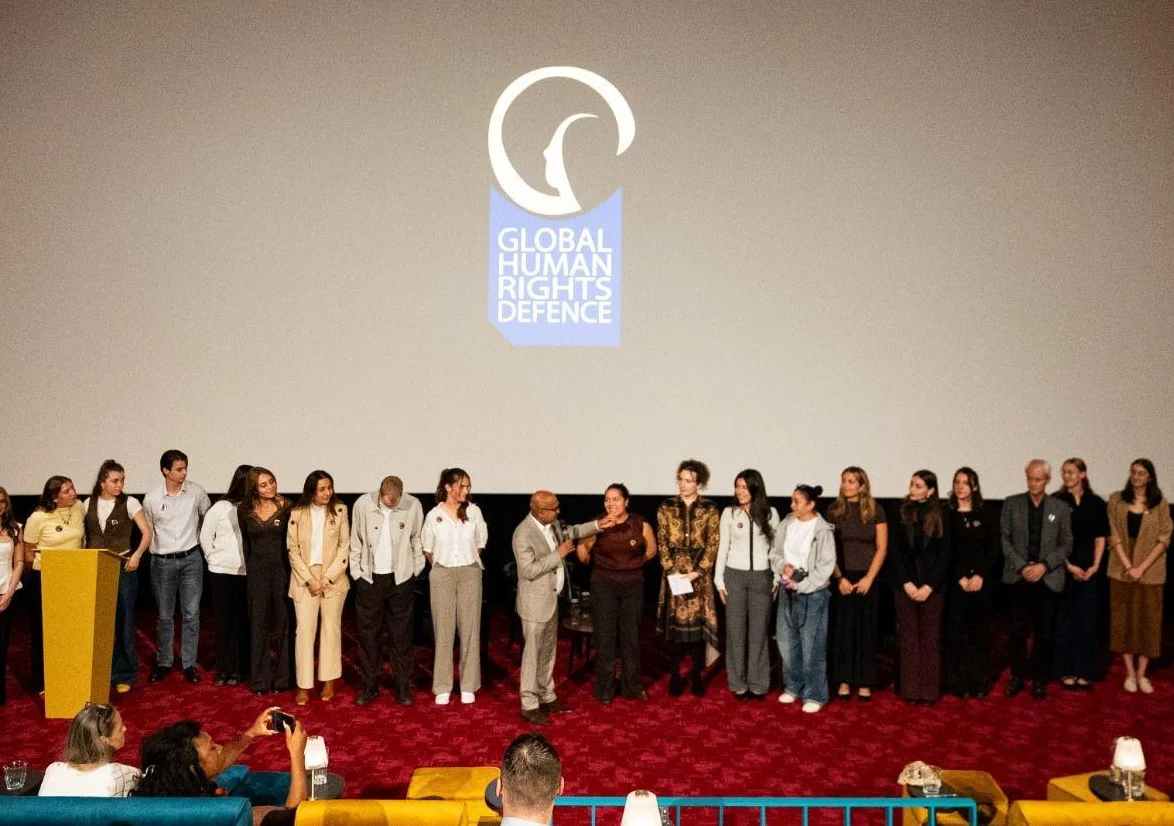
A total of 228 people attended the festival, including numerous embassy representatives from countries including Armenia, Belgium, Georgia, and Mexico. Additionally, the event brought together experts by experience, policy-makers, NGOs, academics, and others eager to learn more about the topic of human trafficking. The diversity of expertise fostered a valuable exchange of perspective, ensuring a deeper understanding of human trafficking, the establishment of new connections and collaborations, and the sharing of best practices. This audience, together with expert panellists and incredibly strong documentaries, helped the festival achieve its aim.
Opening the Film Festival
GHRD was honoured to introduce Prof. Dr. Conny Rijken as the keynote speaker. Prof. Rijken is a leading expert in the field of human trafficking, human rights, and globalisation, and the Dutch National Rapporteur on the Trafficking in Human Beings and Sexual Violence Against Children. In her speech, Prof. Rijken defined the notion of human trafficking, highlighted the biggest trafficking-related challenges, placing particular emphasis on victim identification, before emphasising the importance of the event and providing key takeaways applicable to everyone in the audience.
Following this meaningful and thought-provoking keynote speech, four documentaries were screened. ‘The New Slavery’ directed by Mariona Bassa Camps and Cari Pardo Luzzy, provides a shocking look at the abuse and labour exploitation suffered by many immigrants in Spain, highlighting that these practices often remain invisible.
‘Familial Trafficking’, a film by Joanna Friedman that interviews experts by experience who share stories of having been trafficked by family members during their childhood. ‘Thailand’s Seafood Slaves’ produced by Environmental Justice Foundation, documents situations of slavery, murder, and other serious crimes in Thailand’s seafood sector. Finally, GHRD presented its own documentary called ‘The Pattern’, directed by Rinku Kalsy. This documentary investigates the mechanisms that enable human exploitation, and why these practices still persist despite centuries of so-called reform. All the documentaries were selected based on a rigorous review process by internal and external jury members, including Hanneke de Jonge, Melliena Beckmann, alongside Chloé Roegiers Mayeux, Amber Hombroux, and Wieke van der Kroef from Payoke.
First Panel Discussion
The first round of films was followed by a panel discussion featuring three panellists: Andreas Kleiser, Director for Policy and Cooperation at the International Commission on Missing Persons (ICMP); Nikky Guzman, organiser with Migrante Netherlands; and Esther Ehlting, Public Speaker & Coach, and Human Trafficking Specialist. This panel addressed several forms of exploitation and the challenges associated with identifying and protecting vulnerable individuals. Sexual exploitation was examined in terms of the difficulties to recognise potential victims. Labour exploitation was also discussed, specifically the difficulties experienced by victims when they do not receive the working permits they are waiting for, while their passports are withheld by the perpetrators. Irregular migration was also addressed, which takes place in clandestine circumstances, highlighting the lack of funding and attention that amplify the complexity of finding solutions to this issue.
Second Panel Discussion
The second round of documentaries featured ‘Sex Trafficking in America’, directed by Jezza Neumann, which explores the experiences of young women coerced into prostitution and follows a police unit dedicated to combating sexual exploitation. ‘City of Ghosts’, directed by Elle Ginter and Christian Elliot, tells the story of two men who experience labour exploitation after being lured abroad in an attempt to provide for their families. Finally, ‘This Adventure Called California’, a documentary directed by Jennifer Huang, follows Arnoldo, who tries to rebuild his life and reconnect with his family after being trafficked and surviving the harsh conditions of forced labour.
These screenings were followed by a second panel discussion featuring filmmaker Jennifer Huang; Jill Coster van Voorhout, Project Director and Principal Investigator of Combatting Crime (ComCrim); Fatimazhra Belhirch, Member of the House of Representatives of the Netherlands for D66; and Edith-Bernadette Poot, psychosocial counsellor and human trafficking specialist. This group of panellists engaged in a meaningful discussion, covering topics such as aftercare for victims, which is often vastly underestimated; the issue of impunity, since it is hard to prove the exploitation of the victims; and the growing vulnerability of individuals due to an increasingly digitalised world.
The concluding remarks were made by Fatimazhra Belhirch, who underlined once again that human trafficking could be seen as a form of modern slavery, and that it is essential for everyone to see what they can do to combat human trafficking, which starts by paying attention to your own environment. Besides this, she emphasised that the work of civil society is of major importance, and that researchers, law enforcement, NGOs, and victims should all work together to raise awareness about what is really happening.
Fostering cooperation
The sixth edition of GHRD’s film festival concluded with a networking event, where the attendees of the film festival were able to engage in conversations with one another. This facilitated in-depth reflection on the topic of human trafficking and created a pathway for policy-makers, experts by experience, academics, and NGOs to exchange best practices and establish new partnerships. Due to the networking event, GHRD reinforced the festival’s objectives of raising awareness, to initiate further discussions between different stakeholders, and to encourage attendees to strengthen cooperation, all with the goal to combat human trafficking.
Next year’s edition
After the success of the sixth edition of the GHRD’s film festival, the next edition will take place in October 2027. The seventh edition will focus on how climate change affects people’s and communities’ ability to enjoy their rights and freedoms, and how its effects can be mitigated.