
From Territorial Crisis to Humanitarian Displacement
1.1 Historical Background: Post-Soviet Disputes and International Mediation
Historically, the Nagorno-Karabakh Autonomous Oblast (NKAO) was established within the Azerbaijani Soviet Socialist Republic on July 7th, 1923 (Paylan, 2025). Despite the majority of ethnic Armenians living in the territory, Baku has historically aimed towards the forced cessation of Nagorno-Karabakh’s existence, representing a systematic campaign to empty the territory of its ethnic Armenian population (de Werd et al., 2023).
With the collapse of the Soviet Union in the late 1980s and the emergence of Armenia and Azerbaijan as independent states in 1991, the conflict evolved into a full-scale war in the Caucasus. After the referendum held in Nagorno-Karabakh on December 10th, 1991, to seek independence and long-term affiliation with Armenia, the First Nagorno-Karabakh War broke out, leaving 350,000-700,000 Azerbaijanis displaced from the enclave, while 300,000 Armenians fled from Azerbaijan (International Crisis Group, 2022). By the time of the Russian-sponsored ceasefire in 1994, thousands of Azerbaijani civilians were killed, and approximately half a million were forcibly displaced (Amnesty International, 2022).
Establishing the territory as de facto independent, with the mediation of the OSCE Minsk Group (comprising the United States, France, and Russia), was an attempt to reach a long-term peace resolution. However, after Azerbaijan’s large-scale offensive to reclaim the territories in 2020 and the concession of several parts of Nagorno-Karabakh, Baku recently launched a military operation to seize the whole territory (Paylan, 2025). As some experts mention, the recourse to violence by the Azerbaijan military forces and the blockade of the Lachin Corridor in 2022, essential for connecting Armenia with the disputed territory, resulted in shortages and starvation conditions for the civilian population.
Throughout the various phases of the conflict from 2020 onwards, extrajudicial executions and other abuses against civilians were documented, leaving more than 6,000 people dead and 90,000 displaced (United Nations High Commissioner for Refugees, 2021; Amnesty International, 2022).
1.2 Systemic Reproduction of Human Rights Violations in Nagorno-Karabakh
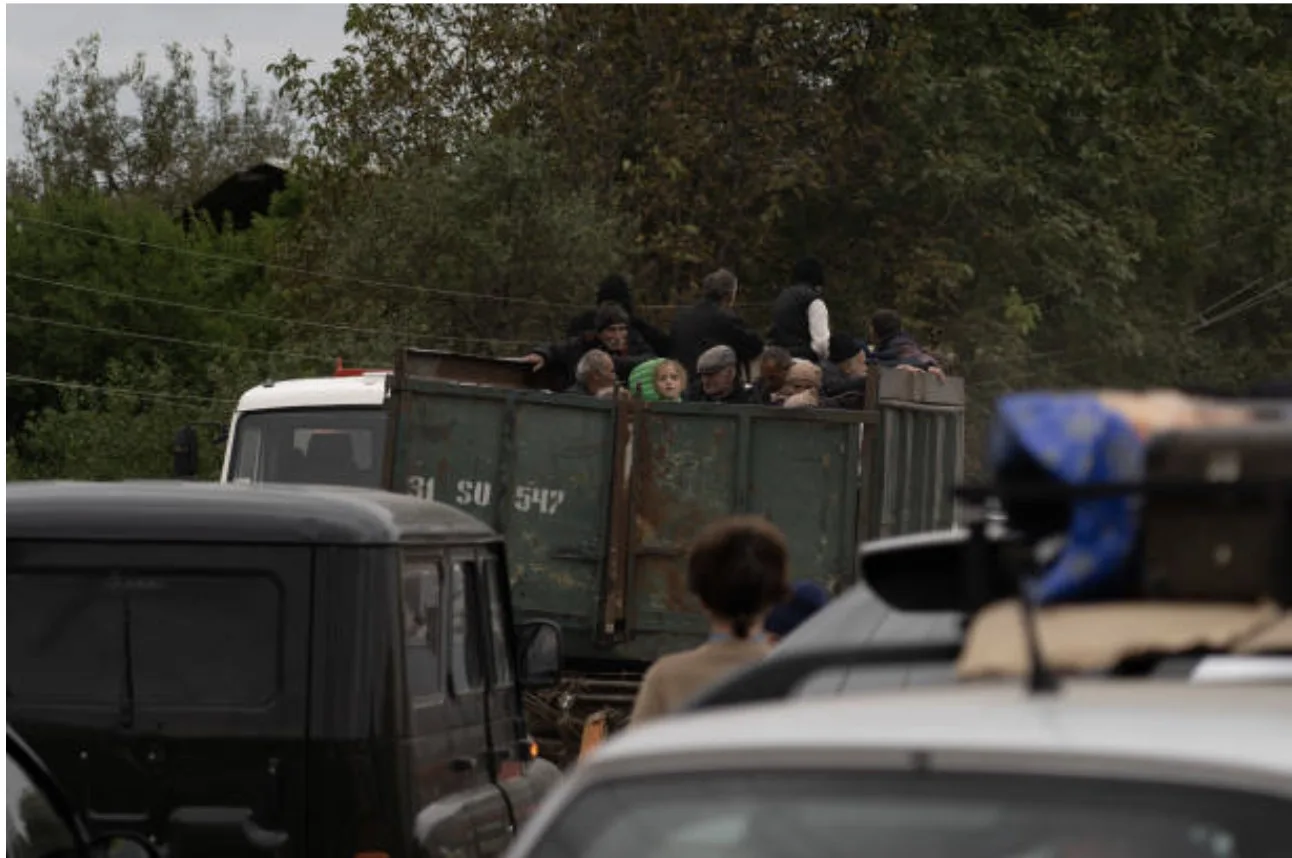
Since September 19th, 2023, more than 100,000 Armenians have fled Nagorno-Karabakh, representing nearly the entire population of the area (Human Rights Watch, 2023). Severe breaches of international law have led to a disregard for human rights, including the use of force to annex disputed territory. As Amnesty International (2020) confirms, both Azerbaijani and Armenian forces committed war crimes against opponents. Denis Krivosheev, Amnesty International’s Research Director for Eastern Europe and Central Asia, described the recent ethnic disputes as follows: “[t]he depravity and lack of humanity […] shows the deliberate intention to cause ultimate harm and humiliation to victims, in clear violation of international humanitarian law”.
During Azerbaijan’s takeover of Nagorno-Karabakh, many of the actions carried out by the military, such as torture, mutilation of dead bodies, and attacks on the civilian population, have been described as war crimes and, as some experts deem, as genocide (Paylan, 2025). Although the Azerbaijani President, Ilham Aliyev (2023), reaffirmed the forced dissolution of the region, Nagorno-Karabakh still represents the struggle for self-determination by the ethnic Armenian population and the continuous abuses of fundamental human rights in the South Caucasus.
Geopolitical Complicity and Identity Preservation Failures
2.1 International Law Deterioration and Regional Power Dynamics
The international community’s response to the Nagorno-Karabakh crisis reveals several inconsistencies in the application of international humanitarian law and the principle of self-determination, as enshrined in Article 1(2) of the UN Charter. In response to the prioritisation of territorial claims over human rights compliance, the UN Security Council (UNSC) passed four resolutions regarding the Nagorno-Karabakh conflict in 1993, in response to Baku’s further displacement of civilians (Paylan, 2025). However, despite the clear provisional measures of the International Court of Justice (ICJ) concerning the blockade of the Lachin corridor, Azerbaijan’s non-compliance and subsequent inaction by the international community demonstrated the deterioration of judicial mechanisms when confronted with geopolitical realities.
For years, as documented by de Werd et al. (2023), the 2020 Nagorno-Karabakh War has established new regional dynamics, driven by the geopolitical aspirations of several external actors. For example, Türkiye’s close ties with Azerbaijan remain central for its political and economic relevance in Central Asia, where it competes with other actors such as Iran and Russia, notwithstanding the historical implications of Ankara’s denial of the Armenian genocide in 1915-1916 (International Crisis Group, 2022). Meanwhile, Russia has consolidated its role as a mediator between Armenia and Azerbaijan over the decades, as confirmed by the establishment of a monitoring headquarters with Türkiye in Azerbaijan and the presence of peacekeeping forces (de Werd et al., 2023).
The country’s support as the leading supplier of arms and munitions for Armenia enabled it to maintain an equal footing with Azerbaijan and rely on Russia in the event of an armed attack against its territory (de Werd et al., 2023). However, contrary to Russia’s strategy for normalising Armenian-Azerbaijani relations through low-politics agreements and economic re-engagement, Baku-Moscow relations deteriorated significantly due to competing interests and Western alignment (Hosaka, 2025). Russia’s prioritisation of the Ukraine war, combined with Western reluctance to challenge Azerbaijan’s actions effectively, facilitated the abandonment of the Armenian population and systematically enabled their ethnic cleansing (International Crisis Group, 2022).
Russia’s disengagement with Azerbaijan and the recent increased disregard for democratic values and human rights in the United States have expanded the latter’s influence over the region. Trump’s “Agreement on Peace and Establishment of Interstate Relations”, signed on August 8th, 2025, has been described as a milestone for regional peace and stability (Hosaka, 2025). While this agreement may represent a geopolitical shift towards diplomatic normalisation, it failed to address the inadequate enforcement mechanisms that enabled the ethnic cleansing in Nagorno-Karabakh. Beyond US operations, the EU’s engagement in the region further underscores the region’s vital geopolitical significance, where the Middle Corridor (Trans-Caspian International Transport Route) presents a strategic alternative to traditional Russian-dominated supply chains (Pkhaladze, 2025). In this context, the European Union’s diplomatic efforts, including EU-hosted discussions to facilitate border conversations between states and the deployment of the EU mission in Armenia (EUMA), resulted in an operational, albeit limited, impact in preventing the displacement of the Armenian population.
2.2 Cultural and Ethnic Cleansing: The Destruction of Armenian Identity
In a report released in June 2023, the Caucus Heritage Watch documented the partial damage and destruction of 98 per cent of the ethnic Armenian cultural heritage sites in Shusha and the territories surrounding Nagorno-Karabakh (Smith et al., 2023). The demolition of historic churches, cemeteries and other centuries-old cultural properties to build military installations has been an essential state policy in Azerbaijan’s mission to rewrite South Caucasus regional history. These destruction patterns clash with the few Azerbaijani heritage sites that were erased under Armenian control (1994-2020) following the First Nagorno-Karabakh War, caused primarily due to collateral damage by mining (Ghulyan et al., 2023).
However, Baku’s invocation of “Western Azerbaijan” to deny the historical realities of authocthonous Armenians in Nagorno-Karabakh remains, as the European Parliament (2022) condemned in a resolution, “a wider pattern of a systematic, state-level policy of Armenophobia, historical revisionism and hatred towards Armenians promoted by the Azerbaijani authorities.” (University Network for Human Rights, 2023). This cultural dimension of ethnic cleansing, often overlooked in political analysis, represents a violation of international cultural rights standards. According to the UNHCR, similar happenings, such as the Turkish invasion of Cyprus in 1974, resulted in the destruction and abandonment of over five hundred churches and monasteries, as well as several museums and archaeological sites (Ghulyan et al., 2023). The labelling of an enemy “Other”, represented by the ethnic Armenian population in the disputed regions, enables the replacement of Armenian heritage with Azerbaijani cultural restoration, threatening the complete elimination of Nagorno-Karabakh’s regional patrimony.
Integration Realities and Rights-based Mechanisms
3.1 European Union’s Protection Frameworks and Transitional Justice
In the context of forced displacement dynamics and historical revisionism, the European Union has actively participated in efforts to promote a comprehensive conflict settlement, particularly through the “European Neighbourhood Policy” (ENP), the “Eastern Partnership Policy beyond 2030,” and other instruments (Panahova, 2024). With the diminished credibility of the OSCE Minsk Group as a mediator, a new legal framework for EU-Armenia relations, the Comprehensive and Enhanced Partnership Agreement (CEPA), was established to reinforce institutional structures for political cooperation. As part of the 2021-2027 road map for EU engagement, the EU has also encouraged a bottom-up approach to Armenia’s democratisation and has strengthened “good governance” principles, reforming law enforcement and protecting human rights by increasing trust in Civil Society Organisations (CSOs) and public institutions (Delcour & Ghazaryan, 2024).
Similarly, the EU Mission in Armenia (EUMA), launched in 2023, has contributed to greater human security in conflict-affected areas. However, support for democracy has remained partially disconnected from the region’s broader socio-economic context, as the EU’s engagement through conditionality mechanisms has undermined Armenia’s reforms of law enforcement and electoral democracy (Demoulin & Gressel, 2023). In this regard, the European Union’s policy response has failed to address the systematic nature of the ethnic cleansing and provide support for long-term integration needs.
To this end, transitional justice, as outlined by the UN Special Rapporteur on the promotion of truth, justice, reparation and guarantees for non-recurrence, remains essential for establishing reconciliation mechanisms (Office of the United Nations High Commissioner for Human Rights, 2023). It links accountability to reparative social and economic integration, as well as addressing legacies of large-scale human rights violations within post-conflict societies. Throughout the conflict, there has been continuous misapplication of international law. The failure to adopt a human rights-based approach in addressing the Nagorno-Karabakh conflict has contributed to the perpetuation of sovereignty and territorial integrity claims over human rights considerations (Paylan, 2025).
3.2 Reconciliation, Accountability, and Ethnic Preservation
Effective integration policies must be grounded in human rights principles that recognise displaced individuals as rights-holders rather than passive recipients of international assistance. The European Parliament has recently emphasised the importance of respecting minority rights, including historical and cultural heritage, as a prerequisite for establishing conditions for post-war rehabilitation and reconciliation between the two countries (European Parliament, 2022).
The South Caucasus remains essential for the EU’s gradual energy diversification strategy, and as Pkhaladze (2025) confirms, one that safeguards EU strategic necessities while keeping regional actors committed to transparency, human rights accountability, and stability. However, as mentioned earlier, the increasing complexity of the geopolitical environment between the leading global actors presents a significant challenge for the delivery of effective humanitarian action by CSOs and peacekeeping operations in protecting the civilian population (Amnesty International, 2022; Pkhaladze, 2025). In this sense, immediate action by the EU and the international community requires the provision of financial resources, technical expertise, and institutional support for long-term integration of displaced Nagorno-Karabakh Armenians, including, among others:
- Regional Stability and Social Support: Immediate regularisation of legal status for all displaced individuals. As Amnesty International (2022) concludes, improving outreach to displaced people through social workers’ networks and CSOs is essential, ensuring the creation of programs for reconstructing civilian infrastructure and creating conditions for the dignified return of displaced ethnic Armenians.
- Long-term Cultural Preservation: Balance of the principles of territorial integrity and self-determination to protect the rights of minorities against dominant geopolitical agendas. Likewise, establish the foundations for a sustainable peace based on effective communication and the memorialisation of regional legacy (Crisis Group, 2022; Ghulyan et al., 2023).
- Legal Accountability and Prevention Mechanisms: Implementation of transitional justice mechanisms that document violations of human rights. Similarly, support for the International Criminal Court investigations into crimes against humanity and the revision of the international humanitarian legal framework, preventing the ethnic cleansing of Nagorno-Karabakh ethnic minorities (United Nations, 2023; University Network for Human Rights, 2023; Paylan, 2025).
Conclusion
Armenia’s political transformation underwent a major shock on September 19th, 2023, with Azerbaijan’s takeover of Nagorno-Karabakh, resulting in the displacement and violations of human rights of the ethnic Armenian population. The increasing societal polarisation exposed the international community’s incapacity to address the humanitarian situation provoked by the misapplication of international law (Paylan, 2025). This crisis revealed significant failures in prevention mechanisms, adoption of a human rights-based approach, and international accountability that have enabled an institutional campaign of ethnic cleansing in the annexed territories.
The violence that Azerbaijani forces have conducted against local Armenians has been described as a wider pattern of a systematic, state-level policy of Armenophobia, holding no regard for the lives or fundamental human rights of the Armenian population (University Network for Human Rights, 2023). In this context, both the EU’s and the international community’s response to this humanitarian crisis has been limited, with the establishment of new cooperation strategies aimed at comprehensive integration support for local minorities. However, as mentioned above, the absence of transitional justice provisions that guarantee minority rights and prevent future displacement contributes to the elimination of ethnic cleansing through international tolerance. Failure to develop a more inclusive legal framework threatens to undermine Armenia’s human capital, cultural diversity, and historical legacy, setting a serious precedent for the protection of minorities worldwide and undermining the credibility of international human rights frameworks.
Bibliography
Aliyev, I. [@IlhamAliyev]. (2023, October 17). The subject of the Karabakh conflict is closed once and for all! [Video attached] [Post]. X. https://x.com/presidentaz/status/1714323834134773774
Amnesty International. (2020, December 10). Armenia/Azerbaijan: Decapitation and war crimes in gruesome videos must be urgently investigated [Press release]. https://www.amnesty.org/en/latest/press-release/2020/12/armenia-azerbaijan-decapitation-and-war-crimes-in-gruesome-videos-must-be-urgently-investigated/
Amnesty International. (2022). Last to flee (EUR 54/5214/2022). https://www.amnesty-international.be/sites/default/files/bijlagen/last-to-flee.pdf
Amnesty International. (2025). The state of the world’s human rights (POL 10/8515/2025). https://www.amnesty.org.pl/wp-content/uploads/2025/04/Amnesty-International-Report-2024-25.pdf
Delcour, L., & Ghazaryan, N. (2024, January 23). Armenia’s fragile democratisation: A new role for the EU? European Democracy Hub. https://europeandemocracyhub.epd.eu/armenias-fragile-democratisation-a-new-role-for-the-eu/
de Werd, P., de Jong, M., & Bouwmeester, H. (2023). 2020 Nagorno-Karabakh War: A case of triple D: Diplomacy, Drones and Deception. In P. B. M. J. Pijpers, M. Voskuijl, & R. J. M. Beeres (Eds.), Towards a data-driven military: A multidisciplinary perspective (pp. 303–332). Leiden University Press. http://www.jstor.org/stable/jj.14250136.20
Dumoulin, M., & Gressel, G. (2023, November 24). After Nagorno-Karabakh: How Europeans can strengthen Armenia’s resilience. European Council on Foreign Relations. https://ecfr.eu/article/after-nagorno-karabakh-how-europeans-can-strengthen-armenias-resilience/
European Parliament. (2022). Join motion for a resolution on the destruction of cultural heritage in Nagorno-Karabakh (2022/2582(RSP)). https://www.europarl.europa.eu/doceo/document/RC-9-2022-0146_EN.pdf
Ghulyan, H., Khatchadourian, L., Smith, A. T., & Lindsay, I. (2023). CHW Special Report #2: Between the wars: A satellite investigation of the treatment of Azerbaijani cultural heritage in the unrecognized Republic of Nagorno-Karabakh, 1994-2020. Caucasus Heritage Watch. https://caucasusheritage.cornell.edu/wp-content/uploads/2023/04/CHW_SpecialReport2B.pdf
Hosaka, S. (2025). Trump-brokered Azerbaijan-Armenia Deal: Breakthrough or another geopolitical conundrum? International Centre for Defence and Security (ICDS). http://www.jstor.org/stable/resrep71882
Human Rights Watch. (2023, October 5). Guarantee right to return to Nagorno-Karabakh. https://www.hrw.org/news/2023/10/05/guarantee-right-return-nagorno-karabakh
International Crisis Group. (2022). Nagorno-Karabakh: Seeking a path to peace in the Ukraine war’s shadow. International Crisis Group. http://www.jstor.org/stable/resrep40592
Office of the United Nations High Commissioner for Human Rights. (2023, November 24). Armenia: Transitional justice measures key to addressing legacy of human rights violations says UN expert [Press release]. https://www.ohchr.org/en/press-releases/2023/11/armenia-transitional-justice-measures-key-addressing-legacy-human-rights
Panahova, L. (2024). Recognition of the EU’s Actorness in the Karabakh Peace Process by Azerbaijan. Problems of Post-Communism, 72(2), 188–197. https://doi.org/10.1080/10758216.2024.2380329
Paylan, S. (2025). Legitimization of violence and state dissolution in Nagorno-Karabakh: A Critical Legal Analysis. In J. Grzybowski, G. P. Oltramonti, & A. Verdebout (Eds.), Contested states in war and law (1st, First Edition ed., pp. 105–126). Bristol University Press. https://doi.org/10.2307/jj.25941162.10
Pkahaladze, T. (2025). Navigating geopolitical realities: The EU’s strategic positioning in the South Caucasus and Central Asia. European Centre for International Political Economy (ECIPE). https://ecipe.org/wp-content/uploads/2025/04/ECI_25_PolicyBrief_10-2025_LY01.pdf
Smith, A. T., Ghulyan, H., Khatchadourian, L., & Lindsay, I. (2023b). CHW Nagorno-Karabakh Monitoring Report #5. Caucasus Heritage Watch. https://caucasusheritage.cornell.edu/wp-content/uploads/2023/06/CHW-Report-2023-05.pdf
United Nations High Commissioner for Refugees (UNHCR). (2021). Armenia. https://www.unhcr.org/am/wp-content/uploads/sites/123/2022/02/UNHCR-Armenia-Operational-Update-July-September-2021.pdf
University Network for Human Rights. (2023). Submission to the United Nations Special Adviser on the Prevention of Genocide: Risk of ethnic cleansing and possible genocide in Nagorno-Karabakh. https://www.humanrightsnetwork.org/publications/nk-genocide-osapg