
Human rights defenders and political analysts met today, in the climate of the Human Rights Council, in Geneva. They focused on the human rights situation in Balochistan and other regions in Pakistan. The conference, organized by the Baloch National Movement, highlighted the history of the region and the recent rise in violence.
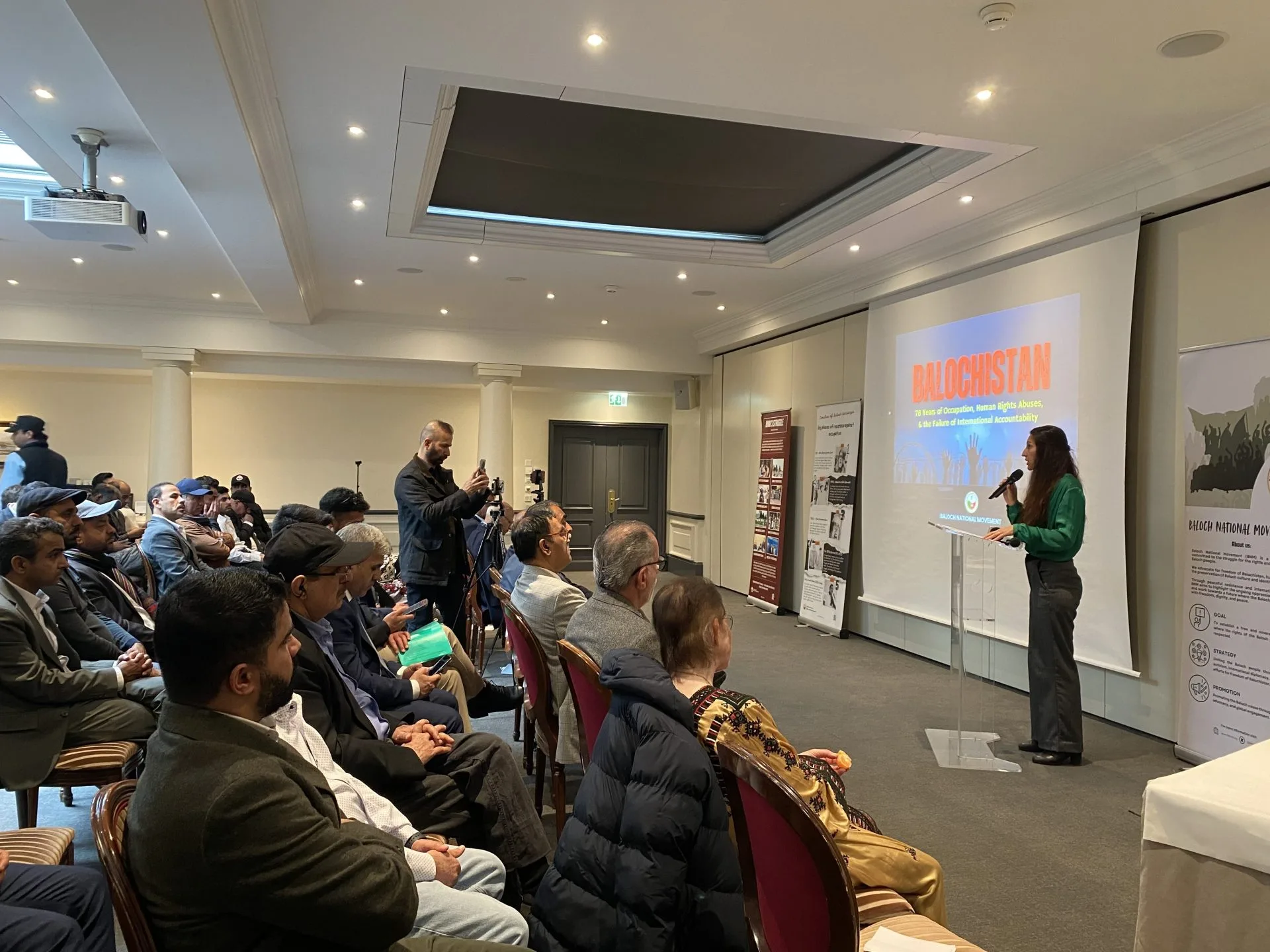
Sherbaz Khan, a political activist from Gilgit Baltistan, opened the session with an overview of the challenges facing the Baloch people. He was followed by Hatim Baloch, a coordinator at PAANK BNM who reported a sharp rise in state pressure. His data shows that March 2026 has already seen 228 reported cases of enforced disappearances. He also noted 81 extrajudicial killings. He said that families and schools are increasingly being targeted. He highlighted that women, children, families, and schools are increasingly being targeted by Pakistani state agencies.
Ana Lorena, a member of the UN Working Group on Enforced or Involuntary Disappearances (WGEID) and human rights lawyer, participated in the event and confirmed that documentation of arbitrary arrests, enforced disappearances, misuse of administrative measures, and further violations had been formally submitted to the Pakistani government, jointly signed by seven UN special procedures in February 2025. She underscored a troubling escalation of these crimes against the Baloch community and flagged severe obstacles faced by families seeking justice, including internet shutdowns, geographic isolation, and intimidation by intelligence agencies operating without warrants.
Dr. Naseem Baloch, Chairman of the BNM and a survivor of torture, recalled Balochistan’s history prior to its occupation in 1948 and described repeated waves of military repression in 1948, 1962, 1973, and the 2000s, each marked by mass arrests and intensified human rights violations. He urged the United Nations to deploy an investigative mission to the region, emphasizing the prolonged regimes of terror and warning that international silence only deepens impunity.
Mercè Monje, Secretary General of the Unrepresented Nations and Peoples Organization (UNPO), condemned what she characterized as a state-sponsored campaign of “enforced invisibility” against the Baloch people. This campaign includes communication blackouts and the weaponization of counter-terrorism laws to detain activists without trial. She also spoke about hope and the importance of having the opportunity to actively decide the future of our communities.
Speakers from allied communities, including Hidayat Bhutto of the World Sindhi Congress and Manzoor Pashteen, head of the Pashtun Tahafuz Movement, expressed solidarity with the Baloch people and condemned the broader pattern of state violence against non-Punjabi ethnic communities in Pakistan. Sardar Akhtar Mengal, president of the Balochistan National Party (BNP), and Dr. Ayesha Siddiqa, Senior Fellow at King’s College London, also contributed to discussions on the militarization of Pakistani politics and its consequences for minority communities.
The event concluded with a unified call for the United Nations to open a formal investigation into human rights abuses in Balochistan, for the international community to hold Pakistan accountable for documented crimes, and for immediate protection of human rights defenders, journalists, and activists facing transnational repression. As journalist and human rights activist Andy Vermaut stated: “When institutions fail, memory becomes resistance. History does not forget the disappeared.”