
Agnieszka T
According to the World Health Organisation, “every individual has the right to decide freely and responsibly – without discrimination, coercion and violence – the number, spacing and timing of their children, and to have the information and means to do so, and the right to attain the highest standard of sexual and reproductive health. Access to legal, safe and comprehensive abortion care, including post-abortion care, is essential for the attainment of the highest possible level of sexual and reproductive health” (WHO, 2021). However, this is not a global reality in 2022.. On Tuesday, the 25th of January 2022, a woman known as Agnieszka T died after being refused a potentially life-saving abortion procedure. Agnieszka was pregnant with twins in her first trimester and was first admitted to the hospital on 21st of December 2021. The first fetus died in utero on December 23rd. Following this, doctors at the hospital quoted the current legislation on performing abortions in Poland and refused to proceed with the adequate medical care needed. The hospital waited to see what would happen to the mother and baby, and, a week later, the heartbeat of the second twin also stopped. Doctors then waited a further two days to terminate the pregnancy on the 31st of December, when both fetuses were dead (Strzyżyńska, 2022). Agnieszka, forced to carry a dead fetus in her womb for over a week, died on the 25th of January 2022. Agnieszka’s death marks the first anniversary of the 2021 ruling that declared abortion due to foetal abnormalities illegal. Abortion can now only be carried out in cases of rape, incest, or if the mother’s life and health are in danger (Kapelańska-Pręgowska, 2021). Agnieszka’s family released a statement on Facebook stating that her husband begged the doctors to save her life, with Agnieszka’s twin sister, Wioletta Paciepnik, adding, “This is proof of the fact that the current government has blood on their hands” (Strzyżyńska, 2022).
Polish Abortion Laws
On the 22nd of October 2020, Poland’s constitutional tribunal implemented one of the most restrictive pieces of abortion legislation in Europe. The Polish Constitutional Court held unconstitutional an exception in the Family Planning Act of 1993 that provided for legal abortion in cases of fetal abnormalities. Julia Przyłębska, Chief Justice, stated that prior to the existing legislation, abortions of fatal foetal abnormalities were “incompatible” with the constitution (Kosc, 2020). The ruling made cases of abortion only legal in the case of rape, incest or a threat to the mother’s health and life, which make up only about 2% of reasons for legal terminations conducted prior to the legislation being introduced in Poland (The Guardian, 2021).
Last September, two months after the constitutional change in a seminal situation, a 30-year-old Polish woman known as Izabela died of septic shock because her doctors did not perform a life-saving abortion in her 22nd week of pregnancy, waiting instead for the foetus to die because of the restrictions (Europarl, 2021). Her family claims she was refused an abortion or caesarean section, and that the hospital cited the country’s abortion laws. An investigation found that “medical malpractice” led to Izabela’s death and the hospital was fined (Europarl, 2021). Soon after, an anonymous man from Świdnica, in south-west Poland, came forward to share that his wife, Ania, died in similar circumstances in June 2021. In the one year since the ruling, it is estimated that 34,000 women in Poland are known to have sought abortions illegally or abroad (Swash, 2021).
Reaction
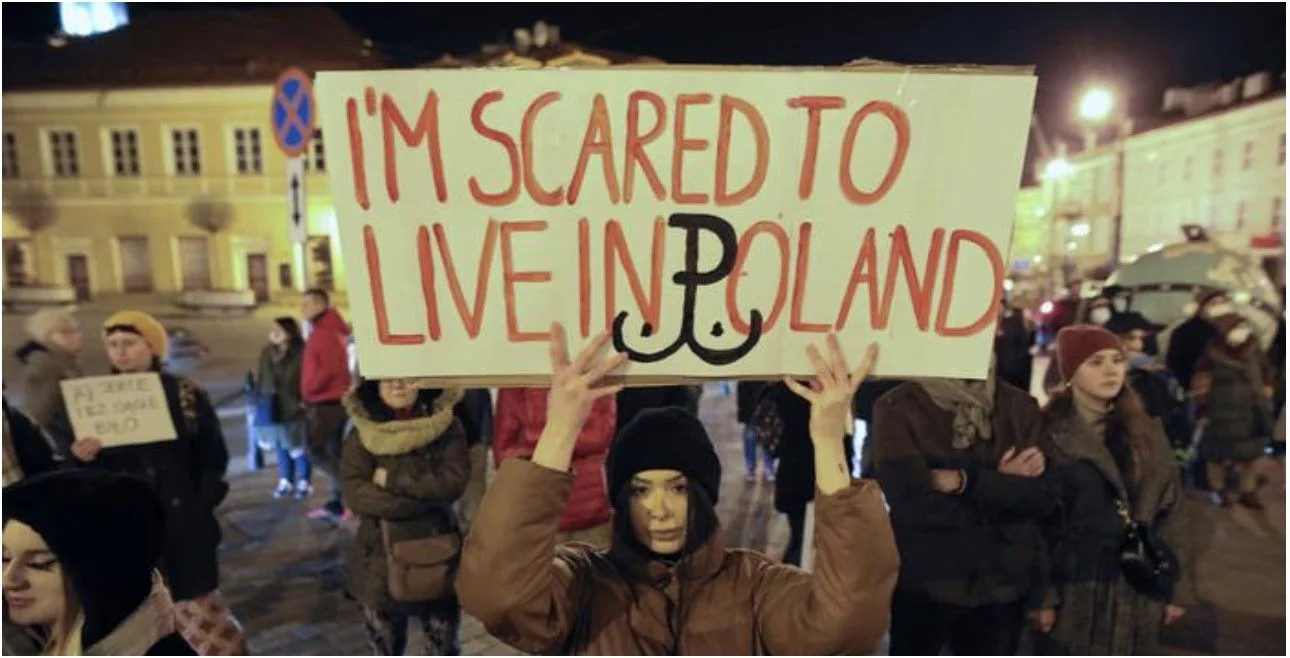
Following Agnieska’s death, people took to the streets of Warsaw, laying wreaths and lanterns. Marta Lempart, who was a key organiser of the protests, explained: “We continue to protest so that no one else will die […] The Polish abortion ban kills. Another person has died because the necessary medical procedure was not carried out on time.” (The Guardian, 2022). The All-Poland Women’s Strike group also released a statement, blaming the death on the 2020 strict anti-abortion verdict. They say it has a chilling effect on doctors, leading to inept medical decisions. “Another victim of the ban on abortion in Poland: 37-year-old Agnieszka of Częstochowa […] We keep shouting #NotOneMore, but the ban on abortion is killing more and more women.” (ABCnews, 2022). The Group has called on people across the country to picket the offices of the Law and Justice party (PiS), who had a key role in implementing the law.
When the law officially changed in 2020, several NGOs and officials spoke out against the restrictive law. Helena Dalli, a Maltese politician serving as European Commissioner for Equality, stated in the European Parliament that “the EU has no competence on abortion rights within a member state and thus, abortion legislation is up to the member states concerned. However, when making use of the competences, member states must respect fundamental rights which bind them by virtue of the constitutions and commitments under international law.” (Euronews, 2021). The Council of Europe Human Rights Commissioner, and a group of UN human rights experts, have also expressed the opinion that the Polish abortion ban goes against its international human rights obligations. (Euronews, 2021). Accompanying this, several NGOs including Amnesty International, Human Rights Watch, and the World Organisation Against Torture issued a joint statement on the law, stating that it has “a devastating impact on women’s lives. The ruling has increased the extreme obstacles faced by women seeking access to abortion and has had tragic consequences for many of them and their families.” (Human Rights Watch, 2022).
Since the ruling took effect in January 2021, more than 1000 women have turned to the European Court of Human Rights to challenge the law. Several of the applicants claim that the Polish abortion law violates their rights to privacy and freedom from torture and other ill-treatment. The Court is expected to begin ruling on some of these cases: K.B. v Poland and 3 other applications, K.C. v Poland and 3 other applications, and A.L.-B. v Poland and 3 other applications (Amnesty International, 2022).
As well as this, nine leading international human rights organisations have filed third-party interventions to the European Court of Human Rights in these cases, including Amnesty International, the Center for Reproductive Rights, Human Rights Watch, the International Commission of Jurists, the International Federation for Human Rights, the International Planned Parenthood Federation European Network, Women Enabled International, Women’s Link Worldwide, and the World Organisation Against Torture. The interventions provide evidence and analysis drawing on international human rights law, comparative European law and guidelines from the World Health Organisation (Amnesty International, 2022).
Prosecutors in Katowice are awaiting the results of three autopsies to determine the cause of death of Agnieszka T., and the deaths of her two foetuses. Even before the law was narrowed, an estimated 200,000 women had terminated their pregnancies illegally or abroad, while fewer than 2,000 legal abortions were performed each year in Poland (Amnesty International, 2022). We have yet to see any significant efforts to remedy the dangerous consequences of this law and no responsibility has been taken by the government, which continues to fully support it.
Sources and further reading:
Reports
World Health Organization (2021). Abortion: Access to safe abortion protects women’s and girls’ health and human rights. Sexual and Reproductive Health and Research. Available at:
https://www.who.int/health-topics/abortion#tab=tab_1
The European Parliament (2021). Poland: no more women should die because of the restrictive law on abortion. Available at:
https://www.europarl.europa.eu/news/en/press-room/20211108IPR16844/poland-no-more-women-should-die-because-of-the-restrictive-law-on-abortion
Human Rights Watch (2022). Regression on Abortion Harms Women in Poland. Available at: https://www.hrw.org/news/2022/01/26/regression-abortion-harms-women-poland
Amnesty International (2022) Poland: Regression on abortion access harms women. Available at: https://www.amnesty.org/en/latest/news/2022/01/poland-regression-on-abortion-access-harms-women/
News Articles
abcNews (2022, January 31). Prosecutors probe pregnant woman’s death in Poland. abcnews. Available at: https://abcnews.go.com/Health/wireStory/prosecutors-probe-pregnant-womans-death-poland-82577939
Euronews (2021, February 25). EU criticises Poland’s abortion ban as it reminds member states to ‘respect fundamental rights’. Available at: https://www.euronews.com/2021/02/24/eu-criticises-poland-s-abortion-ban-as-it-reminds-member-states-to-respect-fundamental-rig
Kosc, W. (2020, October 22). Polish court outlaws almost all abortions. Politico. Available at:
https://www.politico.eu/article/poland-court-outlaws-almost-all-abortion/
Strzyżyńska, W. (2022, January 28). Protests flare across Poland after death of young mother denied an abortion, The Guardian. Available at: https://www.theguardian.com/global-development/2022/jan/27/protests-flare-across-poland-after-death-of-young-mother-denied-an-abortion
Strzyżyńska, W. (2022, January 26). Polish state has ‘blood on its hands’ after death of woman refused an abortion. The Guardian. Available at: https://www.theguardian.com/global-development/2022/jan/26/poland-death-of-woman-refused-abortion
Swash, R. (2021, October 22). More than 30,000 Polish women sought illegal or foreign abortions since law change last year. The Guardian. Available at: https://www.theguardian.com/global-development/2021/oct/22/more-than-30000-polish-women-sought-or-foreign-abortions-since-law-change-last-year
Journal articles
Kapelańska-Pręgowska, J. (2021) The Scales of the European Court of Human Rights: Abortion Restriction in Poland, the European Consensus, and the State’s Margin of Appreciation. HHRJournal, Volume 23/2, pp. 213-224 Available at: https://www.hhrjournal.org/2021/11/the-scales-of-the-european-court-of-human-rights-abortion-restriction-in-poland-the-european-consensus-and-the-states-margin-of-appreciation/