
Introduction
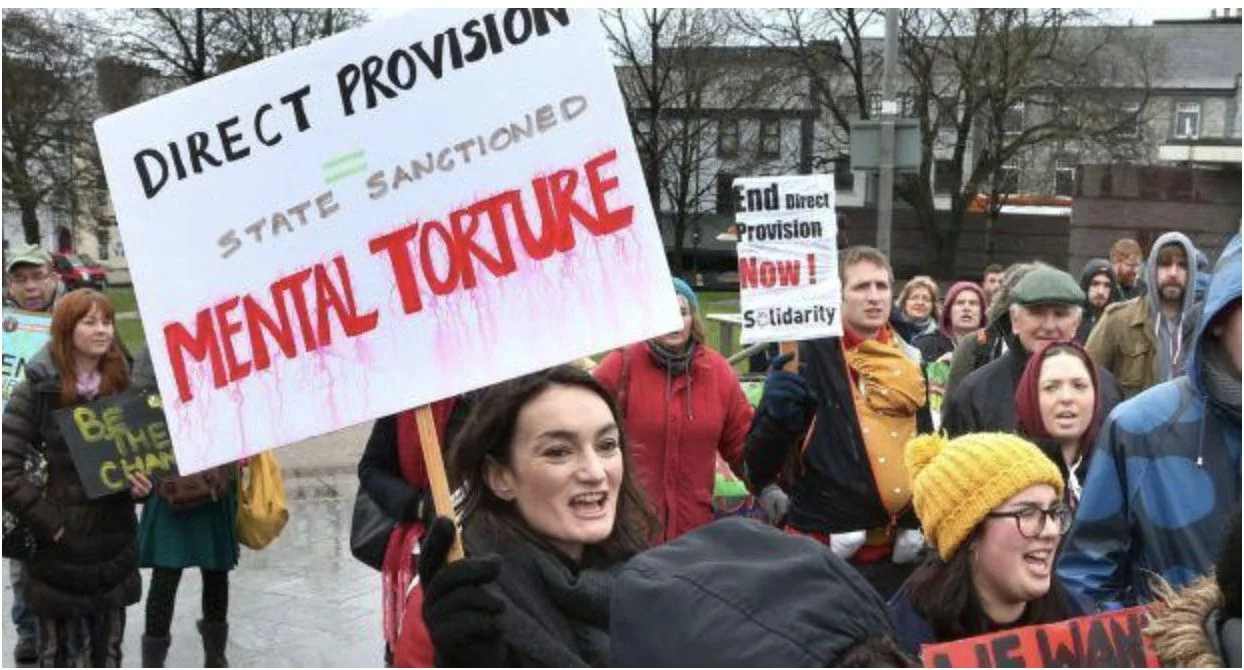
Since its introduction in 1999, Ireland’s Direct Provision system has been a consistent attack on the human rights of asylum seekers. Direct Provision, put forward as a temporary and ‘emergency’ solution to deal with an influx of people seeking international protection, has become a forum of “rights denial, degradation and disempowerment of human beings” (Amnesty Ireland, 2021). In 2021, the Irish government revealed a plan to dismantle the Direct Provision system. While these plans are a step forward, the situation has continued to worsen in 2021. Direct Provision has to be fully and finally ended, and the proposed alternative must protect people’s human rights.
What is Direct Provision?
People seeking international protection are given accommodation in various institutions upon their arrival in Ireland. This reception system is known as ‘Direct Provision’. Once someone is in the Direct Provision system, the State ‘directly provides’ essential services, including medical care, accommodation and board, along with a weekly allowance of €38.80 per adult and €29.80 per child. They are not allowed to work until they have been in Direct Provision for at least six months and they must inform the accommodation centre manager if they or their family are away overnight. If they are away for more than three consecutive nights, the accommodation centre manager will write to them . The manager will ask why they were away, and if their reasons are considered unacceptable, the manager could take away their daily expenses allowance or they could lose their accommodation (Citizens Information, 2021). If they do not accept these conditions in Direct Provision, they will no longer be eligible for any help from the Irish state. The Direct Provision system is overseen by the Reception and Integration Agency (RIA), a body of the Department of Justice and Equality. The majority of the centres around the country are privately owned and operated, which is a major issue as companies are profiting off the inhumane system, and these private contracts sustain the system as it stands.
Ireland’s policy on refugees and asylum seekers is governed by the International Protection Act of 2015. In 2018, Ireland opted into the EU Reception Conditions Directive (recast) which provides minimum standards that all EU countries must adhere to in the reception of asylum seekers (Directive 2013/33/EU). In line with the Directive, asylum seekers who have been waiting over nine months for a first instance decision on their asylum application now have access to the labour market through a Labour Market Access Permission (NASC, 2019).
Hunger Strikes
In 2021, a series of high-profile hunger strikes caught the attention of national and international media. Given that the human rights of asylum seekers in Direct Provision were consistently being violated, without any action being taken by the state, many turned to extreme forms of protest.
In 2020, a group of asylum seekers who were staying in a Direct Provision centre in Cahersiveen, Co. Kerry, who had been asking the Irish government to move them out for four months, went on hunger strike to protest the “inhumane conditions” they were living in (The Independent, 2020). There were also several Covid-19 outbreaks at the height of the pandemic, due to a lack of health and safety standards. One of the protestors stated, “we have been traumatised and for us to recover from this, we need to be all moved out of this accommodation immediately to the appropriate accommodation centres. We are just 41 asylum seekers remaining, including seven children. More than 30 asylum seekers left the centre to different parts of the country because they preferred to be on the street than to continue to live here” (The Independent, 2020). There had also been alarming allegations from the asylum seekers that the food and water at the centre were rationed.
In February 2021, in Co. Cork, 90 asylum seekers went on strike over the food quality in their Direct Provision centre. The residents of Ashbourne House also sent a letter to Children’s Minister Roderic O’Gorman to explain their situation. Following this, the residents of over five more Direct Provision centres in Ireland, including the Kinsale Road Accommodation Centre in Cork City, The Montague in Portlaoise, and further centres in Co. Limerick and Athlone began protesting the inhumane living conditions in Direct Provision.
Most recently, in October 2021, an Indian asylum seeker known as Nadim Hussain, who was a frontline worker in Ireland throughout the Pandemic, began a hunger strike in the hopes of being granted permission to remain in Ireland. Hussain had been living in Direct Provision since 2019. He had applied for asylum however, in September 2021, Hussain received a letter from the International Protection Appeal Tribunal (IPat), stating that he would not be declared a refugee and would not be granted protection status (Gorman, 2021). He then began a hunger strike in Protest of the decision. On the ninth day of his hunger strike, Hussain was hospitalised. He was subsequently diagnosed with pancreatitis and the doctors are investigating complications with his kidneys as a direct result of his hunger strike. The Movement of Asylum Seekers in Ireland (MASI) expressed serious concern for the well-being of Hussain and urged the Minister for Justice to expedite his asylum case with a view of granting him permission to remain. They made a call for “the Irish government to grant long-term residency (permission to remain) to all frontline workers with precarious immigration permission in the State and workers without an immigration permission” (MASI, 2021). As a result of Hussain’s consistent fight for international protection and while in hospital, the Department of Justice delivered the news that he would not be deported. The Twitter page Abolish Direct Provision Campaign shared a video of Hussain thanking people for their support, he stated “thank you every one of Ireland for helping me” (Irish Examiner, 2021).
Looking Forward
The conditions in Direct Provision are notoriously appalling, and as demonstrated, residents have to go to extreme lengths to have their voices heard. However, there is a small light at the end of the tunnel. In August 2021, The Government of Ireland released a White Paper that outlined a plan to end its two-decade-long reliance on Direct Provision. The White Paper was published by the Department of Children and Equality, and it proposes a two-stage “blended” accommodation system instead of the reliance on private contracts (Department of Children, Equality, Disability, Integration and Youth, 2021). Newly arrived asylum seekers will spend a maximum of four months in State-owned reception centres before moving into non-for-profit housing secured through Approved Housing Bodies. Housing for single people will also be acquired through “urban renewal initiatives” and “rent-a-room schemes”, while private tenancies will be used to house some families (Department of Children, Equality, Disability, Integration and Youth, 2021).
The Department has stated that the new system will be “grounded in the principles of human rights, respect for diversity, privacy, and family”. The new system will be up and running by December 2024 (The Irish Times, 2021). Minister O’Gorman said that the system would not reform the direct provision, but ‘end it and bring about a new model of accommodation’. He said the institutionalisation, which was very much an element of direct provision, “needs to end and we need to work towards integration from day one” (Extra, 2021).
While the plans give merit to cautious optimism, at the beginning of 2022, the commitments have yet to be implemented.Direct Provision has continued through more than 21 years of successive governments and, until it ends, thousands of people will remain in a system the government has admitted is not fit for purpose.
Sources and Further Reading
Government Publications
Ireland. Department of Children, Equality, Disability, Integration and Youth. A White Paper to End Direct Provision and to Establish a New International Protection Support Service. Available at: file:///C:/Users//Downloads/134465_c64a1547-c63e-4362-a04c-f3f1ea75439b.pdf Accessed on: 10/02/2022
Ireland. Citizens Information. Direct Provision. Available at: https://www.citizensinformation.ie/en/moving_country/asylum_seekers_and_refugees/services_for_asylum_seekers_in_ireland/direct_provision.html
Reports
Amnesty International (2020) End Direct Provision. Amnesty International, Ireland. Available at: https://www.amnesty.ie/end-direct-provision/
MASI (2021) Statement on hunger strike in Direct Provision. Movement of Asylum Seekers, Ireland. Available at: https://www.masi.ie/2021/10/21/statement-on-hunger-strike-in-direct-provision/
Nasc (2019) The Asylum Process & Direct Provision. Nasc. Available at: https://nascireland.org/campaigns/asylum-process-direct-provision
Legislation
Council of the European Union, Directive 2013/33/EU of the European Parliament and Council of 26 June 2013 laying down standards for the reception of applicants for international protection (recast), 29 June 2013, OJ L. 180/96 -105/32; 29.6.2013, 2013/33/EU, available at: https://www.refworld.org/docid/51d29db54.html
Newspaper Articles
Condron, A. (2021, February 18) 90 asylum seekers launch hunger strike at Cork direct provision centre. The Extra. Available at:
https://extra.ie/2021/02/18/news/irish-news/asylum-seekers-hunger-strike-cork
Coyne, E. (2020, July 8) We have been traumatised’ – Asylum seekers in a Kerry Direct Provision centre on hunger strike in protest at ‘inhumane conditions’ The Independent. Available at:
https://www.independent.ie/irish-news/we-have-been-traumatised-asylum-seekers-in-a-kerry-direct-provision-centre-on-hunger-strike-in-protest-at-inhumane-conditions-39403971.html
English, E. (2021, October 22) Cork asylum seeker ends hunger strike after ‘assurances’ he would not be deported. The Irish Examiner. Available at: https://www.irishexaminer.com/news/munster/arid-40727328.html
Gessen, M. (2019, June 4) Ireland’s Strange, Cruel System for Asylum Seekers. The New York Times. Available at: https://www.newyorker.com/news/dispatch/irelands-strange-cruel-system-for-asylum-seekers
Gorman, S. (2021, October 22) Indian asylum seeker hospitalized as he continues hunger strike in Ireland. InfoMigrants. Available at: https://www.infomigrants.net/en/post/35942/indian-asylum-seeker-hospitalized-as-he-continues-hunger-strike-in-ireland
Pollack, S. (2021, February 26) Plan to end direct provision by 2024 would see asylum seekers housed in State accommodation. The Irish Times. Available at:
https://www.irishtimes.com/news/social-affairs/plan-to-end-direct-provision-by-2024-would-see-asylum-seekers-housed-in-state-accommodation-1.4495389