
Introduction
Since the February 2021 military coup, Myanmar has been governed under authoritarian control, with the military consolidating legislative, executive, and judicial authority. The military junta has announced new elections for the years 2025 and 2026, whereinissues are already emerging. Ethnic minorities face disproportionate barriers to voting, standing for office, and engaging in political activities. This report provides an overview of Myanmar’s electoral history, examines the conduct and conditions of the 2025-2026 elections, analyses systematic violations and minority exclusion, and assesses compliance with international legal standards.
Historical Background
The Conduct and Outcome of the 2020 Elections
In November 2020, Myanmar held parliamentary elections to decide the members of the national legislature. These elections happen every five years.1 The legislature, the Union Assembly, has two chambers: the lower chamber, Pyithu Hluttaw, the People’s Assembly, and the upper chamber Amyotha Hluttaw, the House of Nationalities.2
The general elections took place on November 8th, 2020. The two main parties competing were the National League for Democracy (NLD) and the Union Solidarity and Development Party (USDP).3 The NLD, led by Aung San Suu Kyi, was the country’s leading pro-democracy party, who supported the movement for civilian governance and opposed the military rule. The USDP is the party closely allied with the military, composed of former officers of the Tatmadaw and closely affiliated with the military personnel that is currently active.4
On November 15th, 2020, Myanmar’s Union Election Commission announced the official election results, with the National League for Democracy winning 396 seats out of 476.5 The Union Solidarity and Development Party came in second, winning only 33 seats combined.6
After the results were announced, the USDP refused to accept them and requested a re-run of the voting The party claimed there had been voter fraud, problems with ballot counting, and issues in vote counting in multiple townships.7 On January 27th, 2021, before the scheduled seating of the new Parliament, the army chief Min Aung Hlaing publicly hinted at the possibility of a military coup, stating that the constitution could be “revoked” if the alleged voting issues were not being addressed.8 The following day, the Union Election Commission rejected the fraud accusations and stated that the election had been conducted fairly. It also reminded the opposition that, under Myanmar’s constitution, the commission had the final authority over electoral matters.9
The 2021 Military Coup and the Collapse of Electoral Governance
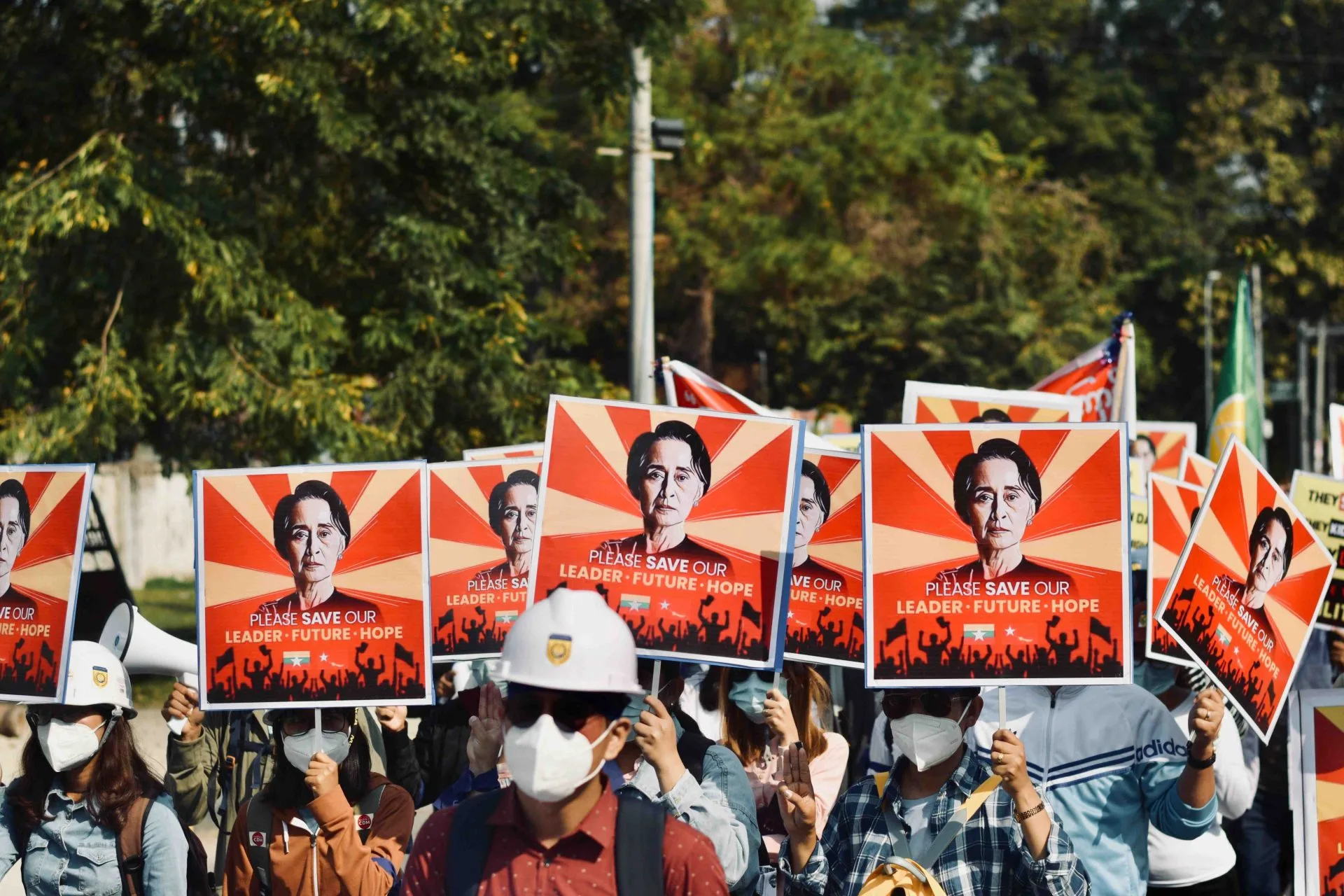
On February 1st, 2021, on the day the parliament was scheduled to meet for the first time since the election, the Tatmadaw staged their coup. Civilian leaders such as Aung San Suu Kyi and President U Win Myint were detained along with government officials, members of parliament, and civil society activists. Afterwards they took control of the government.10 The Tatmadaw justified its actions by claiming there had been voter fraud and irregularities during the 2020 election process..11 Afterwards, power was transferred to Commander-in-Chief Min Aung Hlaing by Vice President U Myint Swe under Articles 417 and 418 of Myanmar’s constitution.12 The articles state that the President, in coordination with the National Defence and Security Council, can declare a state of emergency and transfer all legislative, executive, and judicial powers to the Commander-in-Chief of the Defence Services.13 This act was unlawful, as the law clearly stated that the president, not the vice-president, is the person authorised to make this decision.14 This political disruption marked the collapse of Myanmar’s democratic institutions and led to the start of the civil war.
After the coup, the military strengthened its control through the State Administration Council (SAC), which took over all branches of government.15 The original one-year state of emergency was repeatedly extended.16 The military junta also had cancelled the results of the 2020 elections. In June 2021 they appointed a new Election Commission staffed with members close to the generals.17 Later on, the military introduced the Political Parties Registration Law of January 2023, which created strict rules for party memberships and administrative guidelines, and these primarily affected ethnic parties.18 Despite earlier commitments to restore civilian governance, the junta continued to extend the state of emergency through 2023 and then again in 2024.19
Current Elections
Electoral Timeline
Myanmar’s military junta, also known as the State Administration Council (SAC) announced a multistage general election, taking place in late December 2025 and January 2026.20 The first phase took place on the 28th of December 2025 in 102 townships, and thesecond phase on the 11th of January 2026 in 100 townships. A third and final phase is scheduled on the 25th of January in 63 townships.21 These election phases only include areas where the Union Election Commission has determined that voting can take place despite the active ongoing conflict, while other parts remain excluded.
Systematic Violations
On July 31, 2025, in preparation for the elections, the junta announced the formation of the State Security and Peace Commission to replace the State Administration Council, in place since the coup. The elections take place in an environment in which the military continues to actively suppress participation. This raises serious concerns regarding their credibility, inclusiveness, and conformity with international electoral standards.
The elections overlap with ongoing hostilities due to the civil war, as the country is in a state of fragmented control of territory. Armed conflicts continue to affect large parts of the country, leaving significant regions that are outside of the junta’s control out of the voting process. Elections will not be held in 56 townships out of 330 due to alleged security concerns, effectively depriving the civilians of those certain areas of their right to vote.22 This insecurity is further underscored by the military’s coercive governance, imposing martial law in 63 townships across nine states and regions, and extending the emergency order on October 31st, 2025, for a period of 90 days, ensuring it remains in place during the election period.23 Additionally, there has been an increase in attacks in other regions since August 2025, with airstrikes, arson, and mass arrests targeting civilian populations in strategic areas. Such actions allow the military to cut the lifelines of opposition groups and ensure access to the electoral process in those territories.24
The Union Election Commission (UEC), which oversees the voting process, is perceived as a subordinate to the military rather than an independent body. Leadership of the commission was appointed after the February 2021 coup, and members consist of former military officers.25 The current chair of the UEC is Than Soe, a former major general in the Tatmadaw. Reports of irregularities in voters’ lists have surfaced in multiple regions, but there is no evidence of action by the UEC.26 Other concerns include the use of voting machines indicated by the commission, which does not allow the voter to cast a blank vote if they decide not to make a choice, raising concerns about possible fraud or voter intimidation.27 Additionally, the commission has banned campaign rallies and street demonstrations, limiting candidates to give their respective speeches at military-approved locations and times only.28
An increased number of opposition parties and organizations have been dissolved, criminalized, or barred from participation. In 2023, the junta enacted the Political Parties Registration Law, designed to disqualify senior NLD members from participating in the elections. More than 40 political parties or groups were dissolved because they did not meet legislative requirements.29 Additionally, smaller ethnic minority parties are also disqualified under the legislation. The legislation requires political parties to recruit at least 100,000 members within three months of registration and possess funding of at least 47,000 USD. This had left participation nearly impossible.30
Repressive tactics have also been reported, with the military using warnings and incentives to boost voter turnout. Tactics used are efforts to influence political behaviour by threatening personal safety and security or encouraging voters to seek tradeoffs of fundamental rights and freedoms in exchange for basic livelihoods and services.31 Laws that severely restrict the freedom of speech and political expression have been put in place, intended to punish dissent or criticism of the electoral process with harsh sentences.32 On July 29, the junta enacted the Law on the Prevention of Obstruction, Disruption, and Sabotage of Multiparty Democratic General Election.33 The new law effectively criminalises any criticism regarding the elections by banning speeches or protests that disrupt the electoral process. Violations serve sentences up to 20 years in prison, and the death penalty, and over 94 arrests have been recorded since its enactment.34
Minority Exclusion
Ethnic minorities have been facing systematic barriers to participation in the electoral process, further undermining the validity of the planned elections.35 The 1982 Citizenship Law creates a hierarchy of citizenship based on ethnicity. Rohingya, Gurkas, Tamils, and Chinese are excluded from voting because they do not possess full political rights, including the right to vote and to stand as candidates in elections.36
The junta’s decision to exclude voting from many townships and village tracks has a disproportionate impact on ethnic minority populations and their political representation. Many of the excluded areas are under the control of ethnic armed organisations and resistance forces, leaving civilians out of the electoral process.37 Regions include the Kachin, Karenni, Chin, Sagaing, Rakhine, and Shan, which are states with a larger density when it comes to minority populations.38 The removal of these areas will lead to a political environment where only allied parties of the military will be able to meaningfully participate, undermining fairness.
The 2023 Political Party Registration Law systematically excludes minority electoral parties from the candidates’ list. The harsh financial and organisational requirements have resulted in many smaller ethnic groups being disqualified for participation, blocking many long-term established parties from registering.39 Additionally, the law empowers the UEC to cancel or block registrations for vague alleged links to unlawful or terrorist groups, a label that is often applied to opponents of the military junta during the civil war conflict, to ensure a legislature that is dominated by military allies.40
Violence, restrictions on freedoms, mass detentions, and forced displacement are affecting minority populations and stopping them from political participation.41 Such conditions make it difficult for minorities to vote, campaign, and engage in political life without suffering from punishments by the military junta.
International Standards
The assessment will be based on two international instruments. First, The Universal Declaration of Human Rights (UDHR), as Myanmar is a member of the United Nations, and the instrument is recognized as customary international law. Second, the International Covenant on Civil and Political Rights (ICCPR) is an international treaty that sets authoritative standards for the protection of civil and political rights. Myanmar has not ratified the ICCPR, but the instrument remains relevant because the country has signed the treaty and the treaty sets standards for universally recognised political rights.
Several provisions of the UDHR are particularly relevant in this case. Article 2 states that all individuals are entitled to rights and freedoms without discrimination based on race, ethnicity, political opinion, or other status, and prohibits political discrimination and limitation.42 Article 21(1) states that everyone has the right to take part in the government of their country directly and through freely chosen representatives.43 Article 21(2) guarantees the right to equal access to public service.44 Article 21(3) states that government authority must be based on the will of the people, expressed through genuine and regular elections with equal voting rights.45
Under the International Covenant on Civil and Political Rights, article 2(1) requires states to respect and ensure all rights recognized in the Covenant without discrimination based on race, colour, political opinion, or other status.46 Article 25 states that every citizen has the right to participate in public affairs, to vote and be elected at genuine elections, and to access public office on equal terms, without unreasonable restrictions or coercion.47
Conclusion
The recent elections in Myanmar have taken place under conditions of military control, widespread insecurity, and systematic oppression. Ethnic minorities and opposition groups were excluded, and due to restrictive laws and other tactics, which have resulted in the elections not being conducted in a fair manner. The military’s actions violate fundamental political rights codified in customary international law. The electoral process cannot be considered free, fair, or representative, and the result will not reflect the will of the people of Myanmar. This article, therefore, highlights the need for accountability and changes towards an inclusive political reform. The military junta needs to ensure adherence to international legal standards for present and future electoral processes.
Bibliography
BTI – Myanmar Country Report (Bertelsmann Transformation Index) https://bti-project.org/en/reports/country-report/MMR accessed 21 January 2026.
Constitution of the Republic of the Union of Myanmar (2008).
Council of the European Union, Myanmar: Statement by the High Representative on behalf of the European Union on the upcoming elections (Press Release, 9 December 2025) https://www.consilium.europa.eu/en/press/press-releases/2025/12/09/myanmar-statement-by-the-high-representative-on-behalf-of-the-european-union-on-the-upcoming-elections accessed 22 January 2026.
Human Rights Watch, Myanmar: Elections a Fraudulent Claim for Credibility (HRW, 16 November 2025) https://www.hrw.org/news/2025/11/16/myanmar-elections-a-fraudulent-claim-for-credibility accessed 22 January 2026.
Human Rights Watch, Myanmar: Political Parties Law Shackles Opposition (HRW, 14 February 2023) https://www.hrw.org/news/2023/02/14/myanmar-political-parties-law-shackles-opposition accessed 21 January 2026.
International Covenant on Civil and Political Rights (adopted 16 December 1966, entered into force 23 March 1976)
Kugiel P, Coup in Myanmar—Democratisation Interrupted (PISM) https://www.pism.pl/publications/Coup_in_MyanmarDemocratisation_Interrupted accessed 21 January 2026.
McKenna A, 2021 Myanmar Coup d’état (Britannica, 19 December 2025) https://www.britannica.com/event/2021-Myanmar-coup-d-etat accessed 21 January 2026.
Myanmar Coup Tracker, “2020 Election Results” (Myanmar Coup Tracker, 8 November 2020) https://myanmarcouptracker.eu/2020-election-results/ accessed 21 January 2026.
Myanmar International TV, Phases of Election: Announcement on constituencies and wards/village-tracts (Myanmar International TV, 28 December 2025) https://www.myanmaritv.com/news/phases-election-announcement-constituencies-and-wardsvillage-tractsaccessed 22 January 2026.
Office of the High Commissioner for Human Rights (OHCHR), Background Paper on Myanmar Military Elections (28 November 2025)
Radio Free Asia, Myanmar Election Authority Rejects Military Claims of Election Fraud (RFA News, 28 January 2021) https://www.rfa.org/english/news/myanmar/election-fraud-01282021184631.html accessed 21 January 2026.
Radio Free Asia, Myanmar’s junta extends state of emergency for yet another six months (RFA, 31 July 2024) https://www.rfa.org/english/news/myanmar/junta-emergency-extension-07312024152952.html accessed 21 January 2026.
The Diplomat, Amid Coup Fears, Myanmar’s Election Commission Rejects Army Election Fraud Claims (The Diplomat, 28 January 2021) https://thediplomat.com/2021/01/amid-coup-fears-myanmars-election-commission-rejects-army-election-fraud-claims/accessed 21 January 2026.
The Irrawaddy, Tension Grows Following Military’s Coup Talk (Irrawaddy, 28 January 2021)
https://www.irrawaddy.com/opinion/analysis/tension-grows-following-militarys-coup-talk.html
accessed 21 January 2026.
The Irrawaddy, Myanmar Junta Rules Out Voting in 121 Constituencies in First Phase of Election (Irrawaddy, 16 September 2025) https://www.irrawaddy.com/news/politics/myanmar-junta-rules-out-voting-in-121-constituencies-in-first-phase-of-election.htmlaccessed 22 January 2026
Thida M, Myanmar’s “general’s election” has failed before it has even started (CETRI, 29 December 2025) https://www.cetri.be/Myanmar-s-general-s-election-has?lang=fr accessed 22 January 2026.
UN General Assembly, ‘Universal Declaration of Human Rights’ UN Doc A/RES/3/217A (10 December 1948)
Walker N, Myanmar: 2020 parliamentary election (House of Commons Library Research Briefing, CBP‑9127, 4 February 2021)