
“EU Enlargement Forum” at the European Commission in Brussels, opened with three key drivers for the unification and enlargement of Europe: credibility, readiness, and enlarging enlargement.
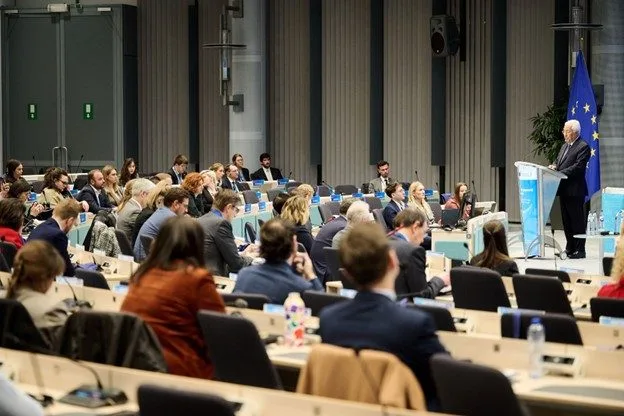
On November 18th, 2025, Global Human Rights Defence (GHRD) attended a high-level forum at the European Commission, organised by Commissioner Marta Kos and the EU Enlargement and Eastern Neighbourhood (DG ENEST). Throughout the session, marking the opening of clusters with several candidate countries, brought together EU Commissioners, the European Council President, and civil society organisations to discuss the state of the European Union and the future of enlargement in today’s geopolitical scenario. Discussions addressed the EU’s ongoing accession discussions under the acquis communitaire with Moldavia, Ukraine, Georgia, Albania, Montenegro, and other candidate countries from the Western Balkans and the Eastern Partnership. Due to global fragmentation and power politics, the EU needs to preserve the principles of peace, democracy, and common responsibility, all of which form the project of a united European Union.
Key Highlights
- Renewed commitment to the Fundamentals of Enlargement: Speakers and political leaders emphasised that the encouragement and support from the Commission and Member States must serve as a moment of advancement—reaffirming the advantages of enlargement to peace, human rights, and sustainable development amid rising geopolitical tensions.
- Differentiate Enlargement Progress: Participants highlighted the significant progress from several candidate countries to acquis communitaire. However, countries such as Georgia and Serbia’s accession process remains stalled due to incomplete actions on preserving democratic principles and the rule of law.
- EU–Eastern Partnership and Western Balkans as a pillar of European unification: The cooperation between neighbouring countries and expectations for further enlargement. However, there is serious potential dysfunctionality of the Union if not reformed. The EU’s plans for these regions, being an essential element for the EU Commission, remain essential for development.
- Defence for human rights and democratic values: In today’s increased geopolitical tensions with Russia, China or even the US, EU officials warned that institutional deadlocks and ineffective reforms risk regional stability and candidate states’ future perspectives.
How to Shape a Stronger and Larger Union
Discussions centred on the momentum to revitalise the European common project through structural and institutional reforms. Speakers agreed that the aggressive actions by the Russian Federation and its attempts to destabilise the Union must mark not only national reflection but also renewal, ensuring that the European Union remains capable of addressing regional threats from the rule of law to security and democratic accountability.
This forum underscored that the 2025 EU Enlargement Package presents essential priorities for candidate countries to increase the prospects of entering the Union. Specifically, the enlargement path involves overcoming the differences of all Member States and moving forward. The EU’s action strategy must be grounded on the success of candidates over the interference of external actors, based on European integration perspectives, resilience, and security guarantees.
Marta Kos, Commissioner for Enlargement of the European Union, and Costa, Presiden of the European Council, emphasised that the enlargement remains an essential element of the journey already started at the end of WWII: “the fight for open societies, the rule of law, and the future of the continent”, stressing that autocratic regimes are not bound by the same moral and legal rules as democratic countries. Because of these challenges posed by such regimes, the European Union is launching the European Safety Net. They underscored that the new EU Democracy Shield, including candidate countries, plays a transformative role in the gradual integration and the defence of democracy in Europe.
Throughout the discussions, speakers and attendees emphasised that the EU pillars referring to peace and security, democracy, and human rights are fundamental, and that young generations from candidate countries want an EU perspective. It was equally highlighted that the EU enlargement offers “an opportunity to heal the wounds from the past”, ensuring that common ideals and the actions by civil society advocate for rights-based approaches and accession to the European Union.
- According to Eurostat, 67% of the population remains not informed enough on the actions carried out by the European Commission and the benefits of EU Enlargement. Thus, further action should be taken to communicate more efficiently the significance of this process.
Alexandra Papadopoulu, Vice-Minister of External Action of Greece, and Kaja Kallas, EU High Representative for Foreign Affairs and Vice-President of the Commission, echoed this new momentum about the political reality of the European Union, describing how “opportunity doors” are currently opened for new accession. They insisted that the increased support for enlargement by the civil society must come with action by political leaders and national institutions defending the integrity of national sovereignty and non-interference of other actors. The current war in Ukraine and cyberattacks on Moldova, Georgia and other countries affect the regional stability and security, ultimately testing Europe’s unification promises and increasing attempts to the detriment of human rights and democratic values.
Conclusion
The first EU Enlargement Forum event of the European Commission represents the defining moment for achieving the historical promises of unification and the need to address the regional architecture, once built on the principles of democracy, human rights, and multilateralism. This high-level event reaffirmed that, despite continued attacks by external actors and severe European institutional constraints, the EU remains committed to speeding up the reforms and future enlargement. The potential accession of Moldova, Albania, Montenegro, and Ukraine by 2030 remains not solely symbolic but essential for the promotion of human rights frameworks, civil society missions, the rule of law, and the preservation of peace in Europe.