
By Juliana Nadalutti, EU Team, Global Human Rights Defence
Introduction
Amsterdam’s Torture Museum offers a stark reminder of how punishment has historically been used to assert authority and legitimise the deliberate infliction of suffering. Its collection of more than 40 historical instruments includes devices designed for torture, public humiliation and execution, reflecting a time when punishment was not only a means of enforcing the law but also a public demonstration of power. Today, displayed as historical artefacts, these instruments invite reflection on how societies have justified the use of violence in the name of justice.
Among them, the guillotine and the Inquisition chair illustrate two different dimensions of punitive power: the attempt to make execution more systematic and the use of physical suffering as a means of coercion. They also provide a starting point for examining a troubling continuity between past and present. While the methods and settings of punishment have changed, the state’s authority to inflict irreversible harm remains a pressing human rights concern. The guillotine may have given way to the modern execution chamber, where death is administered through tightly regulated procedures, but has this transformation made capital punishment more humane, or simply less visible? As the world marks the European and World Day Against the Death Penalty on October 10th, these historical objects offer a starting point for questioning whether greater efficiency and procedural control can ever justify the deliberate taking of a life.
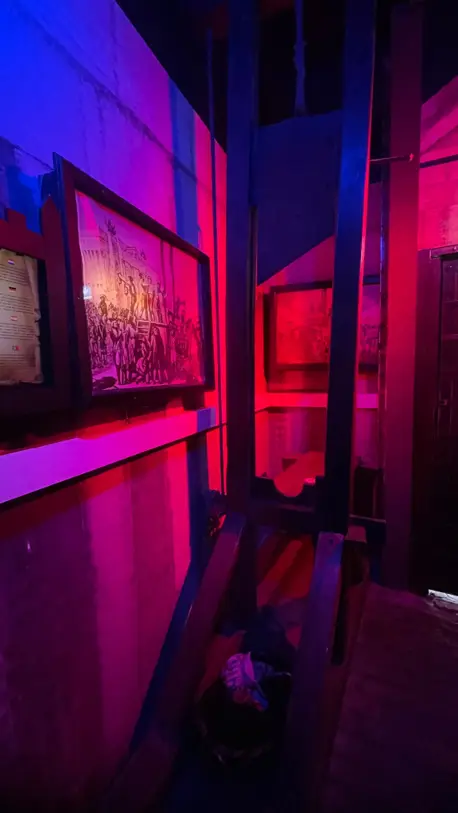

Left: Guillotine / execution exhibit at Amsterdam’s Torture Museum. Right: Inquisition chair on display at Amsterdam’s Torture Museum.
Image credits: © Juliana Nadalutti / Global Human Rights Defence (personal photographs, Amsterdam’s Torture Museum, October 2026)
The Changing Face of Execution
For centuries, executions were public ceremonies. The scaffold was a stage on which authorities demonstrated their power to punish and take life. During the French Revolution, the guillotine became associated with an effort to make execution more uniform. Later technologies, including the electric chair, first used in an execution in 1890, lethal gas, first used in an execution in 1924, and lethal injection, first used in an execution in 1982, were introduced in part amid claims about efficiency or reduced suffering. Yet technological change did not resolve the underlying ethical question: whether the state should deliberately and irreversibly take a human life.
The setting has changed. An execution chamber can look clinical and procedural, with rules, medical equipment and prescribed protocols that create an impression of control. But the appearance of procedure does not remove the violence of the act. An execution is irreversible: if a conviction is unsafe, new evidence emerges or a trial was unfair, the harm cannot be undone. Nor can procedural safeguards eliminate the possibility of error or discriminatory application.
This is one reason the death penalty cannot be assessed only by the method used to carry it out. The question is also about the legitimacy and limits of state power, the right to life, the risk of arbitrary decisions, and the unequal ways criminal justice systems affect people with fewer resources or less political power.
The Numbers: a Global Rise Alongside a Long-term Shift
The latest figures underline the contradiction between a long-term movement towards abolition and a sharp recent increase in executions. Amnesty International recorded at least 2,707 executions in 17 countries in 2025, the highest number it has recorded since 1981, and at least 2,334 death sentences across 48 countries. The execution total excludes the thousands of executions believed to have taken place in China, where the state does not display such data (Amnesty International, 2026b).
In its joint statement for the European and World Day Against the Death Penalty, published on October 9th 2026, the EU High Representative for Foreign Affairs and Security Policy and the Secretary General of the Council of Europe likewise warned that recorded executions had risen by 78 percent compared with 2024. The figures are not a reason to abandon abolition efforts; they are a reason to make them more urgent (European External Action Service [EEAS], 2026).
The joint statement also points to concrete progress. Lebanon abolished the death penalty in August 2026; Gambia and Vietnam reduced the number of crimes punishable by death; and Sierra Leone ratified the Second Optional Protocol to the International Covenant on Civil and Political Rights, which commits states parties to abolishing executions within their jurisdiction. Cambodia, the Central African Republic and Chad took steps towards ratification. These developments show that legal and political change is possible, even while the overall execution figures remain deeply troubling (EEAS, 2026).
Southeast Asia: Reform is Possible, but Progress is Uneven
The regional picture in Southeast Asia illustrates why abolition should be understood as a process as well as a legal destination. In its briefing Changing Tides: Reform and Resistance on the Death Penalty in ASEAN, Amnesty International documents reforms across the Association of Southeast Asian Nations (ASEAN), while stressing that progress is uneven and reversible. Cambodia, the Philippines and Timor-Leste have abolished the death penalty for all crimes. Brunei and Laos retain it in law but have not carried out executions for decades, while Indonesia, Malaysia, Thailand and Vietnam have introduced reforms that restrict its scope. Myanmar and Singapore remain particularly concerning cases (Amnesty International, 2026a).
The briefing describes a decline in the number of ASEAN countries in which Amnesty recorded executions across the periods examined: from five countries two decades ago to three in the more recent period. Indonesia reached ten years without an execution in July 2026; Malaysia and Thailand have also experienced extended pauses. These pauses matter because they can create space for public debate, legal review and eventual abolition. But a pause is not the same as a legal ban: without a formal moratorium and reforms to legislation, executions can resume (Amnesty International, 2026a).
The region also shows the danger of treating the death penalty as an effective response to drug-related offences. Amnesty reports that Singapore carried out 19 executions by September 30th 2026, all for drug-related offences, and that the death penalty remains in force for drug offences across the eight ASEAN states that retain capital punishment. The EU and Council of Europe’s 2026 joint statement stresses that international human rights law restricts capital punishment to the “most serious crimes”, understood as crimes of extreme gravity involving intentional killing, and that drug production and trafficking do not meet that threshold. It also notes that evidence does not show the death penalty deters crime more effectively than other sentences (EEAS, 2026; Amnesty International Netherlands, 2026).
These examples point to a practical route forward: governments should establish or maintain official moratoriums on executions, repeal mandatory death sentences, narrow capital offences in line with international law, ensure fair trials and non-discriminatory application of justice, and commute existing death sentences while moving towards abolition.
A Human Rights Standard, Not a Question of Appearances
The EU and Council of Europe reaffirmed in their joint statement delivered on October 9th, that they oppose the death penalty “in all cases and in all circumstances”. They describe the death penalty, including the process leading to execution, as inhuman and degrading treatment and call on states that retain it to introduce an immediate moratorium as a first step towards abolition. They also reject attempts to reintroduce or expand capital punishment, including in Europe, and call for democratic debate grounded in human rights and the rule of law (EEAS, 2026).
The death penalty also raises concerns about wrongful convictions, discrimination, unfair trials and political repression. Its application can be shaped by poverty, unequal access to legal representation, and the treatment of marginalised communities. These concerns are not resolved by making execution less visible or by describing it as a technical process. A state’s ability to impose a punishment does not, by itself, establish that the punishment is just, necessary or compatible with human rights.
Nor is abolition incompatible with public safety or accountability. A rights-based criminal justice system can investigate serious crimes, protect communities, support victims and impose proportionate sentences without making punishment irreversible. The EU and Council of Europe’s call to embrace restorative justice is a reminder that justice should address harm and uphold human dignity, rather than rely on the deliberate taking of life (EEAS, 2026).
Conclusion: From Museum Display to Present-day Responsibility
The European and World Day Against the Death Penalty, marked October 10th, invites us to look beyond the machinery of execution and ask what justice should mean. The objects in Amsterdam’s Torture Museum help make the past visible: they show how punishment has been justified through authority, ritual and claims of necessity. But the continuing use of capital punishment demonstrates that the underlying question is not confined to history.
The global rise in recorded executions and the uneven reforms in Southeast Asia make the choice before governments clear. Moratoriums, legal reform and the protection of fair-trial rights are meaningful steps, but the ultimate goal must remain abolition. The instruments in a museum belong to the past. The death penalty should join them.
Sources and Further Reading
Amnesty International. (2026a). Changing Tides: Reform and Resistance on the Death Penalty in ASEAN. Index ACT 50/1511/2026. First published 2026. https://www.amnesty.nl/content/uploads/2026/10/Changing-Tides-Death-penalty-ASEAN-v4-WEB.pdf?x52493
Amnesty International. (2026b). Death penalty in 2025: Facts and figures. Published May 2026. https://www.amnesty.org/en/latest/news/2026/05/death-penalty-in-2025-facts-and-figures/
Amnesty International Netherlands. (2026, 8 October). Positieve stappen richting afschaffing doodstraf in Zuidoost-Azië [Positive steps towards abolition of the death penalty in Southeast Asia]. https://www.amnesty.nl/actueel/positieve-stappen-richting-afschaffing-doodstraf-in-zuidoost-azie
European External Action Service. (2026, 9 October). European and World Day against the Death Penalty, 10 October 2026: Joint statement by the High Representative of the European Union and the Secretary General of the Council of Europe. https://www.eeas.europa.eu/eeas/european-and-world-day-against-death-penalty-10-october-2026-joint-statement-high-representative_en
Torture Museum. (n.d.). Instruments and historical collection. https://torturemuseum.org/instrumenten/
World Coalition Against the Death Penalty. (n.d.). Resources and campaigns for abolition. https://worldcoalition.org/
Council of Europe. (n.d.). European and World Day Against the Death Penalty. https://www.coe.int/en/web/portal/10-october-against-death-penalty