
30 October 2026 | The Hague, Netherlands
Mees van Barneveld, EU Team, Global Human Rights Defence.
On October 30th, 2026, Global Human Rights Defence (GHRD) attended a breakout session at the World Forum in the Hague for the fifth UNESCO Global Forum against Racism and Discrimination. According to UNESCO, a large proportion of reported discrimination cases relate to race and gender, and recent international figures show that more than one in five people report having experienced discrimination. These developments underline the urgency of the forum, to be an international platform focused on knowledge-sharing, collaboration and the development of concrete solutions.
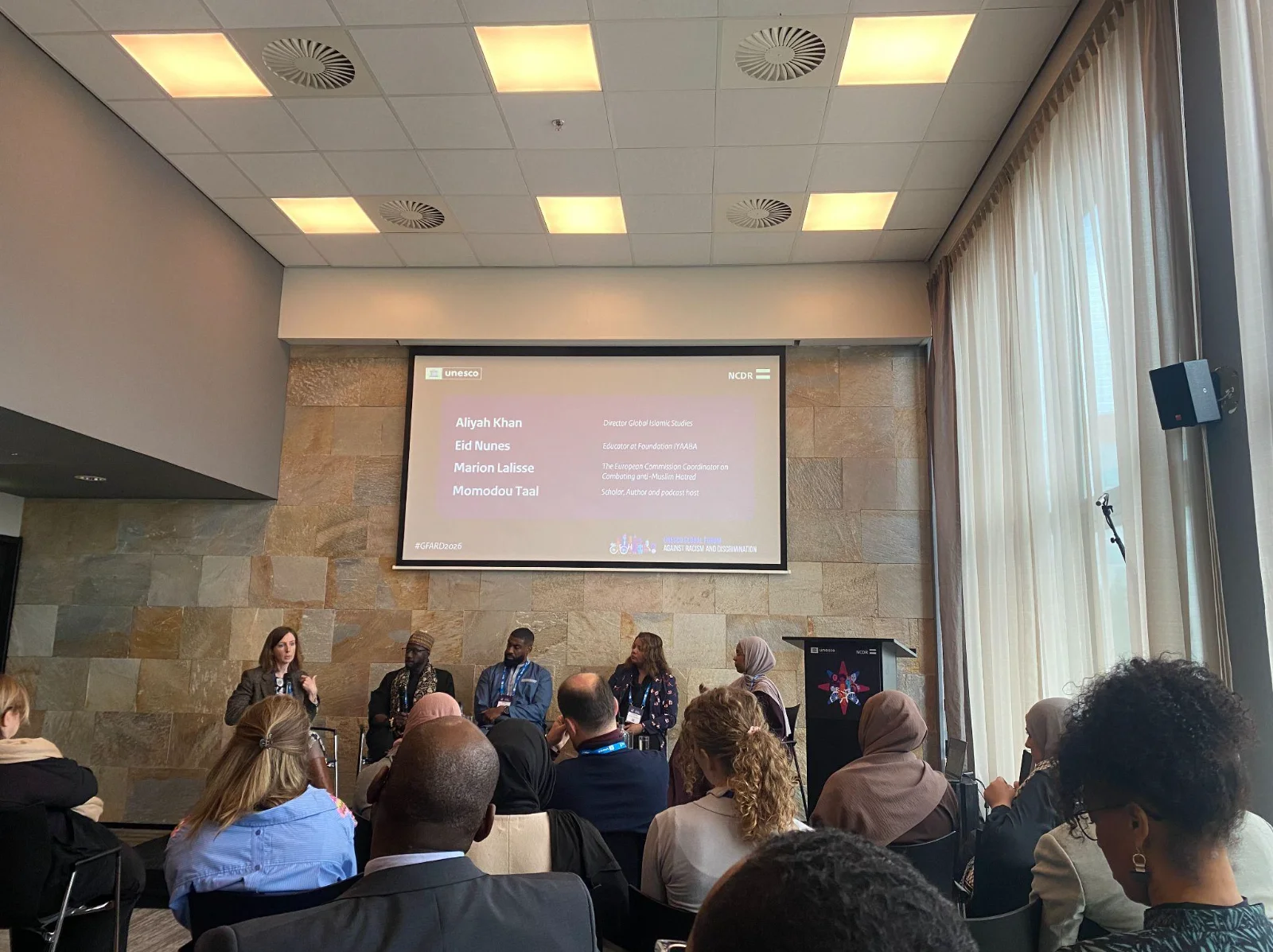
The breakout session – Afro-Muslims: Intersectional Discrimination – brought together a panel consisting of:
- Aliyah Khan: Director of the Global Islamic Studies Center (GISC) at the University of Michigan;
- Eid Nunes: Educator at Foundation IYAABA, a foundation focused on preserving the Afro-Caribbean Muslim community;
- Marion Lalisse: European Commission Coordinator on Combating anti-Muslim Hatred;
- Momodou Taal: Scholar, author and podcast host.
The breakout session focused on the intersectional discrimination experienced by Afro-Muslims, taking the following premise as its starting point: whose problems are visible and whose remain unseen. The challenges faced by Afro-Muslims undeniably fall into the second category. As Momodou Taal highlighted at the outset, most people are unfamiliar with Afro-Caribbean Muslims, as well as Afro-Muslims more broadly. To begin understanding how Afro-Caribbean Muslims, and Afro-Muslims in general, experience the dual pressures of racism and Islamophobia, global awareness of their stories must be fostered.
The session subsequently turned its focus to Afro-Muslim communities in the Netherlands. Eid Nunes explained how these communities struggle to find a sense of belonging, emphasising that this issue is deeply rooted in a broader negative self-image within the community, they are subject to internalised discrimination, which is – among others – rooted in the Dutch school system. The Dutch history curriculum regarding African countries primarily begins with the transatlantic slave trade, thereby neglecting major African empires that predated the era of slavery, such as the Kingdom of Aksum and the Songhai Empire. Beyond prevailing societal and institutional perceptions, this historical omission adversely affects the standing and advancement of the Afro-Muslim community in the Netherlands.
Marion Lalisse then addressed the position of Afro-Muslims within French society. She first touched upon the deadly attacks in Trappes and La Verrière (Paris), in which a 26-year-old French-Congolese man was fatally shot by a perpetrator who admitted to targeting individuals of Muslim and African descent. Lalisse also cited the Being Black in the EU report, published in 2023 by the European Union Agency for Fundamental Rights. The findings are unequivocal: despite decades of binding anti-discrimination and anti-racism legislation, both continue to rise across most metrics rather than decline. Lalisse highlighted one statistic in particular: reporting rates remain exceptionally low, with only 9 per cent of victims reporting incidents of discrimination. This is largely attributable to a fundamental lack of institutional trust. According to Nunes, law enforcement must begin by acknowledging ethnic profiling rather than denying it, as this could serve as the vital starting point for a dialogue aimed at rebuilding institutional trust among Afro-Muslim minorities.
The range of issues addressed during the breakout session underlines the urgent need for greater attention and enhanced legislation to combat discrimination and racism, while reinforcing the significance of the UNESCO Global Forum against Racism and Discrimination.