
4 November 2026 | Brussels
Clémence Franchet, EU Team, Global Human Rights Defence.
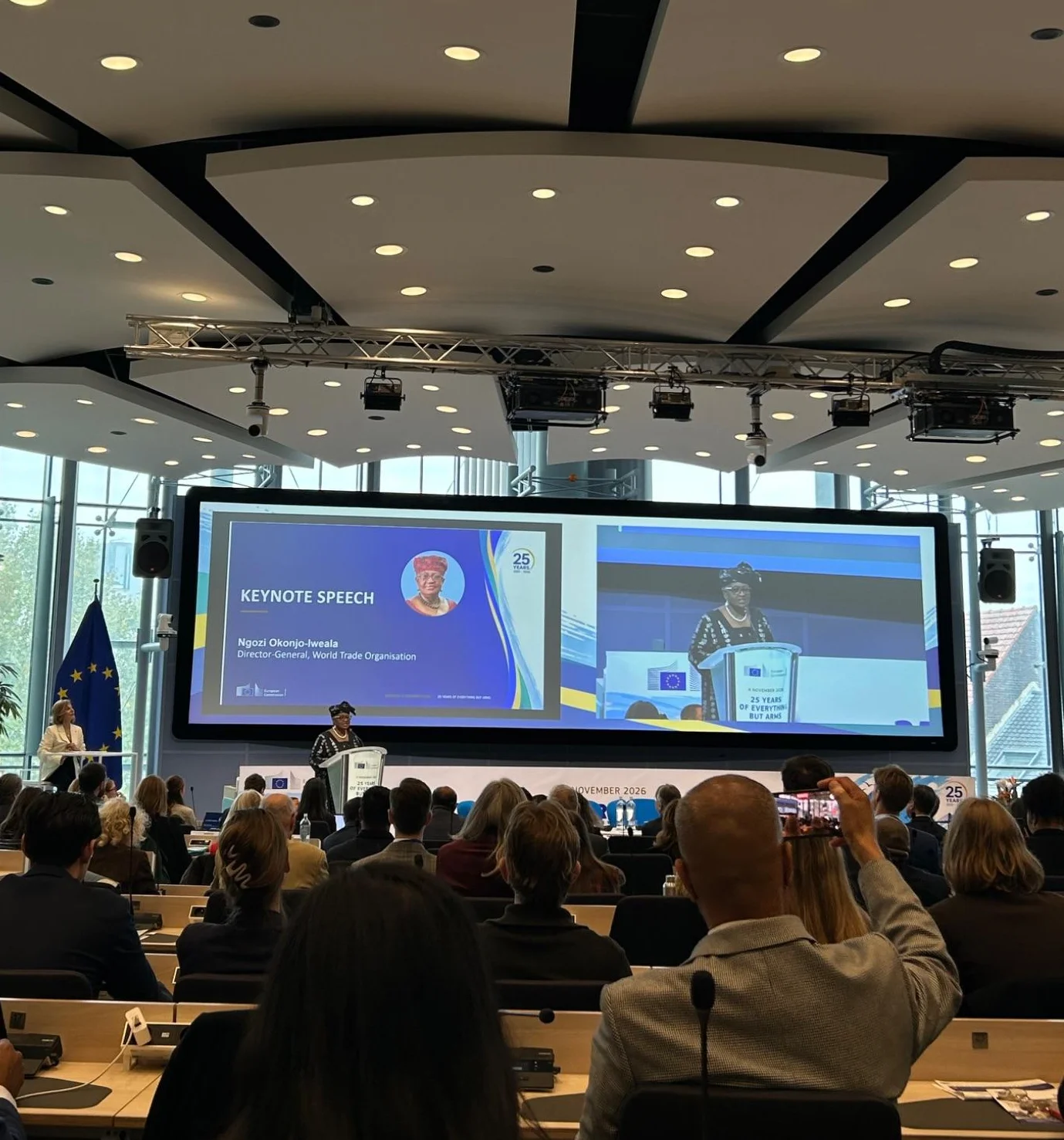
Key Facts Shared Ahead of the Conference
- The EU’s Generalised Scheme of Preferences (GSP) was established in 1971, while the Everything But Arms (EBA) initiative marks its 25th anniversary this year. The new GSP Regulation will apply from January 1st, 2027.
- The EU offers three preferential trade arrangements, with each eligible country benefiting from only one arrangement at a time:
- Standard GSP: zero or reduced tariffs on two-thirds of product lines for eligible lower-middle-income countries and below (11 beneficiaries under the new Regulation).
- GSP+: zero tariffs on two-thirds of product lines for vulnerable countries that ratify and effectively implement 32 international conventions. The eight current beneficiaries have a two-year transition until the end of 2028.
- EBA: duty and quota-free access for all products except arms and ammunition for LDCs (46 beneficiaries). It has no expiry date, applies automatically and encourages investment and export diversification.
- In 2025, 58.6 per cent of GSP preferences were used for clothing and textiles.
The conference was hosted by journalist Shada Islam as Master of Ceremonies. It opened with a welcome speech by Maroš Šefčovič, the European Commissioner for Trade and Economic Security, who described EBA as the EU’s most generous and predictable instrument for Least Developed Countries (LDCs) and underlined that the GSP can support sustainable development. He noted that countries graduating from LDC status have three years to adapt. He also highlighted that the EU is Africa’s first trading partner, while Africa is the EU’s fourth. He further referred to ongoing negotiations with Côte d’Ivoire and the EU’s efforts to promote more inclusive mechanisms through WTO reform.
Ngozi Okonjo-Iweala, WTO Director-General, presented EBA as a milestone of global integration, offering the highest level of preferences and a comprehensive, predictable framework that helps countries add value, export more and create jobs.
Bernd Lange, Chair of the European Parliament’s Committee on International Trade (INTA), spoke of a better future for people in the Global South and stressed that the Parliament has a real role in the legislative process.
Panel 1: GSP and EBA in a Changing Geopolitical and Geo-economic Environment
Introduced by Ditte Juul Jørgensen, Director-General of DG Trade and Economic Security, the panel brought together San Bilal (ECDPM), Shoko Noda (UNDP) and Dora Correia (European Commission). Panellists stressed the need for predictability and certainty amid shifts in security, development and geopolitics, and discussed how EBA and the GSP are evolving to fit today’s evolving world and the next ten years. Speakers called for reducing vulnerability, increasing resilience and making trade and investment more inclusive.
Shoko Noda, UNDP Assistant Secretary-General and Director of the Crisis Bureau, added that respect for human rights is essential, especially in fragile settings, and reminded participants that there are people beyond trade, with local social opportunities to consider. Others pointed out that EBA also benefits EU citizens through soft power and political engagement. The new GSP broadens the range of UN conventions it covers, and long-term engagement, close monitoring and dialogue were presented as key to sustainable development. The Ambassadors of Nepal and Ethiopia also took part.
Panel 2: Business Opportunities Through GSP/EBA
The second panel looked at how predictable market access can support exporters, investors and value-chain development, especially for small and medium-sized enterprises and women-owned businesses. Panellists came from the European Commission (DG INTPA), Business Europe, the Joint Apparel Association Forum of Sri Lanka and the Africa Business Council.
Amany Asfour, President of the Africa Business Council, described the GSP as a win-win situation for investors and called for giving women their place in these opportunities.
GHRD’s Perspective
The conference showed how crucial trade has become to the EU’s relations with developing countries. For GHRD, whose work on the GSP focuses on human rights conditionality in EU trade relations, the reminder that trade must respect human rights, especially in fragile contexts, is particularly relevant.
However, GHRD notes that the discussions focused mainly on predictability, market access and business opportunities, while human rights received comparatively limited attention, and no human rights organisation was among the panellists. With 58.6 per cent of GSP preferences used for clothing and textiles, a sector where labour rights are a recurrent concern, close monitoring and dialogue are essential. GHRD hopes that the new Regulation will be accompanied by strong, transparent monitoring of the conventions that underpin GSP+.