
23 September 2026 | Strasbourg, France
Mees van Barneveld, EU Team, Global Human Rights Defence.
On September 17th, 2026, Global Human Rights Defence (GHRD) attended a side event at the Council of Europe in Strasbourg for the second Western Business and Human Rights Forum. The panel was organised by UN Global Compact France alongside the International Federation for Human Rights (FIDH) and Touton, a leading agro-industrial actor in the cocoa, coffee and vanilla sector.
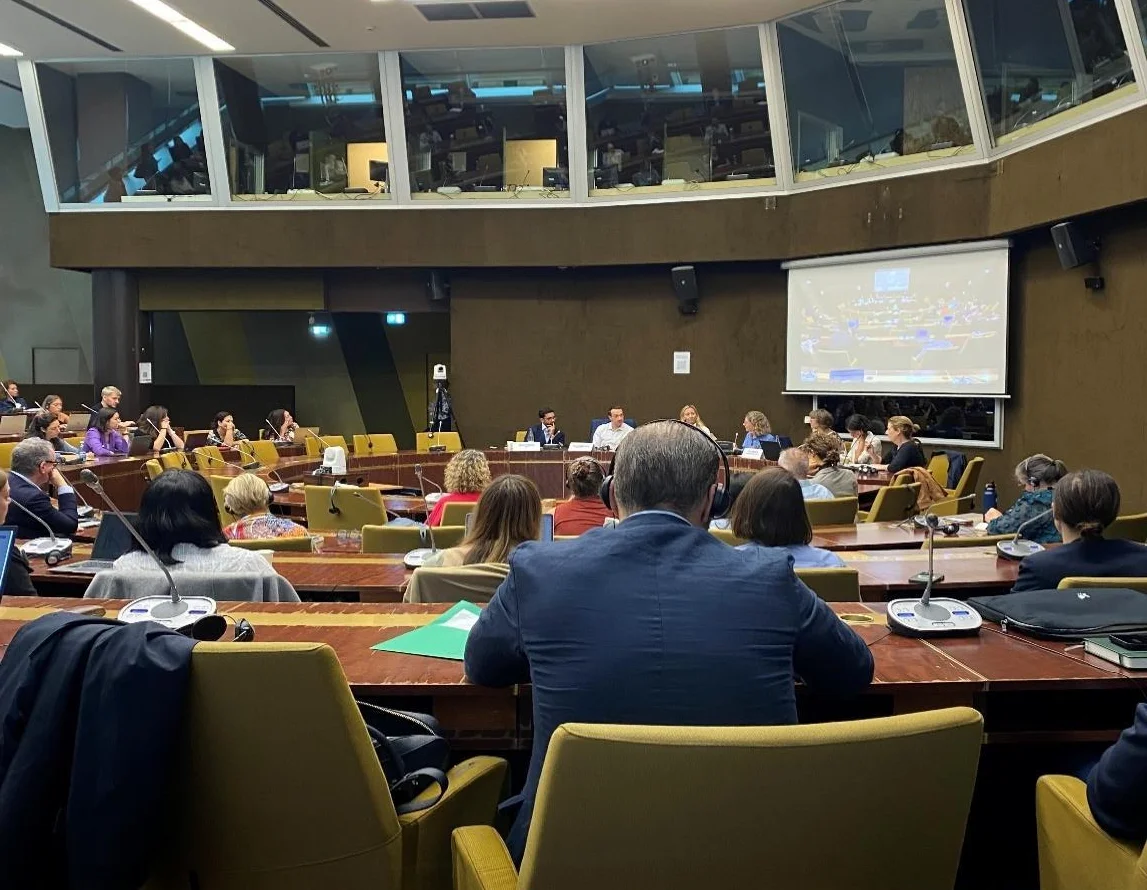
The panel brought together:
- Céline da Graça Pires, Independent Expert in Business & Human Rights and Community Engagement;
- Isabelle Adam, Public Relations and Public Affairs expert, Touton;
- Alice Bulteau, Programme Officer at FIDH – Business, Human Rights & Environment;
- Eline Bardeau, Human Rights Project Manager, UN Global Compact Network France.
The side event explored how meaningful engagement with communities affected by business operations should and can be shaped. While many companies approach engagement with affected communities as a formality or risk management exercise, the panelists showed the path towards meaningful engagement through practical steps.
Practical Guide
The practical steps presented at the side event are from UN Global Compact France’s practical guide: Businesses – Affected Communities, Adopting a Human Rights-based Approach for Meaningful Engagement and Effective Impact Management. Through seven steps, the guide introduces a comprehensive framework for building lasting relationships, grounded in trust, transparency, and respect for human rights. The guide is designed for companies across all sectors, but particularly relevant for large companies which engage directly – either themselves or their partners – with affected companies.
Key Takeaways
Companies generally approach engagement with affected communities in a top-down manner. Instead, the approach should be centred around dialogue and cooperation while recognising the diversity of cultural and social contexts. Affected communities are generally expected to adapt to the company’s pace; this ought to be avoided wherever possible.
Companies often underestimate how organised and structured indigenous communities really are; rather than lacking structure, they rely on established governance systems and collective decision-making. To engage meaningfully, companies must respect these structures on their own terms, while staying mindful of the unique cultural, environmental, and social fragilities that external projects can easily disrupt.
Many companies approach grievance systems incorrectly: they impose digital corporate systems onto local communities, which fails due to corporate jargon, unsafe reporting channels and fear of retaliation. Grievance mechanisms should be co-designed with affected communities, featuring culturally appropriate and barrier-free channels, predictable response timelines, and proper anti-retaliation safeguards. This approach is crucial to guaranteeing affected communities a fair pathway to remedy and detecting human rights violations early.
The UN Global Compact has provided a toolbox for large companies to improve their engagement with communities affected by their operations. It is now up to companies to put these practical steps into action and better protect the human rights of community members, while civil society must continue to emphasise the importance of meaningful local engagement.