
Introduction
For over a year, the US President Donald Trump has openly threatened to take the world’s largest island, Greenland, which is currently a semi-autonomous entity within the Kingdom of Denmark (Al Jazeera, 2026). But the situation really took a turn from a “real estate” curiosity into a full-blown human rights crisis at the beginning of January, when Trump held the military operation to capture former Venezuelan President Nicolás Maduro.
In the middle of January 2026, the quiet streets of Nuuk, the capital of Greenland, witnessed something unprecedented. Thousands of Greenlanders carefully marched across snow and ice to take a stand against US President Donald Trump (PBS, 2026). They held the signs of protest, waved their national flag, and chanted “Greenland is not for sale” in the face of increasing threats of an American takeover (ABC, 2026). Statement suggesting that a territory can be taken, owned, or placed under another state’s control for economic or strategic interests reflect a colonial mindset, and such rhetoric violates principles of human dignity and equality. Greenlanders are recognised as a people under international law, and they have the right to freely determine their political status and pursue their economic, social, and cultural development.
Just as the Greenlanders finished their protest, another piece of news broke, Trump announced that he would charge a 10 percent import tax starting in February on goods from eight European countries over the opposition to US control of Greenland (PBS, 2026). European leaders, however, believe that only Denmark and Greenland should decide on matters concerning the territory (ABC, 2026).
While Trump talks about “national security” and securing rare earth minerals, the 57,000 people living on the island are being treated as nothing more than a footnote in property negotiations. Moreover, threatening a NATO ally with economic warfare to force them to sell the land, the US is most likely bypassing the most basic rule of democracy, that the people who live on a land have the right to decide who governs them. And the Greenlanders truly feel like they “are treated like an item to buy” (CBC, 2026).
This article aims to examine the human rights implications behind Trump’s decision to “buy” Greenland. It will first delve into the indigenous people’s right of self-determination. Then the article will also discuss the Monroe Doctrine and its application to the situation in Greenland.
The Right to Self-Determination of Indigenous People
The right to self-determination is a fundamental human right, the right of people to freely determine their political status and freely pursue their economic, social, and cultural development. This right appears in different legal instruments. Article 1 of the UN Charter states that “The Purposes of the United Nations are to develop friendly relations among nations based on respect for the principle of equal rights and self-determination of peoples, and to take other appropriate measures to strengthen universal peace”.Moreover, Article 1 is shared by both the International Covenant on Civil and Political Rights (ICCPR) and the International Covenant on Economic, Social, and Cultural Rights (ICESCR), and protects the right to self-determination.
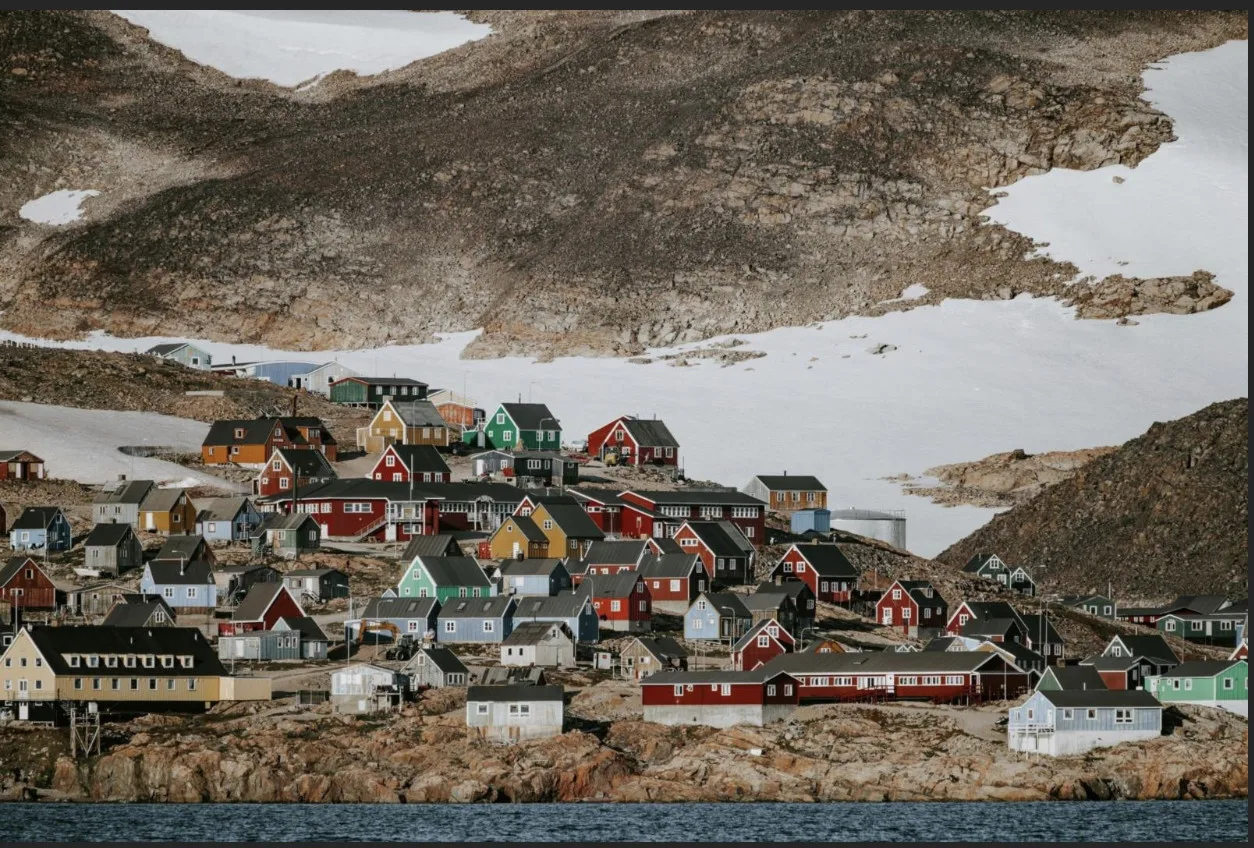
Self-determination is a right to independence; it means that people have the freedom from outside interference to exercise self-government and pursue their development. Nowadays, Greenland is 90 percent Inuit and has maintained its traditions, language, knowledge, and land despite centuries of colonial rule, and it is viewed as a model of indigenous self-determination and sovereignty (Grist, 2026). This status is not just a political sentiment, but an international entitlement. Greenland was first registered as a “non-self-governing territory” with the UN, which basically meant that it was a colony. However, in 1954, the UN General Assembly confirmed that the people of Greenland had freely exercised their right to self-determination by integrating into the Danish realm, noting with satisfaction “the achievement of self-government by the people of Greenland”. Therefore, the UN terminated the status of territory as a non-self-governing territory (EJIL: Talk!, 2026).
Decades later, in 2009, Denmark and Greenland adopted the Act of Greenland Self-Government, in which Copenhagen enhanced the status of Greenland again (EJIL: Talk!, 2026). The Act was endorsed by over 75 percent of the local population. This act provides a clear pathway to full independence should the population choose it, making it legally and morally impossible for any foreign power to “buy” the island from Denmark. Denmark does not even have the authority to dispose of a territory whose people have an established constitutional and international right to determine their own future. It is the people of Greenland alone who must decide on the future of the territory.
Trump’s statements and actions treat Greenland like a blank space on the map, totally ignoring the indigenous society that has built one of the world’s most successful examples of self-governance. Historians point out that framing this as a simple dispute between the US and Denmark mirrors old colonial narratives that viewed North America as a “squabble” between territories, while ignoring the Native nations already living there (Grist, 2026). This can be seen as a direct attack on the progress Greenland has made in reclaiming its language and its control over natural resources. For the Inuit, who view the land as a communal heritage rather than a piece of private real estate, the idea of being “sold” is not just a political threat,but also a denial of their existence as a sovereign people.
The UN experts also expressed concerns about Donald Trump’s statements regarding Greenland, including suggestions that the territory be placed under US control, and that force could be used to achieve that outcome. They highlighted that “any threat or use of force to alter the political status of Greenland or to challenge the sovereignty of another state is clearly prohibited by Article 2(4) of the UN Charter. These statements are inconsistent with international human rights law and the right to self-determination (OHCHR, 2026). They also stated that the mere suggestion that a territory could be “owned,” controlled, or taken by another state evokes a “logic of colonial domination” that has no place in the 21st century. The people of Greenland are entitled to the full and free exercise of their right to self-determination, a core purpose of the UN. They have the right to “freely determine their political status and freely pursue their economic, social, and cultural development” (UN Declaration on the Rights of Indigenous Peoples, 1992).
The battle for Greenland is a test of whether the world will allow 19th-century imperial logic to dismantle 21st-century human rights. The US is treating a sovereign community as real estate, and by doing so, it is challenging the fundamental principle that peopleown their future. Ultimately, the future of Greenland cannot be decided through negotiations; it belongs to the 57,000 people who have made their island a model of indigenous governance.
The Relevance of the Monroe Doctrine in the 21st Century
After capturing the President of Venezuela, Nicolas Maduro, Donald Trump has coined a new term to describe his approach to foreign policy – the “Donroe Doctrine”, his version of the Monroe Doctrine, a policy vision first articulated in 1823 by then-President James Monroe to oppose European interference in the Western Hemisphere (Time, 2026).
What Is the Monroe Doctrine?
On December 2, 1823, James Monroe introduced what would become known as the Monroe Doctrine. In it, Monroe warned European powers against further colonisation or interference in the Western Hemisphere (Time, 2026). The doctrine warned European nations that the United States would not tolerate further colonisation or puppet monarchs (Archives). The doctrine was conceived to meet major concerns of the moment, but soon it became a watchword of US policy in the Western Hemisphere. The doctrine was invoked in 1865 when the US government exerted diplomatic and military pressure in support of the Mexican President Benito Juárez (Time, 2026). This support enabled Juarez to lead a successful revolt against Emperor Maximilian, who had been placed on the throne by the French government. Later in the 19th century, the US stepped into Cuba’s fight for its independence against Spain and went to war with the European power in 1898, a conflict that ended Spain’s colonial presence in the region (Time, 2026). In 1904, European creditors of several Latin American countries threatened armed intervention to collect debts. President Theodore Roosevelt promptly proclaimed the right of the United States to exercise an “international police power” to curb such “chronic wrongdoing,” in his so-called Roosevelt Corollary to the Monroe Doctrine (Time, 2026). While the Monroe Doctrine was designed to keep European powers out of the Western Hemisphere, Roosevelt would strengthen its meaning to justify sending the US into other countries of the Western Hemisphere (Archives). This updated version of the doctrine helped set the stage for repeated US military intervention in Latin America. Within just over a decade of Roosevelt articulating it, US forces were sent to the Dominican Republic in 1903 and 1904, Nicaragua in 1911, and Haiti in 1915 (Time, 2026).
The 2026 revival of this doctrine, however, represents a radical departure from its original intent. While James Monroe sought to prevent colonisation, the “Donroe Doctrine” is being used to facilitate it. In December 2025, Trump stated: “The US will never waver in the defence of our homeland, our interests, or the well-being of our citizens. Today, my administration proudly reaffirms this promise under a new “Trump Corollary” to the Monroe Doctrine: that the American people- not foreign nations nor globalist institutions- will always control their own destiny in our hemisphere” (Time, 2026). The aim of the “Donroe Doctrine” is to reassert American dominance in the Western hemisphere.
If this “doctrine” and Trump’s approach to international policy are the guidelines for the US, then by applying this logic to Greenland, the administration is clearly attempting to treat the island as a security asset rather than a self-governing community. This creates a fundamental human rights conflict. The US approach suggests that international law only applies when it aligns with American interests. This approach ignores the fact that Greenland is an autonomous territory with the right to its own political status. However, the problem for Trump is that the world has largely evolved away from this mindset. In contrast to a zero-sum game where the other side’s success is your defeat, today’s international community believes that respecting each other’s borders and agreeing on common rules is the way to go forward. At the same time, Trump should not forget that Denmark is not Venezuela. The moment they use military force to take Greenland, the transatlantic security guarantee is most likely dead, and many European countries will find themselves in their greatest security crisis since WWII. As the protests of January 2026 have shown, the Inuit are not interested in being the territory that the US can buy, they are the sovereign people whose dignity cannot be treated as a strategic win.
By framing an inhabited land as a “security asset” and weaponising trade through the “Donroe Doctrine”, the US has attempted to bypass the foundational principle of modern democracy, that sovereignty belongs to the people. The right to self-determination of Greenlanders is protected by the UN Charter and the 2009 Self-Government Act. If the US can successfully use force to threaten a democratic ally and ignore indigenous consent, the very concept of territorial integrity will become obsolete. As the world moves forward, it must decide whether it will be governed by the rule of law and democratic principles, or governed by the “Donroe Doctrine”, where Trump (in this case) acts as it suits him. If the established rules for international peaceful coexistence are not defended and respected, they will become irrelevant and have incalculable consequences for peace and stability, and only dominant powers with imperial ambitions will be able to benefit from the kind of world order that is now evolving before us.
Conclusion
Despite less than 25 percent of 2026 having passed, the year has already seen Trump’s capture of Venezuela’s president, Nicolas Maduro, allowing the US president to demonstrate that international law and its standards are just the words on the paper for him. Now he is trying to “buy” Greenland.
However, the bottom line is that, if his “Donroe” logic succeeds, it will send a very scary message to every small nation and indigenous people on the planet, that their rights only exist as long as they do not get in the way of a “superpower’s” convenience. The Inuit have spent the last century peacefully building a global model for self-governance, proving that decolonisation can work in modern society. To let this be dismantled for the sake of strategic denial would be a catastrophic step backwards for human rights.
The protests in Nuuk were a reminder that culture cannot be bought, and you cannot trade away a people’s dignity. The international community now faces a choice, to uphold the laws, or to return to a world where the maps were drawn by whoever was the strongest. The political leaders around the world need to be pressured to move away from appeasement and acquiescence towards the US and to insist consistently on international law, the United Nations Charter, and the right to self-determination. Greenland has clearly chosen its path.
Bibliography
ABC News (January 17, 2026). Thousands protest in Denmark, chanting ‘Greenland is not for sale’ in response to Trump’s threats. https://www.abc.net.au/news/2026-01-18/denmark-protests-greenland-not-for-sale-response-trump-threats/106241056 accessed January 26, 2026.
ABC News (January 8, 2026). Donald Trump’s comments about Greenland were once seen as a joke, Greenlanders are no longer laughing. https://www.abc.net.au/news/2026-01-09/donald-trump-greenland-denmark-nato-comments-worrying-island/106210090accessed January 26, 2026.
Act on Greenland Self-Government (2009).
Al Jazeera (January 17, 2026). The threat against Greenland shows that we need to stop appeasing Trump. https://www.aljazeera.com/opinions/2026/1/18/the-threat-against-greenland-shows-that-we-need-to-stop-appeasing-trump accessed January 26, 2026.
Archives (1823). Monroe Doctrine. https://www.archives.gov/milestone-documents/monroe-doctrine accessed January 26, 2026.
CBC News (January 8, 2026). Some Greenlanders express outrage over Trump’s threats. But not all are concerned. https://www.cbc.ca/news/world/greenland-trump-threats-reaction-9.7036410 accessed Januaty 26, 2025.
Chatham House (January 23, 2026). If Trump’s ‘framework’ Greenland agreement relies on creating ‘sovereign’ bases, it would bring long-term legal issues. https://www.chathamhouse.org/2026/01/if-trumps-framework-greenland-agreement-based-creating-sovereign-bases-it-would-bring-long accessed Januaty 26, 2025.
EJIL:Talk! (January 23, 2026). The Davos Trap on Greenland. https://www.ejiltalk.org/the-davos-trap-on-greenland/ accessed Janaury 26, 2026.
Grist (January 22, 2026). Greenland is a global model for Inigenous self-governance. Trump’s demands for the island threaten that. https://grist.org/global-indigenous-affairs-desk/greenland-is-a-global-model-for-indigenous-self-governance-trumps-demands-for-the-island-threaten-that/ accessed January 26, 2026.
International Covenant on Economic, Social and Cultural Rights (December 16, 1966). https://www.ohchr.org/en/instruments-mechanisms/instruments/international-covenant-economic-social-and-cultural-rights accessed January 26, 2026.
International Covenant on Civil and Political Rights (December 16, 1966). https://www.ohchr.org/en/instruments-mechanisms/instruments/international-covenant-civil-and-political-rights accessed January 26, 2026.
OHCHR (January 14, 2026). Greenland: UN experts urge United States to respect international law and right to self-determination. https://www.ohchr.org/en/press-releases/2026/01/greenland-un-experts-urge-united-states-respect-international-law-and-rightaccessd January 26, 2026
PBS News (January 17, 2026). Thousands march in Greenland against Trump’s threats to take over the Arctic island. https://www.pbs.org/newshour/world/thousands-march-in-greenland-against-trumps-threats-to-take-over-the-arctic-island accessed January 26, 2026.
Time (January 17, 2026). The 200-Year-Old Foreing Policy Vision Underlying Trump’s ‘Donroe Doctrine.’ https://time.com/7343795/trump-venezuela-monroe-doctrine-history/ accessed January 26, 2026
United Nations Charter (1945). https://www.un.org/en/about-us/un-charter accessed January 26, 2026.
United Nations Declaration on the Rights of Indigenous Peoples (2007).