
Introduction
Originally commissioned by Global Human Rights Defence in the early 2010s, SOLD. A Child Trafficked follows Nepali survivors of child sexual trafficking as they work to heal and to raise awareness in their local communities. The documentary confronts viewers with the realities of sexual exploitation, the vulnerability of children affected by poverty and social exclusion, and the systems that allow such abuses to persist.
In opening the evening, the moderator emphasised that while GHRD engages in advocacy at the United Nations and the European Parliament, community based outreach remains central to its mission. The screening formed part of this broader commitment to fostering informed public dialogue on minority rights and protection frameworks.
The discussion following the film addressed the continued relevance of its message. As highlighted during the panel, available international data indicate that children accounted for 27 percent of detected trafficking victims in 2012, compared to 38 percent in 2022, underscoring the persistence and evolving character of the crime.
The Role of Storytelling, Accountability, and Structural Drivers
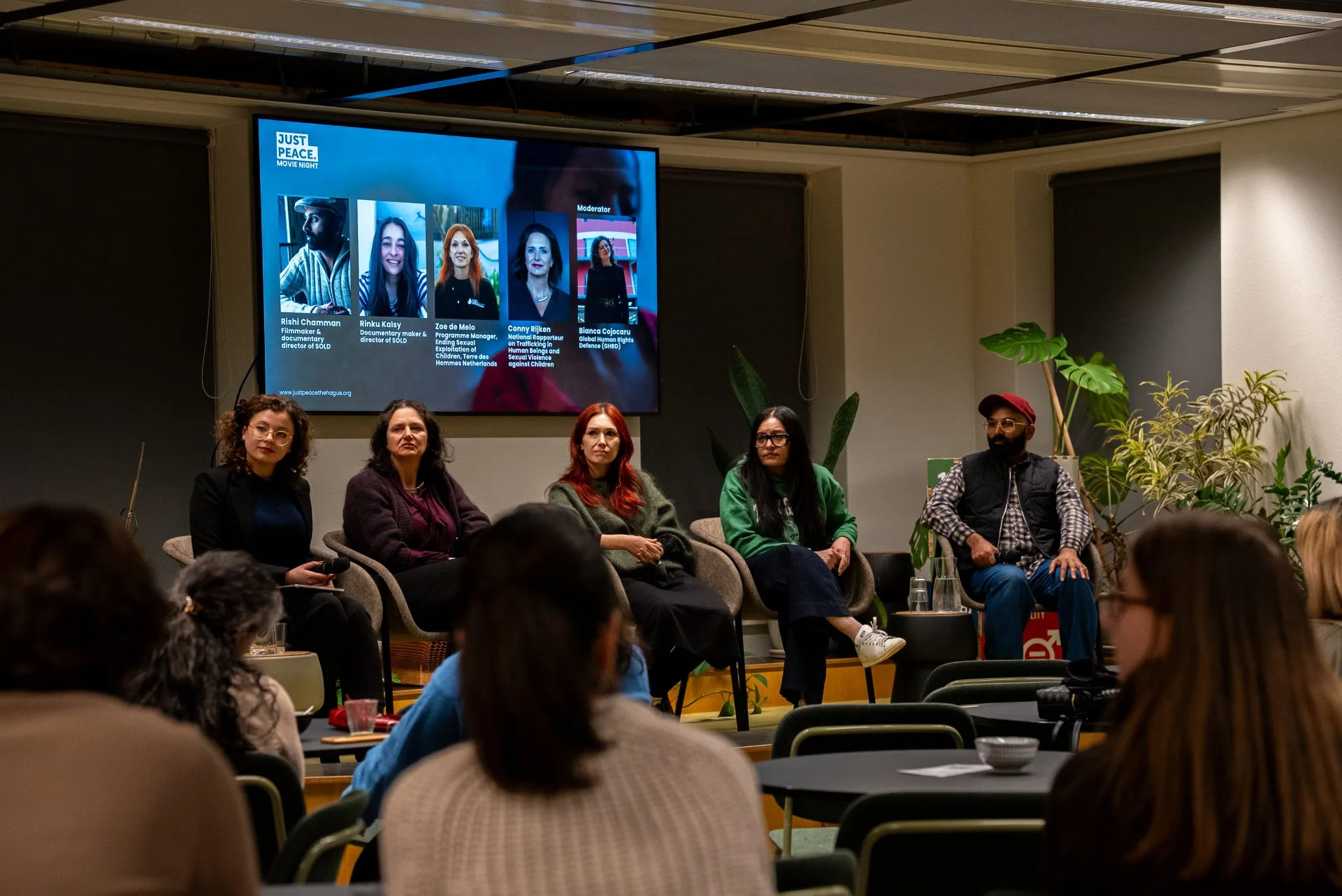
The panel brought together the film’s directors, Rishi Chamman and Rinku Kalsy, alongside Zoe de Melo, Programme Manager at Terre des Hommes Netherlands, and Conny Rijken, Dutch National Rapporteur on Trafficking in Human Beings and Sexual Violence against Children and Professor at Tilburg University.
Reflecting on the role of documentary filmmaking, the directors discussed the ethical responsibilities inherent in portraying survivor experiences, particularly when engaging with children and vulnerable communities. They stressed the importance of establishing trust and avoiding narratives that reduce complex realities to simplified tropes. They also pondered the question of what it means to truly save someone, recalling their experiences shooting the documentary in Nepal. Emphasis was placed on the effect that child sexual trafficking has on the victims, and the ongoing work to heal and rehabilitate.
From a prevention and monitoring perspective, the panel examined the structural drivers of trafficking, including poverty, gender inequality, social marginalisation, and limited access to education and protection systems. It was stressed that trafficking should not be understood solely as isolated criminal acts, but as a phenomenon embedded in broader socio-economic vulnerabilities. Additionally, the discussion addressed the emerging role of social media and digital tools in trafficking. Experts emphasized the relevance of prevention and awareness-building for protecting children and youth from being victimized through online means.
The European and Dutch dimensions of trafficking were also addressed, highlighting that exploitation is not confined to distant contexts. Cross-border cooperation, coordinated policy responses, and victim centred support systems were identified as essential components of effective prevention and accountability frameworks.
In Dialogue with the Audience
The discussion concluded with an interactive question and answer session, during which audience members reflected on the film’s impact and posed questions regarding international enforcement gaps, emerging training for first responders and police forces, and ongoing community engagement with survivors from Nepal.
During the closing round of questions, the panelists were invited to reflect not only on institutional responsibilities, but also on the role of individuals in confronting child sexual trafficking. They emphasised that making exploitation less invisible begins with informed engagement, by challenging harmful stereotypes, and remaining attentive to the structural conditions that place children at risk. Audience members were encouraged to continue educating themselves and others, and to use their professional or academic platforms to advocate for stronger child protection measures.
The discussion underscored that while trafficking is sustained by systemic failures, greater public awareness, sustained attention, and community level dialogue are essential components in reducing its invisibility and reinforcing accountability.
Conclusion
The screening of SOLD. A Child Trafficked reaffirmed the importance of maintaining visibility around child trafficking and of grounding policy discussions in lived experiences. By creating space for dialogue between filmmakers, practitioners, and the public, the event contributed to an ongoing conversation about prevention, accountability, and the collective responsibility to safeguard children’s rights.
Global Human Rights Defence extends its appreciation to the panelists, partners, and attendees who participated in the discussion and to the Just Peace Movie Night programme and The Hague Humanity Hub for hosting the event.