
Introduction
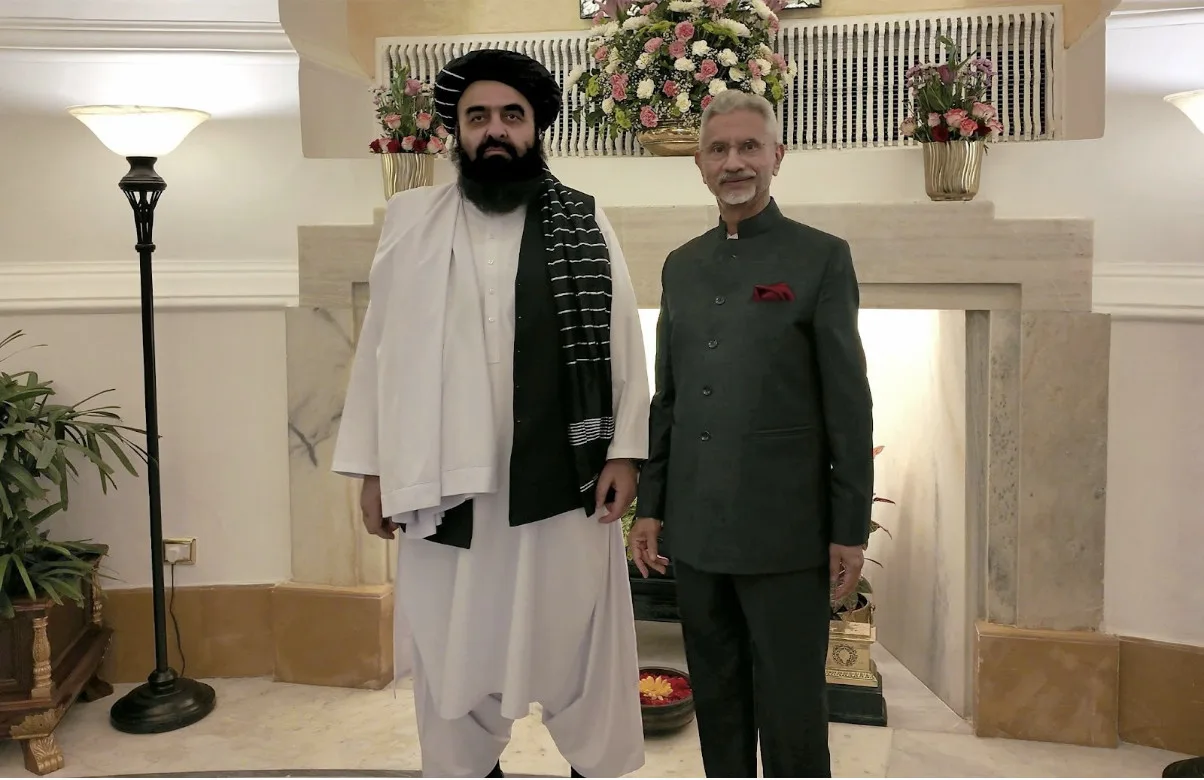
When India closed its embassy in Kabul after the Taliban’s return to power in August 2021, the international community understood this diplomatic decision as a way to signal the country’s opposition to the Taliban governance. Given the case, few imagined that four years later New Delhi would welcome the group’s foreign minister with official honours. IYet, in October 2025, Taliban Foreign Minister Mawlawi Amir Khan Muttaqi arrived in New Delhi for a week-long visit, the first by a Taliban delegation since the group seized power (Sharma, 2025). His meetings with Indian Foreign Minister Subrahmanyam Jaishankar marked a watershed in South Asia’s diplomatic landscape and a striking reversal of India’s historic stance toward the Taliban.
For the Afghan people, however, and especially women, journalists, and minorities, it raises urgent questions about accountability and the silence surrounding ongoing abuses under Taliban rule.
For the Indian government, the move is driven by geopolitical calculus. With relations between Kabul and Islamabad deteriorating, and Pakistan accusing the Taliban of harbouring harboring armed groups that attack its territory, New Delhi sees an opportunity to reclaim influence in Afghanistan and reduce Pakistan’s regional leverage (Sharma, 2025).
For the Afghan people, however, and especially women, journalists, and minorities, it raises urgent questions about accountability and the silence surrounding ongoing abuses under Taliban rule.
India’s new engagement with the Taliban is primarily strategic. With relations between Kabul and Islamabad deteriorating, and Pakistan accusing the Taliban of harbouringharboring armed groups that attack its territory, New Delhi sees an opportunity to reclaim influence in Afghanistan and reduce Pakistan’s regional leverage (Sharma, 2025).
India’s Political Interests
For India, ignoring the Taliban would mean surrendering the Afghan arena to rivals such as Pakistan and China. Analysts in New Delhi argue that the visit demonstrates “pragmatism”, the willingness to deal with whoever holds power, regardless of ideology. The Indian Ministry of External Affairs justified the reset as an effort to contribute to Afghanistan’s “development and stability.” (Sharma, 2025).
But this realpolitik approach contrasts sharply with India’s longstanding support for democracy and civil society in Afghanistan. For two decades, Indian aid projects, scholarships, and cultural initiatives empowered women and youth. By extending de facto recognition to an unaccountable regime that has dismantled women’s rights, banned girls from secondary and higher education, and crushed media freedom, India risks eroding that legacy.
For the Taliban, being hosted in one of the world’s largest democracies is a symbolic and political triumph. The group remains under UN sanctions and unrecogniszed by the international community (OHCHR, 2023). India’s red-carpet reception, complete with meetings at the foreign ministry and visits to the Darul Uloom Deoband, one of South Asia’s most influential Islamic seminaries, provides badly needed legitimacy.
The Taliban also used the visit to court Indian investment in mining and trade, to call India a “close friend,” and to announce plans for direct flights between Kabul and Indian cities. The optics suggest a normaliszation of relations, something the Taliban can present at home as proof of growing international acceptance.
This diplomatic breakthrough, however, came with silence on rights. Neither side addressed the systematic exclusion of women from public life, nor the arbitrary detentions of activists, journalists, and former government officials (United Nations Human Rights Council, 2024; Amnesty International, 2023; Human Rights Watch, 2024). Even during the press conference in New Delhi, female journalists were initially barred from attending.
Afghanistan’s Humanitarian Situation
Since August 2021, Afghanistan has witnessed one of the world’s steepest human-rights declines. The Taliban’s Ministry for the Propagation of Virtue and Prevention of Vice has imposed sweeping restrictions on women’s mobility, work, and education. The UN Special Rapporteur on Afghanistan and numerous rights organiszations have warned of institutionaliszed discrimination amounting to gender persecution, a potential crime against humanity (OHCHR, 2023).
Journalists face censorship, arbitrary arrest, and torture (Human Rights Watch, 2024). Ethnic and religious minorities, including Hazaras and Sikhs, remain under threat (Amnesty International, 2023). Thousands of Afghans are trapped in economic collapse and food insecurity, worsened by the Taliban’s mismanagement and international isolation (World Bank, 2025).
Against this backdrop, India’s silence on rights issues appears deafening. Choosing to prioritisze geopolitical balance over human rights sends a discouraging message, not only to Afghans but also to global partners who once looked to New Delhi for principled diplomacy.
The timing of Muttaqi’s visit coincided with cross-border clashes between Pakistan and Afghanistan, revealing a deeply unstable regional context (Sharma, 2025). India’s outreach may help prevent further Afghan isolation, but it also risks legitimiszing a regime that continues to oppress its own people.
The danger is that pragmatic engagement, without conditions or public criticism, becomes normaliszation. By meeting the Taliban without pressing for rights commitments, such as reopening schools for girls, freeing detained activists, or ensuring women’s participation in governance, India inadvertently rewards repression (Graham-Harrison, 2023; Deutsche Welle, 2024).
While some governments argue that engagement is necessary to sustain humanitarian access, any diplomatic contact with the Taliban must be anchored in clear human-rights conditions. Without accountability, such engagement risks legitimiszing repression and undermining Afghan civil society.
With its embassy in Kabul now fully reopened (Iyengar, 2025), India has an opportunity to act as a channel for international accountability supporting local NGOs, monitoring abuses, and ensuring that its development projects benefit Afghan women and marginaliszed communities.
Conclusion
India’s engagement with the Taliban reflects a regional strategy driven more by security concerns than by solidarity with Afghan citizens. The challenge ahead will be ensuring that diplomatic pragmatism does not come at the expense of human rights.
For the people of Afghanistan, diplomacy without rights is a hollow victory. For India, whose aid and reconstruction projects once symboliszed solidarity with the Afghan people, the real test will be whether engagement with the Taliban upholds that legacy of support for human rights.
Bibliography
Deutsche Welle. (2024, June). Afghan women call for stronger international pressure on the Taliban. https://www.dw.com/en/afghan-women-call-for-stronger-international-pressure-on-the-taliban/a-68499319
Graham-Harrison, E. (2023, December 5). Afghan women’s rights activists accuse world powers of legitimising Taliban. The Guardian. https://www.theguardian.com/world/2023/dec/05/afghan-women-rights-activists-legitimising-taliban
Iyengar, R. (2025, October 22). India reopens its embassy in Kabul for the first time since Taliban takeover. Reuters. https://www.reuters.com/world/asia-pacific/india-reopens-embassy-kabul-first-since-taliban-takeover-2025-10-22/
Sharma, Y. (2025, October 14). Afghan foreign minister in India: Why New Delhi is embracing Taliban now. Al Jazeera. https://www.aljazeera.com/news/2025/10/14/afghan-foreign-minister-in-india-why-new-delhi-is-embracing-taliban-now
OHCHR. (2023, May 8). Afghanistan: Taliban suppression of women’s rights may amount to gender persecution – UN experts. United Nations Office of the High Commissioner for Human Rights. https://www.ohchr.org/en/press-releases/2023/05/afghanistan-taliban-suppression-womens-rights-may-amount-gender-persecution
United Nations Human Rights Council. (2024). Situation of human rights in Afghanistan (Report of the Special Rapporteur on the situation of human rights in Afghanistan, A/HRC/55/24). https://www.ohchr.org/en/country/afghanistan
World Bank. (2025). Afghanistan overview. https://www.worldbank.org/en/country/afghanistan/overview