
International Context
On September 18th, 2025, in New York, the United Nations Security Council (UNSC) once again failed to adopt a resolution calling for an immediate and permanent ceasefire in Gaza. The proposal, presented by the ten elected members of the Council and supported by 14 out of 15 members, was blocked by a “no” from the United States. The country defended its decision by pointing to the draft’s failure to condemn Hamas sufficiently, and to affirm Israel’s right to self-defence (Rubio, 2025; United Nations, 2025a).
This marked the sixth time that the United States has used its veto power to block a ceasefire initiative supported by an overwhelming international majority, since the beginning of Israel’s offensive in Gaza nearly two years ago (Morley, 2025).
The veto came as Israel launched a new phase of its military offensive. Just days earlier, the government announced the beginning of a ground operation in Gaza City, with the declared objective of taking full control of the territory.
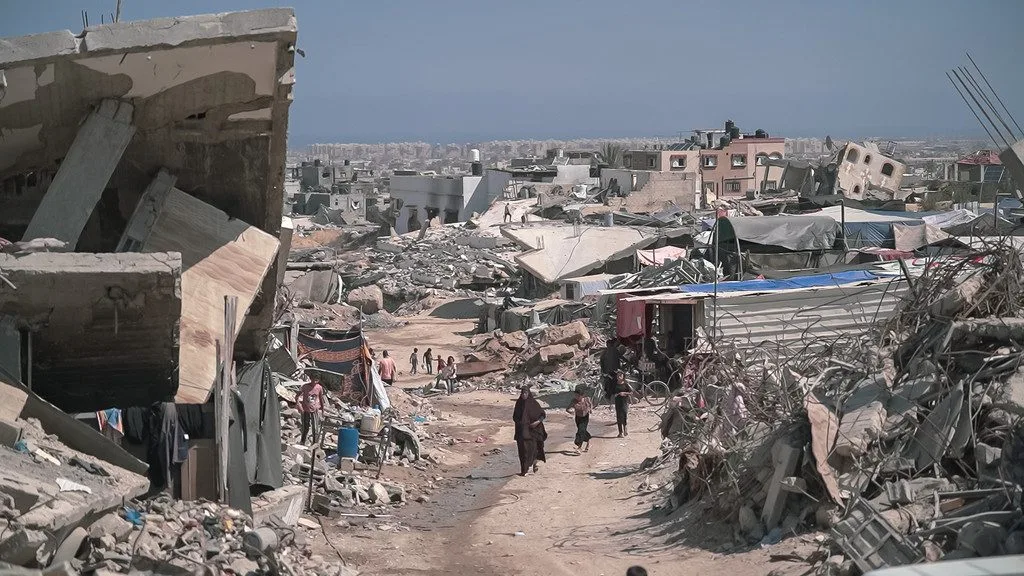
The humanitarian and military situation in Gaza remains dire. The draft resolution described conditions in Gaza as “catastrophic” and called on Israel to lift restrictions on aid delivery.
UN Developments
In parallel, the United Nations Independent International Commission of Inquiry on the Occupied Palestinian Territory, including East Jerusalem, and Israel, presented its latest findings, stating that the atrocities committed in Palestine meet the legal definition of genocide. The Commission documented a systematic pattern of attacks targeting the civilian population, the deliberate destruction of essential infrastructure such as hospitals, water plants, and schools, as well as the use of starvation as a method of warfare through the near-total blockade of humanitarian aid (United Nations, 2025b).
The report further highlights the responsibility of senior Israeli officials in planning and executing these policies, stressing that these are not isolated excesses, but rather a sustained strategy aimed at destroying, in whole or in part, the Palestinian people as a national group. It also warns that the repeated disregard for UN resolutions and the impunity of those responsible are gravely undermining the international human rights protection system.
At the General Assembly, on September 12th, 142 out of 193 Member States voted in favour of the New York Declaration, which reaffirmed support for the two-state solution. A few days later, on September 19th, the Élysée Palace announced that France would officially recognise the State of Palestine on September 22nd during a conference on the two-state solution, held within the framework of the Assembly. The statement also indicated that nine other Western states (Andorra, Australia, Belgium, Canada, Luxembourg, Malta, Portugal, the United Kingdom and San Marino) were expected to take the same step. The New York Declaration is the outcome of an international conference held in July at UN Headquarters, organised by France and Saudi Arabia, which resumes later this month (United Nations, 2025a; The Guardian, 2025a).
Meanwhile, in Geneva, the Human Rights Council continued its debates on the situation of human rights in the occupied Palestinian territories. Although this body does not have the authority to decide on ceasefires, the 60th session served as a platform to endorse the Commission of Inquiry’s conclusions, and to bring forward victims’ testimonies, including those of women and girls.
Within this framework, the GHRD team attended events such as “The Situation of Women in the Occupied Palestinian Territory”, where the systematic persecution and violence endured especially by women and girls were laid out clearly. During this event, the special rapporteur on the situation of human rights in Palestine, Francesca Albanese, also stressed that trading with Israel, despite the recognition of Palestine, is a “disgrace”.
Taken together, these developments reveal a profoundly contradictory international landscape: on the one hand, diplomatic pressure is mounting and the number of states officially recognising Palestine continues to grow; on the other, violence on the ground shows no sign of abating, while the UN’s main institutions remain blocked, unable to halt the destruction and the suffering of Gaza’s civilian population.
Escalation Despite Diplomacy
On September 29th, 2025, U.S. President Trump and Israeli Prime Minister Benjamin Netanyahu jointly announced a 20-point peace plan proposal aimed at ending the war in the Gaza Strip (White House, 2025). Among the key points of Trump’s plan were the creation of a Palestinian transitional government in Gaza under international supervision, the release of both Israeli hostages and Palestinian detainees, and the deradicalisation of the territory, which included the disarmament of Islamist groups (RTVE, 2025).
The announcement came one day after Trump delivered a direct ultimatum to Hamas, setting a deadline for the militant group to accept the conditions or face intensified military action. Netanyahu, under growing domestic pressure, signalled conditional approval of the plan but rejected any elements that implied Palestinian statehood or that would limit Israel’s long-term security control (Le Monde, 2025).
Following intense pressure, on October 8th, 2025, Trump announced that Israel and Hamas had agreed to the first phase of the plan, centred on a temporary ceasefire, the phased release of Israeli hostages and Palestinian detainees and the initial pullback of Israeli troops from specific areas of northern and central Gaza (ABC News, 2025). The following day, the Israeli cabinet approved the arrangement, and limited withdrawals began. International actors welcomed the development, describing it as a rare diplomatic opening after nearly two years of war (PBS Newshour, 2025).
However, the deal’s fragility became immediately apparent. Implementation stalled within days due to disputes over monitoring mechanisms, the security of aid routes, and the presence of Israeli forces around hospitals and shelters. By late October, reports indicated that the ceasefire had largely collapsed in practice, as Israeli airstrikes resumed in parts of Gaza City and Khan Younis, and armed clashes re-escalated around several urban districts. Humanitarian agencies warned that the expected expansion of aid had “failed to materialise,” with convoys still restricted and large parts of the population receiving almost no assistance (OCHA, 2025).
Current Situation
As of now, the situation on the ground remains extremely volatile. Bombardments continue, particularly in the central and southern regions of the Gaza Strip, and civilian casualties are still being reported daily. Israeli forces have re-entered several zones from which partial withdrawals had been announced earlier in the month. Hospitals continue to operate at minimal capacity, thousands remain displaced, and access to clean water, food and fuel remains critically limited (UNRWA, 2025). In this context, the October deal, initially framed as the first step toward a broader peace agreement, has effectively become a stagnant and contested arrangement, lacking the political consensus and operational guarantees needed to prevent renewed violence.
Diplomatically, the process is also stalled. The second phase of the Trump plan, concerning the governance of Gaza, long-term reconstruction, and security arrangements, has not begun. Netanyahu insists that any future phase must exclude Hamas entirely and must not lead to Palestinian sovereignty. At the same time, Hamas rejects demilitarisation and refuses to accept Israeli oversight of Gaza’s borders and institutions (The Guardian, 2025b). With neither side prepared to compromise on core issues, the international community increasingly sees the plan’s first phase as an incomplete pause rather than a peace framework.
At this stage, a return to unstable fighting conditions is unfolding amid a stalled diplomatic proposal. The humanitarian situation continues to deteriorate, and the gap between political announcements and the reality for civilians in Gaza is wider than ever.
Bibliography
ABC News. (2025, October). Israel and Hamas sign off on first phase of peace plan [Video]. https://abcnews.go.com/International/video/israel-hamas-signed-off-1st-phase-peace-plan-126349959
Associated Press. (2025, September). UN General Assembly adopts declaration backing two-state solution. AP News. https://apnews.com/article/a0515517bcc9764f69caa204bbce984f
Castrillo, P. (2025, November). Un fiscal italiano investiga por primera vez los ‘safaris humanos’ en el Sarajevo sitiado. El Salto. https://www.elsaltodiario.com/italia/un-fiscal-italiano-investiga-primera-vez-safaris-humanos-sarajevo-sitiada
Domínguez, Í (2025a, November). La Fiscalía de Milán investiga ‘safaris humanos’ en Sarajevo: viajes a la guerra en los noventa pagando por disparar a personas. El País. https://elpais.com/internacional/2025-11-11/la-fiscalia-de-milan-investiga-safaris-humanos-en-sarajevo-viajes-a-la-guerra-en-los-noventa-pagando-por-disparar-a-personas.html
Le Monde. (2025, September). France to officially recognise the State of Palestine at the UN on 22 September. Le Monde. https://www.lemonde.fr/en/international/article/2025/09/22/how-israel-has-tried-to-halt-the-wave-of-recognition-for-the-state-of-palestine_6745617_4.html
Le Monde. (2025, October). Netanyahu accepts Trump’s Gaza plan under pressure but sets conditions. https://www.lemonde.fr/en/international/article/2025/09/30/netanyahu-accepts-trump-s-gaza-peace-plan-under-pressure-but-sets-conditions_6745930_4.html
Office of the High Commissioner for Human Rights [OHCHR]. (2025, September 16). Israel has committed genocide in Gaza Strip, UN Commission finds. OHCHR. https://www.ohchr.org/en/press-releases/2025/09/israel-has-committed-genocide-gaza-strip-un-commission-finds
PBS NewsHour. (2025, October). What we know about the deal to pause the war in Gaza—and what’s next. https://www.pbs.org/newshour/world/what-we-know-about-the-deal-to-pause-war-in-gaza-and-whats-next
RTVE. (2025, September). Claves del plan de Trump para la paz en Gaza. https://www.rtve.es/noticias/20250929/plan-trump-gaza-21-puntos-convencer-netanyahu-terminar-masacre-paz/16749122.shtml
Rubio, M. (2025, June). Veto of the United Nations Security Council resolution on Gaza [Press Statement]. https://www.state.gov/releases/office-of-the-spokesperson/2025/06/veto-of-the-united-nations-security-council-resolution-on-gaza/
The Guardian. (2025a, September). UK, Canada and Australia announce recognition of Palestine in coordinated move. The Guardian. https://www.theguardian.com/world/2025/sep/21/uk-canada-and-australia-announce-formal-recognition-of-palestine
The Guardian. (2025b, September). Hamas mulls options as countries rush to welcome Trump’s Gaza peace plan. The Guardian. https://www.theguardian.com/world/2025/sep/30/hamas-mulls-options-as-countries-rush-to-welcome-trump-gaza-peace-plan
United Nations. (2025a, September). UN meets on Gaza ceasefire, humanitarian access amid escalating crisis. UN News. https://news.un.org/en/story/2025/09/1165835
United Nations. (2025b, September). Israel has committed genocide in the Gaza Strip, UN Commission finds. https://www.un.org/unispal/document/israel-has-committed-genocide-in-the-gaza-strip-un-commission-finds-16sep25/
Vatican News. (2025, September). U.S. vetoes U.N. ceasefire resolution as Gaza humanitarian crisis worsens. https://www.vaticannews.va/en/world/news/2025-09/us-un-ceasefire-resolution-veto-gaza-humanitarian.html
White House. (2025, October). Global support for President Trump’s bold vision for peace in Gaza. https://www.whitehouse.gov/articles/2025/10/global-support-for-president-trumps-bold-vision-for-peace-in-gaza/