
Reports
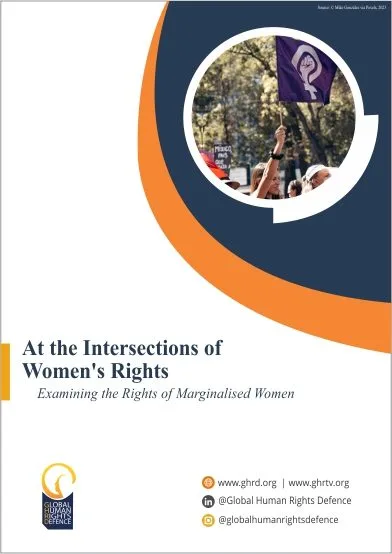
At the Intersections of Women’s Rights : Examining the Rights of Marginalised Women
- GHRD Team
- 5 July 2023
Since the 19th century, the women’s rights movement has championed the rights and entitlements of women and girls all over the world. The movement has advocated for a number of rights, such as the right to vote and to hold public office, freedom from sexual violence, equal pay, bodily and reproductive autonomy, access to education and property ownership, and overall gender equality. Great advances have been made for women and girls in the decades since.
However, the women’s rights movement has historically failed to acknowledge the intersectionalities of so many women, such as race, sexuality, gender identity, age, migration status, and so on. As such, it is imperative to move away from the mainstream, middle class and white-dominated feminist movement which has often excluded women of colour and those of a less advantaged socioeconomic status, and to instead broaden the scope of inclusion to all women, regardless of their background. The path forward must include the experiences of all women, and ensure that rights are guaranteed for all, not just a select, privileged few. As the American writer and activist Audre Lorde stated, “I am not free while any woman is unfree, even when her shackles are very different from my own.”
The need to shed light on the grievances of those groups of women who have historically been, and continue to be, underrepresented by the traditional feminist movements, is unquestionable. This is especially true for women belonging to the more vulnerable subsets of society, whose demands for change are often unheard. As such, the purpose of this report is to illuminate the experiences of those women: migrant women, women with disabilities, transgender women, and sex workers, for instance.
While women around the world have many of the same qualms against sexism, misogyny and the patriarchy, the specific and sometimes distinct needs of different groups of individuals must be addressed. It must always be remembered that, for the women’s rights movement to truly achieve equality for all, it is important to be intentional about inclusion and look at women’s rights through an intersectional lens in order to advance the rights of all women.
However, the women’s rights movement has historically failed to acknowledge the intersectionalities of so many women, such as race, sexuality, gender identity, age, migration status, and so on. As such, it is imperative to move away from the mainstream, middle class and white-dominated feminist movement which has often excluded women of colour and those of a less advantaged socioeconomic status, and to instead broaden the scope of inclusion to all women, regardless of their background. The path forward must include the experiences of all women, and ensure that rights are guaranteed for all, not just a select, privileged few. As the American writer and activist Audre Lorde stated, “I am not free while any woman is unfree, even when her shackles are very different from my own.”
The need to shed light on the grievances of those groups of women who have historically been, and continue to be, underrepresented by the traditional feminist movements, is unquestionable. This is especially true for women belonging to the more vulnerable subsets of society, whose demands for change are often unheard. As such, the purpose of this report is to illuminate the experiences of those women: migrant women, women with disabilities, transgender women, and sex workers, for instance.
While women around the world have many of the same qualms against sexism, misogyny and the patriarchy, the specific and sometimes distinct needs of different groups of individuals must be addressed. It must always be remembered that, for the women’s rights movement to truly achieve equality for all, it is important to be intentional about inclusion and look at women’s rights through an intersectional lens in order to advance the rights of all women.
✨ AI summary
Since the 19th century, the women’s rights movement has championed the rights and entitlements of women and girls all over the world. The movement has advocated for a number of rights, such as the right to vote and to hold public office, freedom from sexual violence, equal pay, bodily and reproductive autonomy, access to education and property ownership, and overall gender equality. Great advances have been made for women and girls in the decades since.
However, the women’s rights movement has historically failed to acknowledge the intersectionalities of so many women, such as race, sexuality, gender identity, age, migration status, and so on. As such, it is imperative to move away from the mainstream, middle class and white-dominated feminist movement which has often excluded women of colour and those of a less advantaged socioeconomic status, and to instead broaden the scope of inclusion to all women, regardless of their background. The path forward must include the experiences of all women, and ensure that rights are guaranteed for all, not just a select, privileged few. As the American writer and activist Audre Lorde stated, “I am not free while any woman is unfree, even when her shackles are very different from my own.”
The need to shed light on the grievances of those groups of women who have historically been, and continue to be, underrepresented by the traditional feminist movements, is unquestionable. This is especially true for women belonging to the more vulnerable subsets of society, whose demands for change are often unheard. As such, the purpose of this report is to illuminate the experiences of those women: migrant women, women with disabilities, transgender women, and sex workers, for instance.
While women around the world have many of the same qualms against sexism, misogyny and the patriarchy, the specific and sometimes distinct needs of different groups of individuals must be addressed. It must always be remembered that, for the women’s rights movement to truly achieve equality for all, it is important to be intentional about inclusion and look at women’s rights through an intersectional lens in order to advance the rights of all women.
However, the women’s rights movement has historically failed to acknowledge the intersectionalities of so many women, such as race, sexuality, gender identity, age, migration status, and so on. As such, it is imperative to move away from the mainstream, middle class and white-dominated feminist movement which has often excluded women of colour and those of a less advantaged socioeconomic status, and to instead broaden the scope of inclusion to all women, regardless of their background. The path forward must include the experiences of all women, and ensure that rights are guaranteed for all, not just a select, privileged few. As the American writer and activist Audre Lorde stated, “I am not free while any woman is unfree, even when her shackles are very different from my own.”
The need to shed light on the grievances of those groups of women who have historically been, and continue to be, underrepresented by the traditional feminist movements, is unquestionable. This is especially true for women belonging to the more vulnerable subsets of society, whose demands for change are often unheard. As such, the purpose of this report is to illuminate the experiences of those women: migrant women, women with disabilities, transgender women, and sex workers, for instance.
While women around the world have many of the same qualms against sexism, misogyny and the patriarchy, the specific and sometimes distinct needs of different groups of individuals must be addressed. It must always be remembered that, for the women’s rights movement to truly achieve equality for all, it is important to be intentional about inclusion and look at women’s rights through an intersectional lens in order to advance the rights of all women.
Share this report
Facebook
X
LinkedIn
WhatsApp