
Reports
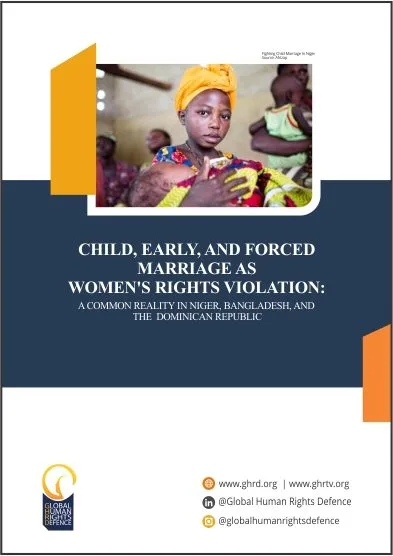
Child, Early and Forced Marriage as Women’s Rights Violation : A common reality in Niger, Bangladesh and the Dominic Republic
- GHRD Team
- 7 June 2023
Achieving gender equality among girls and women around the world is a priority, yet an ambitious
goal that is far from being achieved by the year 2030. Among the numerous violations and gender-
based violence experienced is Child, Early, and Forced Marriage (CEFM), a fundamental violation of
human rights that has profound implications for the development, safety, and well-being of women
and girls around the world. It is estimated that the total number of girls married in childhood stands at
12 million per year (UNICEF, 2022), and while girls are disproportionately affected, boys can also be
victims.
CEFM is intrinsically related to social norms and gender constructions, and it is caused by a range of
factors, such as poverty and a lack of education, and is exacerbated by conflict, humanitarian crises,
and climate change. However, its prevalence is substantially varied across different contexts, regions,
and countries. On a global scale, today, more than half a billion women and girls were married in
childhood. Sub-Saharan Africa and South Asia have the highest rates of child marriage, and in Latin
America and the Caribbean, the levels are equivalent to those from 25 years ago (UNICEF, 2021/b).
The present report aimed to research and analyse the country with the worst data regarding child
marriage in each of the above-mentioned regions. According to the “Child Marriage Atlas” of the NGO
Girls Not Brides, in Niger, located in Sub-Saharan Africa, 76 percent of women aged 20–24 were first
married or in a union before they were 18 years old, making Niger the country with the highest rate of
child marriage in the world. In Bangladesh, located in South Asia, child marriage rate is 51 percent,
the highest in the region. Finally, the Dominican Republic, in Latin America and the Caribbean, has 36
percent (Girls Not Brides n.d/d).
The current report intends to provide an in-depth review of forced marriage and its causes, consequences,
and prevalence worldwide, seeking to inform and raise awareness about the seriousness of the issue.
Thus, it is organised around two main chapters. Chapter 1 aims to address the problem of forced
marriage through its definition, international mechanisms, and national legislation. It will then move
to an examination of the causes and consequences of CEFM.
Chapter 2 will provide a comprehensive overview of Niger, Bangladesh, and the Dominican Republic.
The countries’ cases will be analysed in terms of the prevalence of the issue in the country, its causes,
consequences, and challenges, and finally, what efforts and actions, in terms of policies and projects,
are taken by the country’s government to combat and eradicate CEFM.
goal that is far from being achieved by the year 2030. Among the numerous violations and gender-
based violence experienced is Child, Early, and Forced Marriage (CEFM), a fundamental violation of
human rights that has profound implications for the development, safety, and well-being of women
and girls around the world. It is estimated that the total number of girls married in childhood stands at
12 million per year (UNICEF, 2022), and while girls are disproportionately affected, boys can also be
victims.
CEFM is intrinsically related to social norms and gender constructions, and it is caused by a range of
factors, such as poverty and a lack of education, and is exacerbated by conflict, humanitarian crises,
and climate change. However, its prevalence is substantially varied across different contexts, regions,
and countries. On a global scale, today, more than half a billion women and girls were married in
childhood. Sub-Saharan Africa and South Asia have the highest rates of child marriage, and in Latin
America and the Caribbean, the levels are equivalent to those from 25 years ago (UNICEF, 2021/b).
The present report aimed to research and analyse the country with the worst data regarding child
marriage in each of the above-mentioned regions. According to the “Child Marriage Atlas” of the NGO
Girls Not Brides, in Niger, located in Sub-Saharan Africa, 76 percent of women aged 20–24 were first
married or in a union before they were 18 years old, making Niger the country with the highest rate of
child marriage in the world. In Bangladesh, located in South Asia, child marriage rate is 51 percent,
the highest in the region. Finally, the Dominican Republic, in Latin America and the Caribbean, has 36
percent (Girls Not Brides n.d/d).
The current report intends to provide an in-depth review of forced marriage and its causes, consequences,
and prevalence worldwide, seeking to inform and raise awareness about the seriousness of the issue.
Thus, it is organised around two main chapters. Chapter 1 aims to address the problem of forced
marriage through its definition, international mechanisms, and national legislation. It will then move
to an examination of the causes and consequences of CEFM.
Chapter 2 will provide a comprehensive overview of Niger, Bangladesh, and the Dominican Republic.
The countries’ cases will be analysed in terms of the prevalence of the issue in the country, its causes,
consequences, and challenges, and finally, what efforts and actions, in terms of policies and projects,
are taken by the country’s government to combat and eradicate CEFM.
✨ AI summary
Achieving gender equality among girls and women around the world is a priority, yet an ambitious
goal that is far from being achieved by the year 2030. Among the numerous violations and gender-
based violence experienced is Child, Early, and Forced Marriage (CEFM), a fundamental violation of
human rights that has profound implications for the development, safety, and well-being of women
and girls around the world. It is estimated that the total number of girls married in childhood stands at
12 million per year (UNICEF, 2022), and while girls are disproportionately affected, boys can also be
victims.
CEFM is intrinsically related to social norms and gender constructions, and it is caused by a range of
factors, such as poverty and a lack of education, and is exacerbated by conflict, humanitarian crises,
and climate change. However, its prevalence is substantially varied across different contexts, regions,
and countries. On a global scale, today, more than half a billion women and girls were married in
childhood. Sub-Saharan Africa and South Asia have the highest rates of child marriage, and in Latin
America and the Caribbean, the levels are equivalent to those from 25 years ago (UNICEF, 2021/b).
The present report aimed to research and analyse the country with the worst data regarding child
marriage in each of the above-mentioned regions. According to the “Child Marriage Atlas” of the NGO
Girls Not Brides, in Niger, located in Sub-Saharan Africa, 76 percent of women aged 20–24 were first
married or in a union before they were 18 years old, making Niger the country with the highest rate of
child marriage in the world. In Bangladesh, located in South Asia, child marriage rate is 51 percent,
the highest in the region. Finally, the Dominican Republic, in Latin America and the Caribbean, has 36
percent (Girls Not Brides n.d/d).
The current report intends to provide an in-depth review of forced marriage and its causes, consequences,
and prevalence worldwide, seeking to inform and raise awareness about the seriousness of the issue.
Thus, it is organised around two main chapters. Chapter 1 aims to address the problem of forced
marriage through its definition, international mechanisms, and national legislation. It will then move
to an examination of the causes and consequences of CEFM.
Chapter 2 will provide a comprehensive overview of Niger, Bangladesh, and the Dominican Republic.
The countries’ cases will be analysed in terms of the prevalence of the issue in the country, its causes,
consequences, and challenges, and finally, what efforts and actions, in terms of policies and projects,
are taken by the country’s government to combat and eradicate CEFM.
goal that is far from being achieved by the year 2030. Among the numerous violations and gender-
based violence experienced is Child, Early, and Forced Marriage (CEFM), a fundamental violation of
human rights that has profound implications for the development, safety, and well-being of women
and girls around the world. It is estimated that the total number of girls married in childhood stands at
12 million per year (UNICEF, 2022), and while girls are disproportionately affected, boys can also be
victims.
CEFM is intrinsically related to social norms and gender constructions, and it is caused by a range of
factors, such as poverty and a lack of education, and is exacerbated by conflict, humanitarian crises,
and climate change. However, its prevalence is substantially varied across different contexts, regions,
and countries. On a global scale, today, more than half a billion women and girls were married in
childhood. Sub-Saharan Africa and South Asia have the highest rates of child marriage, and in Latin
America and the Caribbean, the levels are equivalent to those from 25 years ago (UNICEF, 2021/b).
The present report aimed to research and analyse the country with the worst data regarding child
marriage in each of the above-mentioned regions. According to the “Child Marriage Atlas” of the NGO
Girls Not Brides, in Niger, located in Sub-Saharan Africa, 76 percent of women aged 20–24 were first
married or in a union before they were 18 years old, making Niger the country with the highest rate of
child marriage in the world. In Bangladesh, located in South Asia, child marriage rate is 51 percent,
the highest in the region. Finally, the Dominican Republic, in Latin America and the Caribbean, has 36
percent (Girls Not Brides n.d/d).
The current report intends to provide an in-depth review of forced marriage and its causes, consequences,
and prevalence worldwide, seeking to inform and raise awareness about the seriousness of the issue.
Thus, it is organised around two main chapters. Chapter 1 aims to address the problem of forced
marriage through its definition, international mechanisms, and national legislation. It will then move
to an examination of the causes and consequences of CEFM.
Chapter 2 will provide a comprehensive overview of Niger, Bangladesh, and the Dominican Republic.
The countries’ cases will be analysed in terms of the prevalence of the issue in the country, its causes,
consequences, and challenges, and finally, what efforts and actions, in terms of policies and projects,
are taken by the country’s government to combat and eradicate CEFM.
Share this report
Facebook
X
LinkedIn
WhatsApp