
Reports
Civic Space in Jordan: Securitised Governance and Stability Narratives
- Middle East & Africa Team
- 30 June 2026
- Civic Space, Gag Orders, Jordan, Securitisation
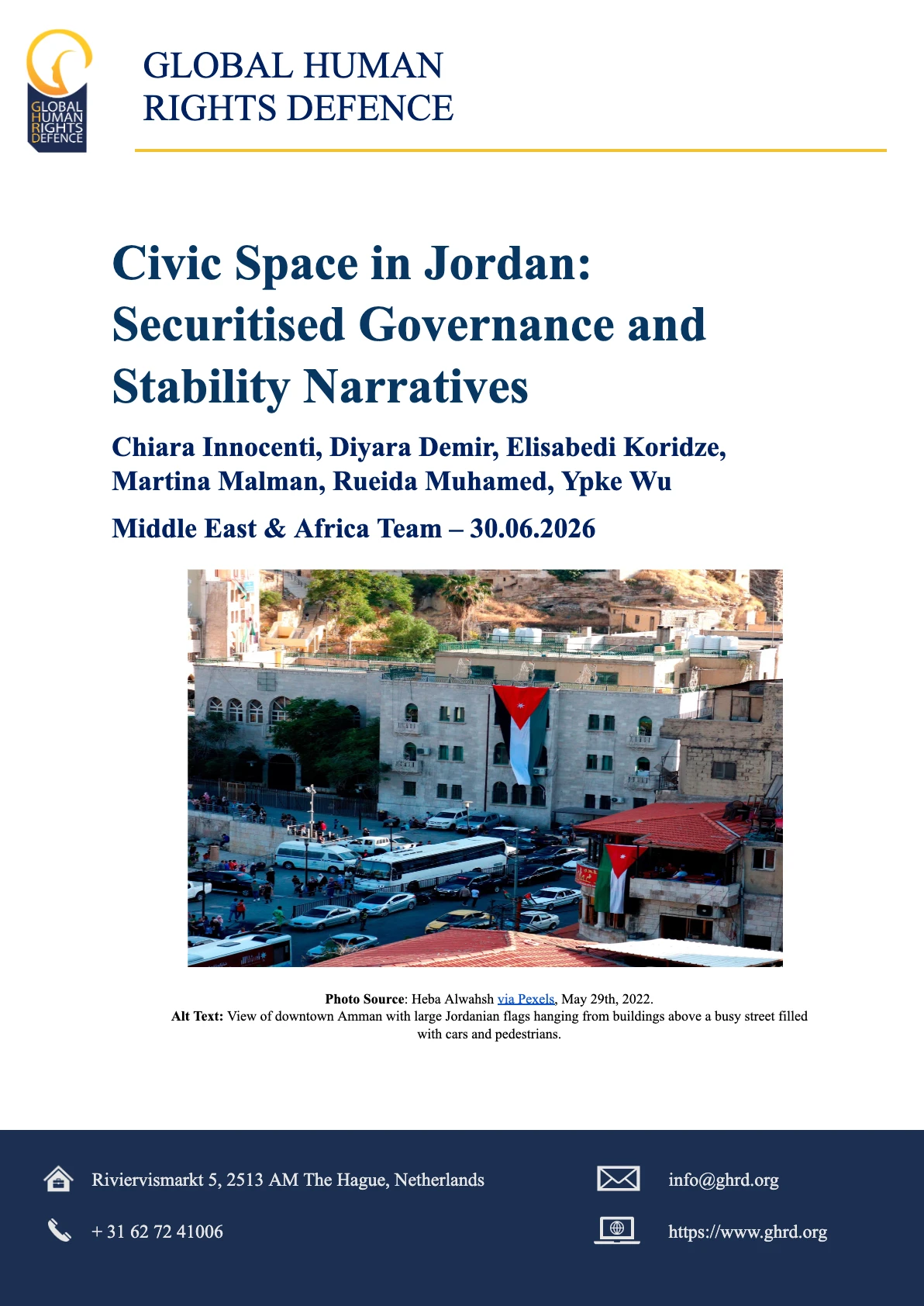
This report examines the constitutional and legal framework governing civic space in Jordan. Although Jordan is widely seen as a modernising state and an “island of stability” in a region full of conflict, the state increasingly relies on securitisation and national stability narratives to control public life and limit democratic freedoms.
Through vague legal frameworks, such as the 2023 Cybercrime Law, coupled with pre-emptive control mechanisms, the freedoms of expression, association and information continue to erode. The report explores expanding securitisation, including the crackdown on the Teachers’ Syndicate, the arrests of activists and the repression of journalists, as well as the use of gag orders and other forms of information control. Finally, it examines how stability and security narratives, together with Jordan’s international partnerships, indirectly reinforce these practices.
Through vague legal frameworks, such as the 2023 Cybercrime Law, coupled with pre-emptive control mechanisms, the freedoms of expression, association and information continue to erode. The report explores expanding securitisation, including the crackdown on the Teachers’ Syndicate, the arrests of activists and the repression of journalists, as well as the use of gag orders and other forms of information control. Finally, it examines how stability and security narratives, together with Jordan’s international partnerships, indirectly reinforce these practices.
✨ AI summary
This report argues that the erosion of civic space in Jordan is the result of a deliberate and cumulative model of governance in which the security narrative has become a tool for political repression. Broad and undefined offences such as “spreading fake news”, “provoking strife” and “online assassination of personality”, found in the 2023 Cybercrime Law alongside anti-terrorism, crime prevention and press legislation, allow the authorities to penalise dissent while maintaining the appearance of legality. Gag orders, media blackouts, internet restrictions and surveillance, including the targeting of at least 35 individuals with Pegasus spyware, have fostered widespread self-censorship among journalists, activists and ordinary citizens, with marginalised groups affected most severely. The report also finds that international partners, prioritising Jordan’s role in regional stability, counterterrorism and mediation, tolerate these restrictive practices. It concludes that reform must restore civil liberties, repeal or substantially revise vague and punitive laws, end arbitrary publication bans and internet restrictions, and ensure accountability for abuses committed in the name of stability.
Share this report
Facebook
X
LinkedIn
WhatsApp