Reports
Cracking Down on the Free Press: Growing Authoritarianism in Indonesia, Philippines, and Vietnam
- Asia Team
- 23 June 2025
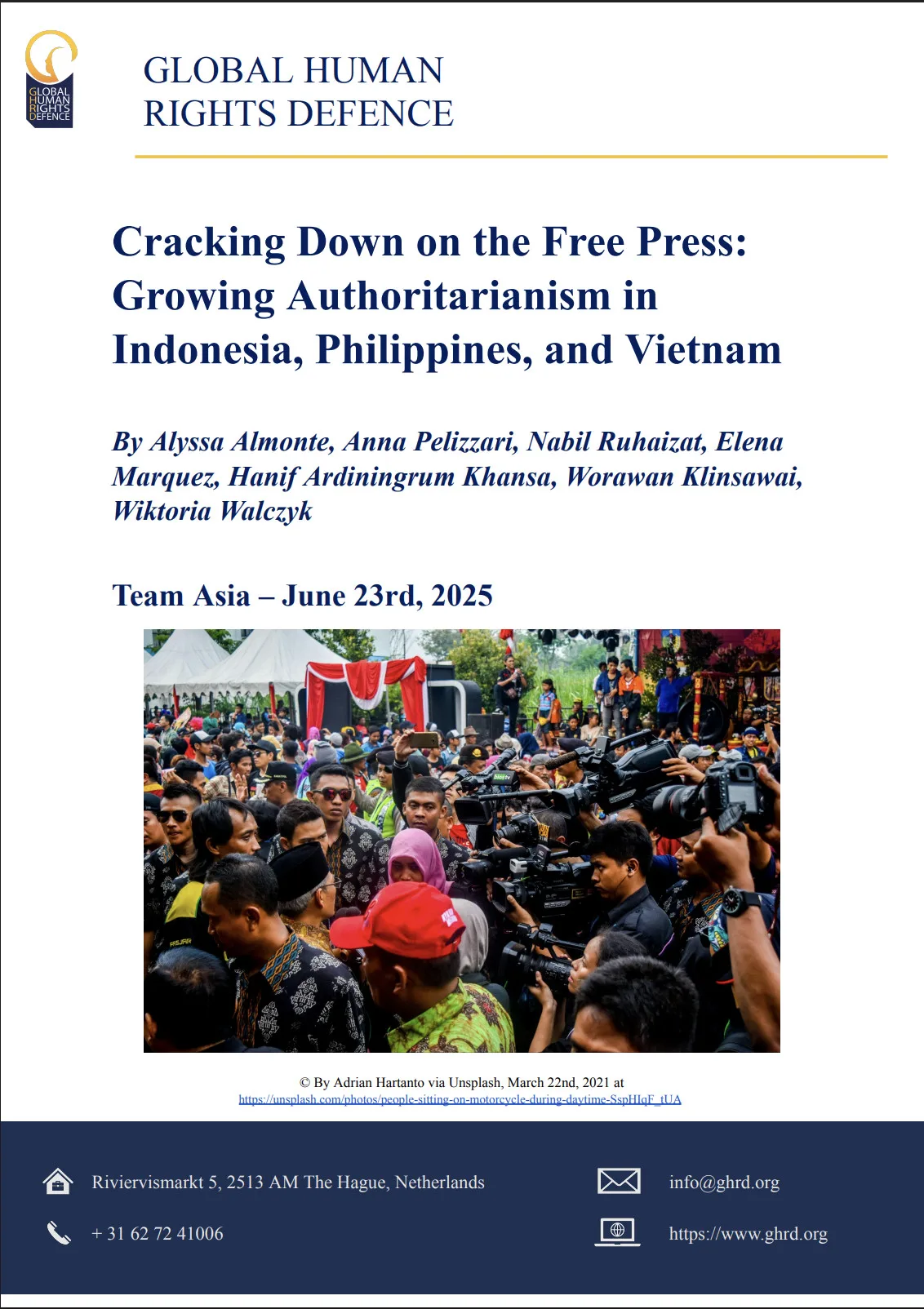
Cracking Down on the Free Press: Growing Authoritarianism in Indonesia, the Philippines, and Vietnam presents evidence of the shrinking boundaries of press freedom in three Southeast Asian nations. In Indonesia, where democratic institutions nominally remain intact, successive administrations have intensified legal intimidation of journalists. In the Philippines –once home to one of the region’s freest media landscapes – red-tagging and online harassment have been normalised through legal coercion. And in Vietnam, a single-party State, surveillance and a penal code are used to strictly control public discourse and suppress dissent.
Despite their differing political systems, all three governments are actively working to restrict critical and constructive journalism. A clear and deliberate pattern has emerged: journalists are increasingly portrayed as adversaries, and public scrutiny is reframed as a threat to national security.
By analysing legislative changes, surveillance practices, media platform manipulation, and various modes of intimidation, this report outlines how press repression has become integral to each country’s political logic. Yet within these constraints, resistance persists. Civil society groups, legal aid networks, and transnational coalitions continue to push back against these encroachments on the freedom of speech. Their efforts, while often precarious, form a crucial institutional buffer against the monopolisation of truth.
This report catalogues violations of free expression to trace how restrictions on the press function as a governance strategy – shaping not only what can be said, but who is allowed to speak, and under what conditions. By examining both the mechanisms of control and the actors challenging them, it offers a grounded account of how information power is being contested in real time and where that struggle still holds ground.
Despite their differing political systems, all three governments are actively working to restrict critical and constructive journalism. A clear and deliberate pattern has emerged: journalists are increasingly portrayed as adversaries, and public scrutiny is reframed as a threat to national security.
By analysing legislative changes, surveillance practices, media platform manipulation, and various modes of intimidation, this report outlines how press repression has become integral to each country’s political logic. Yet within these constraints, resistance persists. Civil society groups, legal aid networks, and transnational coalitions continue to push back against these encroachments on the freedom of speech. Their efforts, while often precarious, form a crucial institutional buffer against the monopolisation of truth.
This report catalogues violations of free expression to trace how restrictions on the press function as a governance strategy – shaping not only what can be said, but who is allowed to speak, and under what conditions. By examining both the mechanisms of control and the actors challenging them, it offers a grounded account of how information power is being contested in real time and where that struggle still holds ground.
✨ AI summary
Cracking Down on the Free Press: Growing Authoritarianism in Indonesia, the Philippines, and Vietnam presents evidence of the shrinking boundaries of press freedom in three Southeast Asian nations. In Indonesia, where democratic institutions nominally remain intact, successive administrations have intensified legal intimidation of journalists. In the Philippines –once home to one of the region’s freest media landscapes – red-tagging and online harassment have been normalised through legal coercion. And in Vietnam, a single-party State, surveillance and a penal code are used to strictly control public discourse and suppress dissent.
Despite their differing political systems, all three governments are actively working to restrict critical and constructive journalism. A clear and deliberate pattern has emerged: journalists are increasingly portrayed as adversaries, and public scrutiny is reframed as a threat to national security.
By analysing legislative changes, surveillance practices, media platform manipulation, and various modes of intimidation, this report outlines how press repression has become integral to each country’s political logic. Yet within these constraints, resistance persists. Civil society groups, legal aid networks, and transnational coalitions continue to push back against these encroachments on the freedom of speech. Their efforts, while often precarious, form a crucial institutional buffer against the monopolisation of truth.
This report catalogues violations of free expression to trace how restrictions on the press function as a governance strategy – shaping not only what can be said, but who is allowed to speak, and under what conditions. By examining both the mechanisms of control and the actors challenging them, it offers a grounded account of how information power is being contested in real time and where that struggle still holds ground.
Despite their differing political systems, all three governments are actively working to restrict critical and constructive journalism. A clear and deliberate pattern has emerged: journalists are increasingly portrayed as adversaries, and public scrutiny is reframed as a threat to national security.
By analysing legislative changes, surveillance practices, media platform manipulation, and various modes of intimidation, this report outlines how press repression has become integral to each country’s political logic. Yet within these constraints, resistance persists. Civil society groups, legal aid networks, and transnational coalitions continue to push back against these encroachments on the freedom of speech. Their efforts, while often precarious, form a crucial institutional buffer against the monopolisation of truth.
This report catalogues violations of free expression to trace how restrictions on the press function as a governance strategy – shaping not only what can be said, but who is allowed to speak, and under what conditions. By examining both the mechanisms of control and the actors challenging them, it offers a grounded account of how information power is being contested in real time and where that struggle still holds ground.
Share this report
Facebook
X
LinkedIn
WhatsApp