Reports
International Accountability for the Destruction of Cultural and Religious Heritage in the Bangladesh Liberation War
- Bangladesh Campaign
- 5 April 2025
They attack culturally significant properties as they believe that their enemies are culturally superior or inferior. With the destruction of cultural property, they wish to establish and exhibit unilateral political authority over “the others” by destroying their rich cultural heritage. (Rahim, 2018)
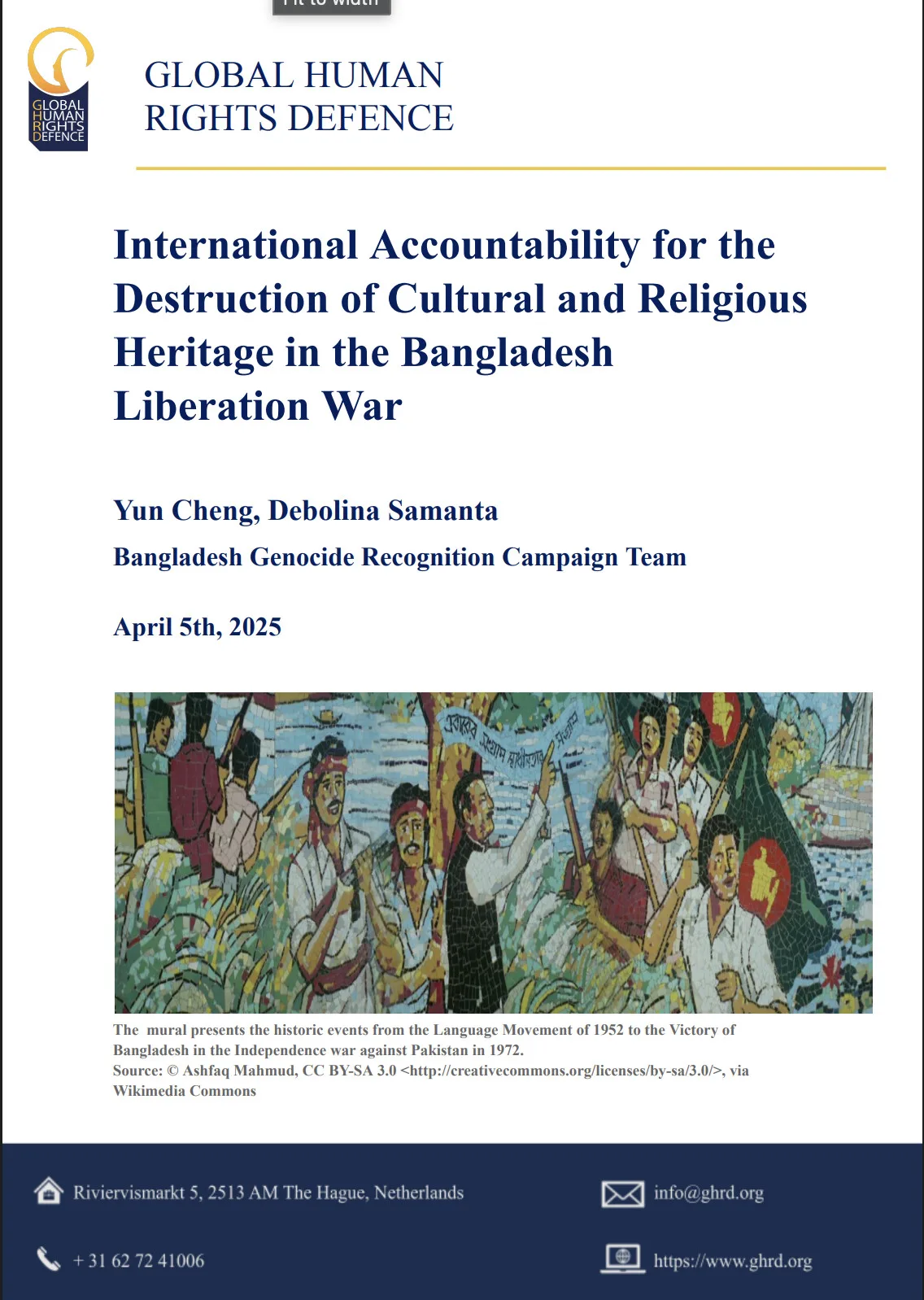
An estimated 1.5 to three million people were killed between March 26th and December 16th, 1971 in occupied Bangladesh (Beachler, 2007). The loss of human life, the targeting of intellectuals, the suppression of Bengali identity, and the displacement of populations profoundly damaged the cultural heritage of Bangladesh during the 1971 Liberation War (Nishant & Hossain, 2022).
The systematic destruction of cultural and religious sites, languages, and intellectual institutions was not incidental, but rather a strategy employed to erase the Bengali identity and resistance. Despite extensive documentation of such destruction, international mechanisms have so far been unable to deliver meaningful accountability. Moreover, the destruction of cultural and religious heritage is not always avoidable in armed conflicts, meaning that sometimes attacks will not constitute international crimes giving rise to international criminal responsibility. Therefore, this report will outline the protection of cultural and religious heritage under international criminal law in line with international humanitarian law and human rights law and analyse international criminal accountability for the destruction of cultural and religious heritages in the 1971 Liberation War.
An estimated 1.5 to three million people were killed between March 26th and December 16th, 1971 in occupied Bangladesh (Beachler, 2007). The loss of human life, the targeting of intellectuals, the suppression of Bengali identity, and the displacement of populations profoundly damaged the cultural heritage of Bangladesh during the 1971 Liberation War (Nishant & Hossain, 2022).
The systematic destruction of cultural and religious sites, languages, and intellectual institutions was not incidental, but rather a strategy employed to erase the Bengali identity and resistance. Despite extensive documentation of such destruction, international mechanisms have so far been unable to deliver meaningful accountability. Moreover, the destruction of cultural and religious heritage is not always avoidable in armed conflicts, meaning that sometimes attacks will not constitute international crimes giving rise to international criminal responsibility. Therefore, this report will outline the protection of cultural and religious heritage under international criminal law in line with international humanitarian law and human rights law and analyse international criminal accountability for the destruction of cultural and religious heritages in the 1971 Liberation War.
✨ AI summary
They attack culturally significant properties as they believe that their enemies are culturally superior or inferior. With the destruction of cultural property, they wish to establish and exhibit unilateral political authority over “the others” by destroying their rich cultural heritage. (Rahim, 2018)
An estimated 1.5 to three million people were killed between March 26th and December 16th, 1971 in occupied Bangladesh (Beachler, 2007). The loss of human life, the targeting of intellectuals, the suppression of Bengali identity, and the displacement of populations profoundly damaged the cultural heritage of Bangladesh during the 1971 Liberation War (Nishant & Hossain, 2022).
The systematic destruction of cultural and religious sites, languages, and intellectual institutions was not incidental, but rather a strategy employed to erase the Bengali identity and resistance. Despite extensive documentation of such destruction, international mechanisms have so far been unable to deliver meaningful accountability. Moreover, the destruction of cultural and religious heritage is not always avoidable in armed conflicts, meaning that sometimes attacks will not constitute international crimes giving rise to international criminal responsibility. Therefore, this report will outline the protection of cultural and religious heritage under international criminal law in line with international humanitarian law and human rights law and analyse international criminal accountability for the destruction of cultural and religious heritages in the 1971 Liberation War.
An estimated 1.5 to three million people were killed between March 26th and December 16th, 1971 in occupied Bangladesh (Beachler, 2007). The loss of human life, the targeting of intellectuals, the suppression of Bengali identity, and the displacement of populations profoundly damaged the cultural heritage of Bangladesh during the 1971 Liberation War (Nishant & Hossain, 2022).
The systematic destruction of cultural and religious sites, languages, and intellectual institutions was not incidental, but rather a strategy employed to erase the Bengali identity and resistance. Despite extensive documentation of such destruction, international mechanisms have so far been unable to deliver meaningful accountability. Moreover, the destruction of cultural and religious heritage is not always avoidable in armed conflicts, meaning that sometimes attacks will not constitute international crimes giving rise to international criminal responsibility. Therefore, this report will outline the protection of cultural and religious heritage under international criminal law in line with international humanitarian law and human rights law and analyse international criminal accountability for the destruction of cultural and religious heritages in the 1971 Liberation War.
Share this report
Facebook
X
LinkedIn
WhatsApp