
Reports
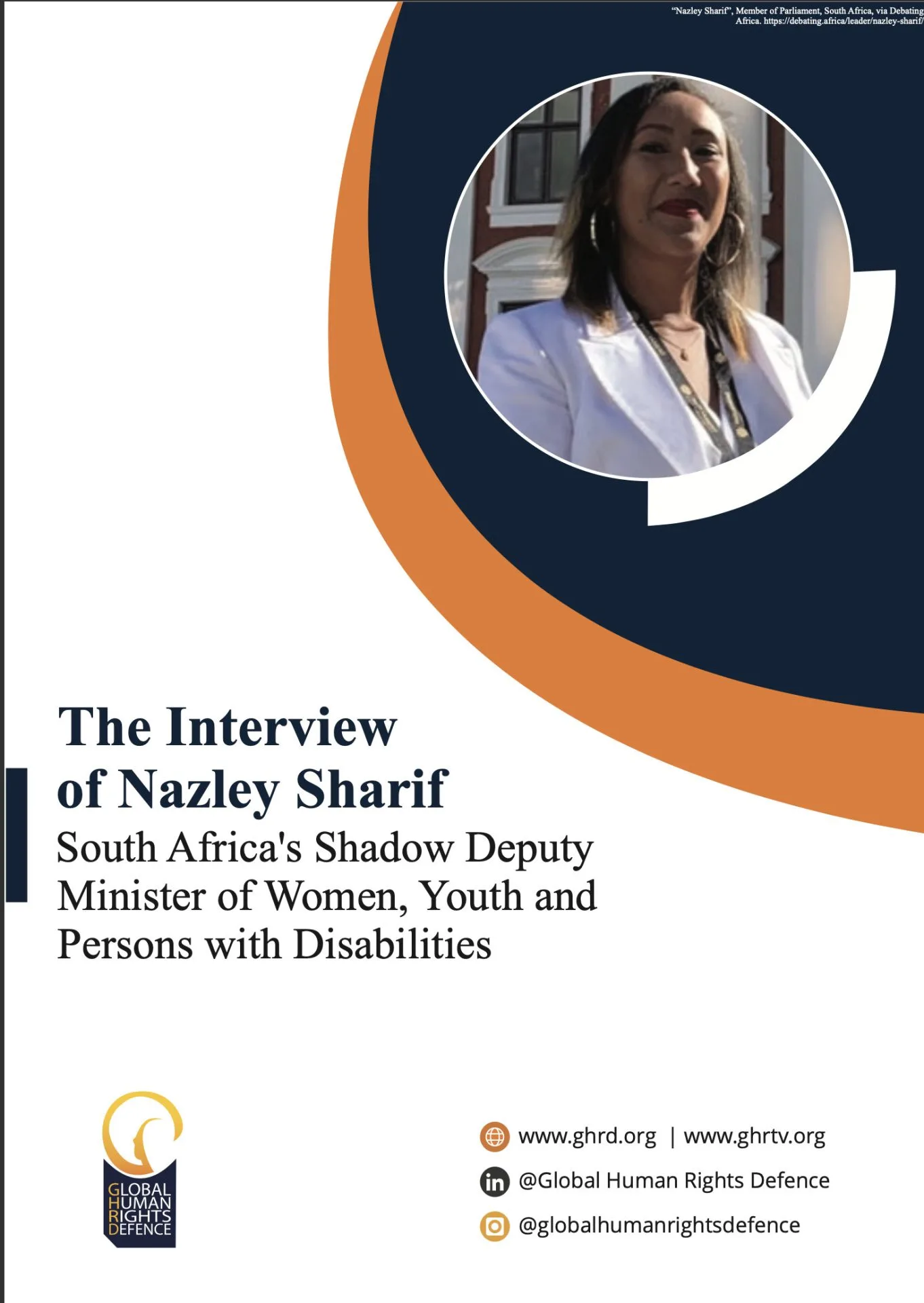
The Interview of Nazley Sharif South Africa’s Shadow Deputy Minister of Women, Youth and Persons with Disabilities
- GHRD Team
- 30 November 2022
The women’s rights team of Global Human Rights Defence aims to shed light on violations that have been left in the shadows while bringing encouraging developments and news to the stage. Women’s rights may seem to be an internal issue that takes place within the borders of countries. However, every advance or regression is important to all women around the world, thus proving that these issues are in fact transnational, international and universal.
In this context, the prevalence of gender-based violence and femicide, to which women are appallingly exposed, constitutes a global problem that touches and affects everyone, no matter where they are in the world. In 2019, the World Bank defined the situation in its publication Gender-Based Violence (violence against women and girls) as a global pandemic “affecting one in three women in their lifetime” (World Bank, 2019). Furthermore, in 2021, the World Health Organisation considered violence against women – in particular intimate partner violence and sexual violence – as “a major public health problem and a violation of women’s human rights” (WHO, 2021).
Therefore, this interview with Nazley Sharif, who is the South Africa’s Shadow Deputy Minister for Women, Youth and Persons with Disabilities, will provide us with an insight into the country’s long- standing problem of gender-based violence (GBV) and femicide, and thus learn how they approach this critical issue. The interview consisted of nine questions addressing GBV, femicide, the role and influence of the police, protection and prevention orders,and recent developments in South Africa.
In this context, the prevalence of gender-based violence and femicide, to which women are appallingly exposed, constitutes a global problem that touches and affects everyone, no matter where they are in the world. In 2019, the World Bank defined the situation in its publication Gender-Based Violence (violence against women and girls) as a global pandemic “affecting one in three women in their lifetime” (World Bank, 2019). Furthermore, in 2021, the World Health Organisation considered violence against women – in particular intimate partner violence and sexual violence – as “a major public health problem and a violation of women’s human rights” (WHO, 2021).
Therefore, this interview with Nazley Sharif, who is the South Africa’s Shadow Deputy Minister for Women, Youth and Persons with Disabilities, will provide us with an insight into the country’s long- standing problem of gender-based violence (GBV) and femicide, and thus learn how they approach this critical issue. The interview consisted of nine questions addressing GBV, femicide, the role and influence of the police, protection and prevention orders,and recent developments in South Africa.
✨ AI summary
The women’s rights team of Global Human Rights Defence aims to shed light on violations that have been left in the shadows while bringing encouraging developments and news to the stage. Women’s rights may seem to be an internal issue that takes place within the borders of countries. However, every advance or regression is important to all women around the world, thus proving that these issues are in fact transnational, international and universal.
In this context, the prevalence of gender-based violence and femicide, to which women are appallingly exposed, constitutes a global problem that touches and affects everyone, no matter where they are in the world. In 2019, the World Bank defined the situation in its publication Gender-Based Violence (violence against women and girls) as a global pandemic “affecting one in three women in their lifetime” (World Bank, 2019). Furthermore, in 2021, the World Health Organisation considered violence against women – in particular intimate partner violence and sexual violence – as “a major public health problem and a violation of women’s human rights” (WHO, 2021).
Therefore, this interview with Nazley Sharif, who is the South Africa’s Shadow Deputy Minister for Women, Youth and Persons with Disabilities, will provide us with an insight into the country’s long- standing problem of gender-based violence (GBV) and femicide, and thus learn how they approach this critical issue. The interview consisted of nine questions addressing GBV, femicide, the role and influence of the police, protection and prevention orders,and recent developments in South Africa.
In this context, the prevalence of gender-based violence and femicide, to which women are appallingly exposed, constitutes a global problem that touches and affects everyone, no matter where they are in the world. In 2019, the World Bank defined the situation in its publication Gender-Based Violence (violence against women and girls) as a global pandemic “affecting one in three women in their lifetime” (World Bank, 2019). Furthermore, in 2021, the World Health Organisation considered violence against women – in particular intimate partner violence and sexual violence – as “a major public health problem and a violation of women’s human rights” (WHO, 2021).
Therefore, this interview with Nazley Sharif, who is the South Africa’s Shadow Deputy Minister for Women, Youth and Persons with Disabilities, will provide us with an insight into the country’s long- standing problem of gender-based violence (GBV) and femicide, and thus learn how they approach this critical issue. The interview consisted of nine questions addressing GBV, femicide, the role and influence of the police, protection and prevention orders,and recent developments in South Africa.
Share this report
Facebook
X
LinkedIn
WhatsApp