Reports
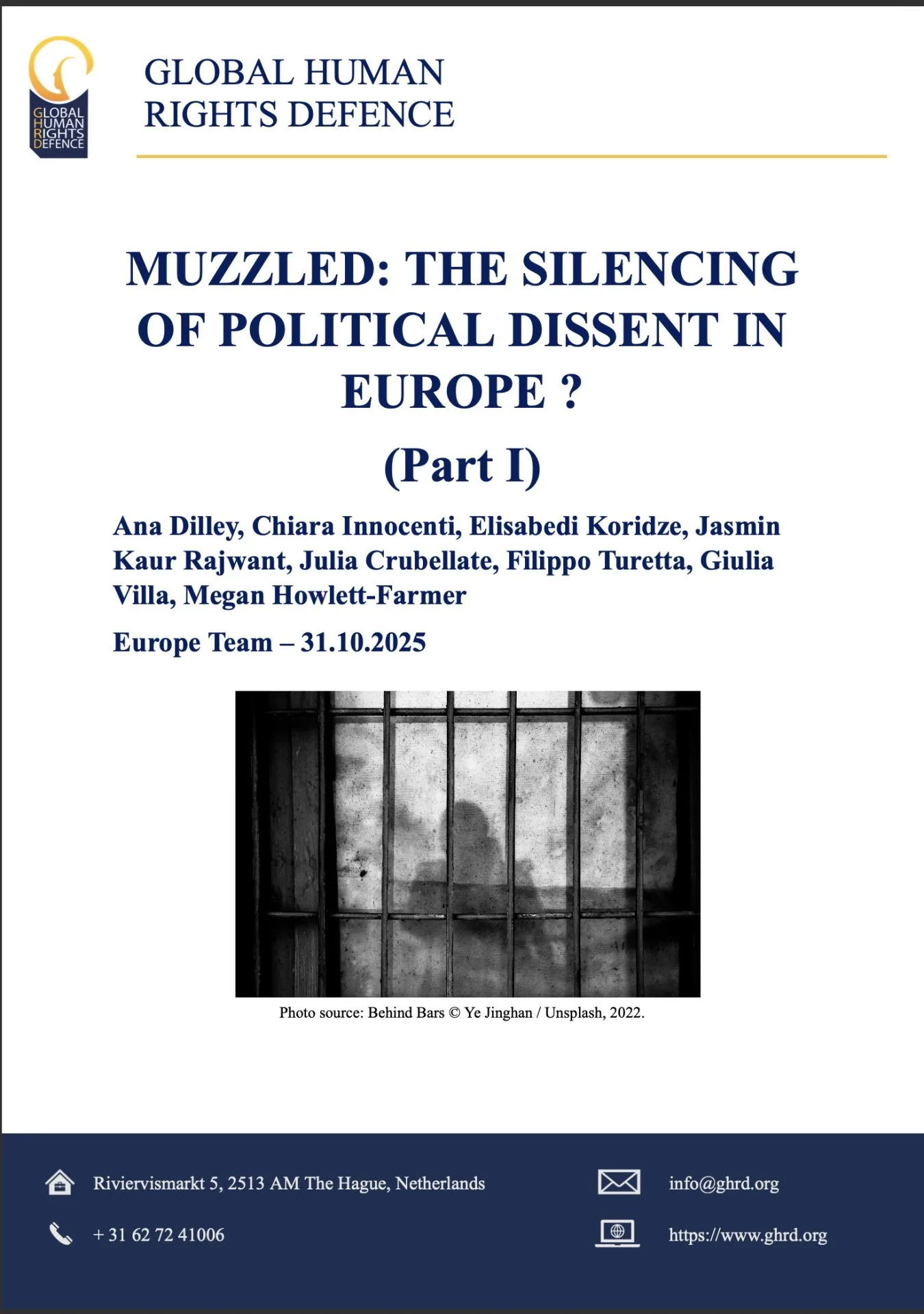
MUZZLED: THE SILENCING OF POLITICAL DISSENT IN EUROPE?
- GHRD Team
- 31 October 2025
Democratic backsliding and the erosion of human rights protections mean that politically motivated imprisonment remains widespread, including in Europe. Freedom of speech and effective political opposition are the cornerstones of democracy; the practice of imprisoning political opponents, or those with divergent political opinions, constitutes a serious attack on democracy and the rule of law. It is imperative to engage critically with emerging trends relating to political repression, arbitrary detention, and civil liberties to recognise the potential democratic threats in Europe.
There is no single established definition of political prisoners, and it remains undefined in international law and human rights treaties. For the purposes of this report, we will use the Parliamentary Assembly of the Council of Europe definition, which was adopted by Council of Europe member states in 2012. This states that a person deprived of their personal liberty is to be regarded as a ‘political prisoner’ if:
“a. the detention has been imposed in violation of one of the fundamental guarantees set out in the European Convention on Human Rights and its Protocols (ECHR), in particular freedom of thought, conscience and religion, freedom of expression and information, freedom of assembly and association;
b. the detention has been imposed for purely political reasons without connection to any offence;
c. for political motives, the length of the detention or its conditions are clearly out of proportion to the offence the person has been found guilty of or is suspected of;
d. for political motives, he or she is detained in a discriminatory manner as compared to other persons; or,
e. the detention is the result of proceedings which were clearly unfair and this appears to be connected with political motives of the authorities.” (SG/Inf(2001)34, paragraph 10).
This report is split into two sections: Part I and Part II. Part I sets out the existing protection mechanisms followed by an analysis of the circumstances relevant to political prisoners in Southern Europe and Eastern Europe. For Southern Europe, the report assesses each country against four key indicators: democratic transitions; structural weaknesses; selective justice; and political clientelism. The Eastern Europe section assesses the following indicators: systemic repression; authoritarian consolidation; post-conflict challenges; and illiberal drift within the EU. Part I finishes with partial conclusions on the state of play in these regions.
In Part II, the report will cover Central and Western Europe, Northern Europe, and the Caucasus and Türkiye. For Central and Western Europe, the analysis focuses on the following: anti-terrorism legislation; the use of ‘exceptional measures’; preventive detention; and migrants and minorities’ rights. In Northern Europe, the analysis will focus on three key areas: digital surveillance; civil liberties; and detention linked to immigration and security. Finally, in the section on the Caucasus and Türkiye, the report will assess the extent of illiberal democracies, authoritarianism, detention of opponents and minorities, and armed conflicts and civic space.
Part II of the report will conclude with a comprehensive analysis of the recurring trends, both within the selected regions, and across Europe more broadly. This will determine any points of contrast between countries and regions, as well as consistencies. These conclusions will inform policy and legal recommendations for inter alia the OSCE, the Council of Europe, the European Union, and other relevant international bodies and the states who purport to conform to their prescribed norms. These recommendations will suggest measures aimed at eliminating the existence of political prisoners in Europe, and to strengthen the democratic environment required to prevent its recurrence.
There is no single established definition of political prisoners, and it remains undefined in international law and human rights treaties. For the purposes of this report, we will use the Parliamentary Assembly of the Council of Europe definition, which was adopted by Council of Europe member states in 2012. This states that a person deprived of their personal liberty is to be regarded as a ‘political prisoner’ if:
“a. the detention has been imposed in violation of one of the fundamental guarantees set out in the European Convention on Human Rights and its Protocols (ECHR), in particular freedom of thought, conscience and religion, freedom of expression and information, freedom of assembly and association;
b. the detention has been imposed for purely political reasons without connection to any offence;
c. for political motives, the length of the detention or its conditions are clearly out of proportion to the offence the person has been found guilty of or is suspected of;
d. for political motives, he or she is detained in a discriminatory manner as compared to other persons; or,
e. the detention is the result of proceedings which were clearly unfair and this appears to be connected with political motives of the authorities.” (SG/Inf(2001)34, paragraph 10).
This report is split into two sections: Part I and Part II. Part I sets out the existing protection mechanisms followed by an analysis of the circumstances relevant to political prisoners in Southern Europe and Eastern Europe. For Southern Europe, the report assesses each country against four key indicators: democratic transitions; structural weaknesses; selective justice; and political clientelism. The Eastern Europe section assesses the following indicators: systemic repression; authoritarian consolidation; post-conflict challenges; and illiberal drift within the EU. Part I finishes with partial conclusions on the state of play in these regions.
In Part II, the report will cover Central and Western Europe, Northern Europe, and the Caucasus and Türkiye. For Central and Western Europe, the analysis focuses on the following: anti-terrorism legislation; the use of ‘exceptional measures’; preventive detention; and migrants and minorities’ rights. In Northern Europe, the analysis will focus on three key areas: digital surveillance; civil liberties; and detention linked to immigration and security. Finally, in the section on the Caucasus and Türkiye, the report will assess the extent of illiberal democracies, authoritarianism, detention of opponents and minorities, and armed conflicts and civic space.
Part II of the report will conclude with a comprehensive analysis of the recurring trends, both within the selected regions, and across Europe more broadly. This will determine any points of contrast between countries and regions, as well as consistencies. These conclusions will inform policy and legal recommendations for inter alia the OSCE, the Council of Europe, the European Union, and other relevant international bodies and the states who purport to conform to their prescribed norms. These recommendations will suggest measures aimed at eliminating the existence of political prisoners in Europe, and to strengthen the democratic environment required to prevent its recurrence.
✨ AI summary
Democratic backsliding and the erosion of human rights protections mean that politically motivated imprisonment remains widespread, including in Europe. Freedom of speech and effective political opposition are the cornerstones of democracy; the practice of imprisoning political opponents, or those with divergent political opinions, constitutes a serious attack on democracy and the rule of law. It is imperative to engage critically with emerging trends relating to political repression, arbitrary detention, and civil liberties to recognise the potential democratic threats in Europe.
There is no single established definition of political prisoners, and it remains undefined in international law and human rights treaties. For the purposes of this report, we will use the Parliamentary Assembly of the Council of Europe definition, which was adopted by Council of Europe member states in 2012. This states that a person deprived of their personal liberty is to be regarded as a ‘political prisoner’ if:
“a. the detention has been imposed in violation of one of the fundamental guarantees set out in the European Convention on Human Rights and its Protocols (ECHR), in particular freedom of thought, conscience and religion, freedom of expression and information, freedom of assembly and association;
b. the detention has been imposed for purely political reasons without connection to any offence;
c. for political motives, the length of the detention or its conditions are clearly out of proportion to the offence the person has been found guilty of or is suspected of;
d. for political motives, he or she is detained in a discriminatory manner as compared to other persons; or,
e. the detention is the result of proceedings which were clearly unfair and this appears to be connected with political motives of the authorities.” (SG/Inf(2001)34, paragraph 10).
This report is split into two sections: Part I and Part II. Part I sets out the existing protection mechanisms followed by an analysis of the circumstances relevant to political prisoners in Southern Europe and Eastern Europe. For Southern Europe, the report assesses each country against four key indicators: democratic transitions; structural weaknesses; selective justice; and political clientelism. The Eastern Europe section assesses the following indicators: systemic repression; authoritarian consolidation; post-conflict challenges; and illiberal drift within the EU. Part I finishes with partial conclusions on the state of play in these regions.
In Part II, the report will cover Central and Western Europe, Northern Europe, and the Caucasus and Türkiye. For Central and Western Europe, the analysis focuses on the following: anti-terrorism legislation; the use of ‘exceptional measures’; preventive detention; and migrants and minorities’ rights. In Northern Europe, the analysis will focus on three key areas: digital surveillance; civil liberties; and detention linked to immigration and security. Finally, in the section on the Caucasus and Türkiye, the report will assess the extent of illiberal democracies, authoritarianism, detention of opponents and minorities, and armed conflicts and civic space.
Part II of the report will conclude with a comprehensive analysis of the recurring trends, both within the selected regions, and across Europe more broadly. This will determine any points of contrast between countries and regions, as well as consistencies. These conclusions will inform policy and legal recommendations for inter alia the OSCE, the Council of Europe, the European Union, and other relevant international bodies and the states who purport to conform to their prescribed norms. These recommendations will suggest measures aimed at eliminating the existence of political prisoners in Europe, and to strengthen the democratic environment required to prevent its recurrence.
There is no single established definition of political prisoners, and it remains undefined in international law and human rights treaties. For the purposes of this report, we will use the Parliamentary Assembly of the Council of Europe definition, which was adopted by Council of Europe member states in 2012. This states that a person deprived of their personal liberty is to be regarded as a ‘political prisoner’ if:
“a. the detention has been imposed in violation of one of the fundamental guarantees set out in the European Convention on Human Rights and its Protocols (ECHR), in particular freedom of thought, conscience and religion, freedom of expression and information, freedom of assembly and association;
b. the detention has been imposed for purely political reasons without connection to any offence;
c. for political motives, the length of the detention or its conditions are clearly out of proportion to the offence the person has been found guilty of or is suspected of;
d. for political motives, he or she is detained in a discriminatory manner as compared to other persons; or,
e. the detention is the result of proceedings which were clearly unfair and this appears to be connected with political motives of the authorities.” (SG/Inf(2001)34, paragraph 10).
This report is split into two sections: Part I and Part II. Part I sets out the existing protection mechanisms followed by an analysis of the circumstances relevant to political prisoners in Southern Europe and Eastern Europe. For Southern Europe, the report assesses each country against four key indicators: democratic transitions; structural weaknesses; selective justice; and political clientelism. The Eastern Europe section assesses the following indicators: systemic repression; authoritarian consolidation; post-conflict challenges; and illiberal drift within the EU. Part I finishes with partial conclusions on the state of play in these regions.
In Part II, the report will cover Central and Western Europe, Northern Europe, and the Caucasus and Türkiye. For Central and Western Europe, the analysis focuses on the following: anti-terrorism legislation; the use of ‘exceptional measures’; preventive detention; and migrants and minorities’ rights. In Northern Europe, the analysis will focus on three key areas: digital surveillance; civil liberties; and detention linked to immigration and security. Finally, in the section on the Caucasus and Türkiye, the report will assess the extent of illiberal democracies, authoritarianism, detention of opponents and minorities, and armed conflicts and civic space.
Part II of the report will conclude with a comprehensive analysis of the recurring trends, both within the selected regions, and across Europe more broadly. This will determine any points of contrast between countries and regions, as well as consistencies. These conclusions will inform policy and legal recommendations for inter alia the OSCE, the Council of Europe, the European Union, and other relevant international bodies and the states who purport to conform to their prescribed norms. These recommendations will suggest measures aimed at eliminating the existence of political prisoners in Europe, and to strengthen the democratic environment required to prevent its recurrence.
Share this report
Facebook
X
LinkedIn
WhatsApp