
Reports
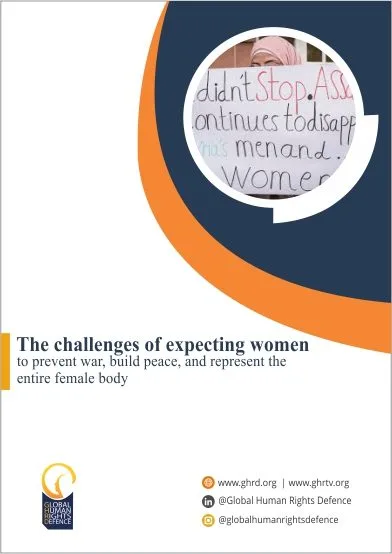
The challenges of expecting women to prevent war, build peace, and represent the entire female body
- GHRD Team
- 7 June 2023
The principle of equality was enshrined in Article 1 of the Charter of the United Nations in 1945.
The terms of reference of the United Nations Commission on the Status of Women, formulated at its
first session in 1947, emphasised that its task was to “prepare recommendations and reports for the
advancement of women’s rights in the political, economic, social and educational fields.” One of the first
results of the Commission’s work was the 1952 Convention on the Political Rights of Women, which
explicitly states that women “shall be admitted, on equal terms with men and without discrimination
of any kind, to all public elections established by national law” (Article 2) and “shall have the right to
hold public office and to exercise all public functions established by national law” (Article 3). Women
today have the right to vote and hold office in almost every country in the world. However, relatively
few women have been elected to national parliaments through the democratic process, and even fewer
have reached top positions (Gierycz, 1999), although various analyses have shown the positive impact
of women’s participation in decision making processes regarding conflict prevention and resolution.
Statistical analysis of the largest dataset on the status of women in the world shows that
countries where women have more power in several areas of life are less likely to go to war
with their neighbours (Elsesser, 2022). Another study found that a state is five times less likely
to use force in an international crisis if the proportion of women in parliament increases by
five percent (O’Reilly, 2015). Additionally, gender equality is a better indicator of a state’s
peacefulness than other factors such as democracy, religion, or GDP (O’Reilly, 2015).
More specifically, women’s participation in peace processes and peacebuilding attempts has proved to
be crucial. Statistical data analysis showed that an agreement is 35 percent more likely to last at least 15
years if women participate in its establishment, which means that women can foster long-lasting peace
through their specific characteristics, lenses, and experiences (O’Reilly, 2015). Despite the evidence that
proves women’s crucial role in peacebuilding processes, there is still a long way to equality. Between 1992
and 2018, only 13 percent of negotiators and 3 percent of mediators were women. When they are invited
to the table, the media is not commenting enough on their contributions;the more popular and persistent
image of women is that of victims, which ignores their impact in conflict recovery (UN Women, 2019).
The driving question is not only how we can ensure that more women are represented in political decision-
making, but also what needs to be considered in representation policy to enable women’s participation
to be more meaningful and effective. When thinking about this issue, we need to pay attention to the
impact of the expectations and stereotypes placed on women and the depoliticisation of women that
can arise when a few women are expected to represent the experiences and positions of all women.
The terms of reference of the United Nations Commission on the Status of Women, formulated at its
first session in 1947, emphasised that its task was to “prepare recommendations and reports for the
advancement of women’s rights in the political, economic, social and educational fields.” One of the first
results of the Commission’s work was the 1952 Convention on the Political Rights of Women, which
explicitly states that women “shall be admitted, on equal terms with men and without discrimination
of any kind, to all public elections established by national law” (Article 2) and “shall have the right to
hold public office and to exercise all public functions established by national law” (Article 3). Women
today have the right to vote and hold office in almost every country in the world. However, relatively
few women have been elected to national parliaments through the democratic process, and even fewer
have reached top positions (Gierycz, 1999), although various analyses have shown the positive impact
of women’s participation in decision making processes regarding conflict prevention and resolution.
Statistical analysis of the largest dataset on the status of women in the world shows that
countries where women have more power in several areas of life are less likely to go to war
with their neighbours (Elsesser, 2022). Another study found that a state is five times less likely
to use force in an international crisis if the proportion of women in parliament increases by
five percent (O’Reilly, 2015). Additionally, gender equality is a better indicator of a state’s
peacefulness than other factors such as democracy, religion, or GDP (O’Reilly, 2015).
More specifically, women’s participation in peace processes and peacebuilding attempts has proved to
be crucial. Statistical data analysis showed that an agreement is 35 percent more likely to last at least 15
years if women participate in its establishment, which means that women can foster long-lasting peace
through their specific characteristics, lenses, and experiences (O’Reilly, 2015). Despite the evidence that
proves women’s crucial role in peacebuilding processes, there is still a long way to equality. Between 1992
and 2018, only 13 percent of negotiators and 3 percent of mediators were women. When they are invited
to the table, the media is not commenting enough on their contributions;the more popular and persistent
image of women is that of victims, which ignores their impact in conflict recovery (UN Women, 2019).
The driving question is not only how we can ensure that more women are represented in political decision-
making, but also what needs to be considered in representation policy to enable women’s participation
to be more meaningful and effective. When thinking about this issue, we need to pay attention to the
impact of the expectations and stereotypes placed on women and the depoliticisation of women that
can arise when a few women are expected to represent the experiences and positions of all women.
✨ AI summary
The principle of equality was enshrined in Article 1 of the Charter of the United Nations in 1945.
The terms of reference of the United Nations Commission on the Status of Women, formulated at its
first session in 1947, emphasised that its task was to “prepare recommendations and reports for the
advancement of women’s rights in the political, economic, social and educational fields.” One of the first
results of the Commission’s work was the 1952 Convention on the Political Rights of Women, which
explicitly states that women “shall be admitted, on equal terms with men and without discrimination
of any kind, to all public elections established by national law” (Article 2) and “shall have the right to
hold public office and to exercise all public functions established by national law” (Article 3). Women
today have the right to vote and hold office in almost every country in the world. However, relatively
few women have been elected to national parliaments through the democratic process, and even fewer
have reached top positions (Gierycz, 1999), although various analyses have shown the positive impact
of women’s participation in decision making processes regarding conflict prevention and resolution.
Statistical analysis of the largest dataset on the status of women in the world shows that
countries where women have more power in several areas of life are less likely to go to war
with their neighbours (Elsesser, 2022). Another study found that a state is five times less likely
to use force in an international crisis if the proportion of women in parliament increases by
five percent (O’Reilly, 2015). Additionally, gender equality is a better indicator of a state’s
peacefulness than other factors such as democracy, religion, or GDP (O’Reilly, 2015).
More specifically, women’s participation in peace processes and peacebuilding attempts has proved to
be crucial. Statistical data analysis showed that an agreement is 35 percent more likely to last at least 15
years if women participate in its establishment, which means that women can foster long-lasting peace
through their specific characteristics, lenses, and experiences (O’Reilly, 2015). Despite the evidence that
proves women’s crucial role in peacebuilding processes, there is still a long way to equality. Between 1992
and 2018, only 13 percent of negotiators and 3 percent of mediators were women. When they are invited
to the table, the media is not commenting enough on their contributions;the more popular and persistent
image of women is that of victims, which ignores their impact in conflict recovery (UN Women, 2019).
The driving question is not only how we can ensure that more women are represented in political decision-
making, but also what needs to be considered in representation policy to enable women’s participation
to be more meaningful and effective. When thinking about this issue, we need to pay attention to the
impact of the expectations and stereotypes placed on women and the depoliticisation of women that
can arise when a few women are expected to represent the experiences and positions of all women.
The terms of reference of the United Nations Commission on the Status of Women, formulated at its
first session in 1947, emphasised that its task was to “prepare recommendations and reports for the
advancement of women’s rights in the political, economic, social and educational fields.” One of the first
results of the Commission’s work was the 1952 Convention on the Political Rights of Women, which
explicitly states that women “shall be admitted, on equal terms with men and without discrimination
of any kind, to all public elections established by national law” (Article 2) and “shall have the right to
hold public office and to exercise all public functions established by national law” (Article 3). Women
today have the right to vote and hold office in almost every country in the world. However, relatively
few women have been elected to national parliaments through the democratic process, and even fewer
have reached top positions (Gierycz, 1999), although various analyses have shown the positive impact
of women’s participation in decision making processes regarding conflict prevention and resolution.
Statistical analysis of the largest dataset on the status of women in the world shows that
countries where women have more power in several areas of life are less likely to go to war
with their neighbours (Elsesser, 2022). Another study found that a state is five times less likely
to use force in an international crisis if the proportion of women in parliament increases by
five percent (O’Reilly, 2015). Additionally, gender equality is a better indicator of a state’s
peacefulness than other factors such as democracy, religion, or GDP (O’Reilly, 2015).
More specifically, women’s participation in peace processes and peacebuilding attempts has proved to
be crucial. Statistical data analysis showed that an agreement is 35 percent more likely to last at least 15
years if women participate in its establishment, which means that women can foster long-lasting peace
through their specific characteristics, lenses, and experiences (O’Reilly, 2015). Despite the evidence that
proves women’s crucial role in peacebuilding processes, there is still a long way to equality. Between 1992
and 2018, only 13 percent of negotiators and 3 percent of mediators were women. When they are invited
to the table, the media is not commenting enough on their contributions;the more popular and persistent
image of women is that of victims, which ignores their impact in conflict recovery (UN Women, 2019).
The driving question is not only how we can ensure that more women are represented in political decision-
making, but also what needs to be considered in representation policy to enable women’s participation
to be more meaningful and effective. When thinking about this issue, we need to pay attention to the
impact of the expectations and stereotypes placed on women and the depoliticisation of women that
can arise when a few women are expected to represent the experiences and positions of all women.
Share this report
Facebook
X
LinkedIn
WhatsApp