
Reports
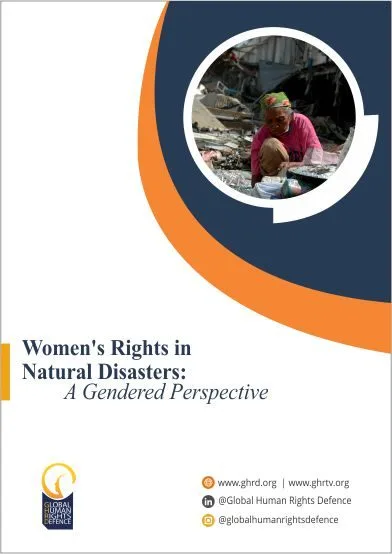
Women’s Rights in Natural Disasters : A Gendered Perspective
- GHRD Team
- 7 June 2023
Natural disasters affect all members of society, however, it is a misconception that their impacts are
indiscriminate. Groups of people who are marginalised are more vulnerable, either socially, economically,
culturally, politically, or institutionally, being impacted in more severe ways (Dagousset, 2020). Among
these vulnerabilities, it is widely observed that natural disasters possess huge gendered consequences.
It is known that women and girls constitute a more vulnerable group in society, due to
discriminatory laws and practices, and gender stereotypes, creating an unequal power relationship
with men that limits their autonomy, access to resources, labour, education, health, decision-
making, and justice (Dagousset, 2020). This vulnerability is further enhanced in a natural
disaster or post-disaster scenario (Dagousset, 2020). It is demonstrated that natural disasters
disproportionately kill women and girls; for instance, in the 2004 Indian Ocean tsunami, 70 percent
of the fatalities were women, and Cyclone Gorky killed 14 women for every man (Howe, 2019).
Based on these premises, the present report will be divided into four sections. The first section will address
the main instruments and provisions in international law that can assist women in a natural disaster scenario.
Then, the report will move to a deeper analysis of the gendered consequences in the context of natural
disasters, including impacts on their chances of survival as well as the post-disaster implications. The
third section will address case studies of natural disasters in different regions of the world, demonstrating
the different impacts on women, and possible measures that could have been (or were) taken to
address this inequality. Finally, the report will also provide recommendations based on the conclusions
achieved, contributing to better guidance and preparedness on the issue of gender in natural disasters.
indiscriminate. Groups of people who are marginalised are more vulnerable, either socially, economically,
culturally, politically, or institutionally, being impacted in more severe ways (Dagousset, 2020). Among
these vulnerabilities, it is widely observed that natural disasters possess huge gendered consequences.
It is known that women and girls constitute a more vulnerable group in society, due to
discriminatory laws and practices, and gender stereotypes, creating an unequal power relationship
with men that limits their autonomy, access to resources, labour, education, health, decision-
making, and justice (Dagousset, 2020). This vulnerability is further enhanced in a natural
disaster or post-disaster scenario (Dagousset, 2020). It is demonstrated that natural disasters
disproportionately kill women and girls; for instance, in the 2004 Indian Ocean tsunami, 70 percent
of the fatalities were women, and Cyclone Gorky killed 14 women for every man (Howe, 2019).
Based on these premises, the present report will be divided into four sections. The first section will address
the main instruments and provisions in international law that can assist women in a natural disaster scenario.
Then, the report will move to a deeper analysis of the gendered consequences in the context of natural
disasters, including impacts on their chances of survival as well as the post-disaster implications. The
third section will address case studies of natural disasters in different regions of the world, demonstrating
the different impacts on women, and possible measures that could have been (or were) taken to
address this inequality. Finally, the report will also provide recommendations based on the conclusions
achieved, contributing to better guidance and preparedness on the issue of gender in natural disasters.
✨ AI summary
Natural disasters affect all members of society, however, it is a misconception that their impacts are
indiscriminate. Groups of people who are marginalised are more vulnerable, either socially, economically,
culturally, politically, or institutionally, being impacted in more severe ways (Dagousset, 2020). Among
these vulnerabilities, it is widely observed that natural disasters possess huge gendered consequences.
It is known that women and girls constitute a more vulnerable group in society, due to
discriminatory laws and practices, and gender stereotypes, creating an unequal power relationship
with men that limits their autonomy, access to resources, labour, education, health, decision-
making, and justice (Dagousset, 2020). This vulnerability is further enhanced in a natural
disaster or post-disaster scenario (Dagousset, 2020). It is demonstrated that natural disasters
disproportionately kill women and girls; for instance, in the 2004 Indian Ocean tsunami, 70 percent
of the fatalities were women, and Cyclone Gorky killed 14 women for every man (Howe, 2019).
Based on these premises, the present report will be divided into four sections. The first section will address
the main instruments and provisions in international law that can assist women in a natural disaster scenario.
Then, the report will move to a deeper analysis of the gendered consequences in the context of natural
disasters, including impacts on their chances of survival as well as the post-disaster implications. The
third section will address case studies of natural disasters in different regions of the world, demonstrating
the different impacts on women, and possible measures that could have been (or were) taken to
address this inequality. Finally, the report will also provide recommendations based on the conclusions
achieved, contributing to better guidance and preparedness on the issue of gender in natural disasters.
indiscriminate. Groups of people who are marginalised are more vulnerable, either socially, economically,
culturally, politically, or institutionally, being impacted in more severe ways (Dagousset, 2020). Among
these vulnerabilities, it is widely observed that natural disasters possess huge gendered consequences.
It is known that women and girls constitute a more vulnerable group in society, due to
discriminatory laws and practices, and gender stereotypes, creating an unequal power relationship
with men that limits their autonomy, access to resources, labour, education, health, decision-
making, and justice (Dagousset, 2020). This vulnerability is further enhanced in a natural
disaster or post-disaster scenario (Dagousset, 2020). It is demonstrated that natural disasters
disproportionately kill women and girls; for instance, in the 2004 Indian Ocean tsunami, 70 percent
of the fatalities were women, and Cyclone Gorky killed 14 women for every man (Howe, 2019).
Based on these premises, the present report will be divided into four sections. The first section will address
the main instruments and provisions in international law that can assist women in a natural disaster scenario.
Then, the report will move to a deeper analysis of the gendered consequences in the context of natural
disasters, including impacts on their chances of survival as well as the post-disaster implications. The
third section will address case studies of natural disasters in different regions of the world, demonstrating
the different impacts on women, and possible measures that could have been (or were) taken to
address this inequality. Finally, the report will also provide recommendations based on the conclusions
achieved, contributing to better guidance and preparedness on the issue of gender in natural disasters.
Share this report
Facebook
X
LinkedIn
WhatsApp