Reports
Women´s roles in the 1971 Bangaldesh Genocide
- Bangladesh Campaign
- 27 May 2024
In the context of armed conflict, women fulfil a wide variety of roles. They confront issues of survival, engage in resistance, and build resilience. Yet their experiences and contributions are often erased from collective consciousness in the process of post-conflict societal rebuilding (Mookherjee, 2006). The Bangladesh Liberation War of 1971 is a noteworthy example of how the lack of acknowledgment of women’s experiences and involvement feeds into, and is mutually reinforced by, the failure to recognise atrocities occurring during conflict. Specifically, the survivors of widespread rape and sexual torture are often purposively excluded from public discourse about the conflict experience, since their identity contradicts cultural stigma about sexuality, the role of women in the community, and perceptions of national honour (Sharlach, 2000). The lack of recognition contributes to Bangladesh’s contemporary political contestation as well as the perception of the role of women (Bass, 2016, p. 262). Therefore, this report sheds light on the intricacy of women’s wartime experiences, their subjugation to sexual aggression, and their contribution to the cause of national self-determination through their participation in liberation movements.
The Bangladesh Liberation War of 1971 was driven by East Pakistan’s demand for autonomy from West Pakistan. Accumulated grievances of economic, linguistic, and political oppression resulted in an uprising, leading to widespread unrest and eventually armed conflict. After the Bengali nationalist Awami League’s electoral victory in the National Assembly was denied by the Pakistani military junta, protests erupted. The Pakistani military responded with brutal repression, committing genocidal violence and triggering a nine-month long war. India’s military intervention and support of the guerrilla forces eventually resulted in the surrender of West Pakistan on December 16th, 1971, and the creation of the state of Bangladesh. Today, it is the largest country facing the consequences of a genocide (Bass, 2016, p. 140). Although it remains largely ignored in the West due to geopolitical and strategic considerations, the Liberation War encompassed one of the most brutal instances of mass atrocities: estimations of its severity claim three million deaths, 10 million forcibly displaced persons, and approximately 200,000 women and girls falling victim to conflict-rape (Jahan, 2012; Sharlach, 2000).
Chapter 1 of this report delves into the multifaceted nature of conflict-related sexual violence (CRSV). By explaining its theoretical underpinnings, this chapter aims to clarify why CRSV is perpetrated and how it may be conceptualised as a ‘weapon of war’. Theories of the purposeful, strategic use of wartime rape are applied to the Bangladesh Liberation War to showcase that CRVS was not merely a ubiquitous conflict by-product, but was in fact perpetrated with genocidal intent.
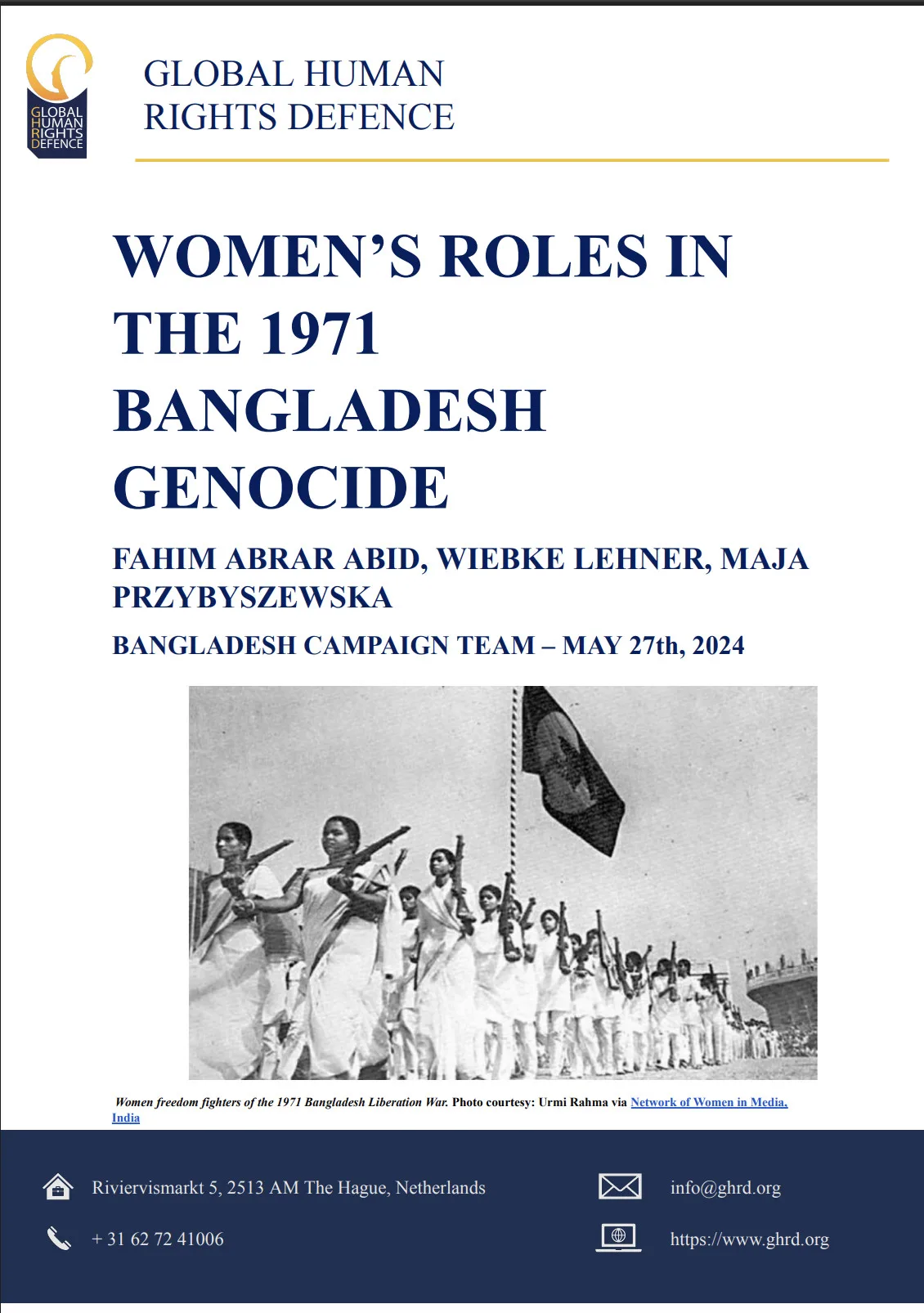
To move beyond a framing of women as mere victims of conflict-related violence, the following chapter examines the agency of women within the Bangladesh liberation movement. Despite the mass atrocities and subjugation through sexual aggression, women contributed much to the cause of liberating Bangladesh and fighting the Pakistani army. Therefore, a presumed causal link between CRSV-victimisation and a motivation to partake in conflict struggles will be examined.
Finally, the report investigates how the lack of international recognition of the genocide affects Bangladesh today, particularly from the perspective of non-acknowledgement of women’s experiences. Moreover, current efforts to achieve recognition of this tragic event are traced to highlight the challenges inherent to demanding accountability and public education. The role of organisational initiatives (the government of Bangladesh and genocide research centres), commemoration, and awareness raising are emphasised, concluding with an account of Global Human Rights Defence’s own efforts to contribute to the cause of recognition.
The Bangladesh Liberation War of 1971 was driven by East Pakistan’s demand for autonomy from West Pakistan. Accumulated grievances of economic, linguistic, and political oppression resulted in an uprising, leading to widespread unrest and eventually armed conflict. After the Bengali nationalist Awami League’s electoral victory in the National Assembly was denied by the Pakistani military junta, protests erupted. The Pakistani military responded with brutal repression, committing genocidal violence and triggering a nine-month long war. India’s military intervention and support of the guerrilla forces eventually resulted in the surrender of West Pakistan on December 16th, 1971, and the creation of the state of Bangladesh. Today, it is the largest country facing the consequences of a genocide (Bass, 2016, p. 140). Although it remains largely ignored in the West due to geopolitical and strategic considerations, the Liberation War encompassed one of the most brutal instances of mass atrocities: estimations of its severity claim three million deaths, 10 million forcibly displaced persons, and approximately 200,000 women and girls falling victim to conflict-rape (Jahan, 2012; Sharlach, 2000).
Chapter 1 of this report delves into the multifaceted nature of conflict-related sexual violence (CRSV). By explaining its theoretical underpinnings, this chapter aims to clarify why CRSV is perpetrated and how it may be conceptualised as a ‘weapon of war’. Theories of the purposeful, strategic use of wartime rape are applied to the Bangladesh Liberation War to showcase that CRVS was not merely a ubiquitous conflict by-product, but was in fact perpetrated with genocidal intent.
To move beyond a framing of women as mere victims of conflict-related violence, the following chapter examines the agency of women within the Bangladesh liberation movement. Despite the mass atrocities and subjugation through sexual aggression, women contributed much to the cause of liberating Bangladesh and fighting the Pakistani army. Therefore, a presumed causal link between CRSV-victimisation and a motivation to partake in conflict struggles will be examined.
Finally, the report investigates how the lack of international recognition of the genocide affects Bangladesh today, particularly from the perspective of non-acknowledgement of women’s experiences. Moreover, current efforts to achieve recognition of this tragic event are traced to highlight the challenges inherent to demanding accountability and public education. The role of organisational initiatives (the government of Bangladesh and genocide research centres), commemoration, and awareness raising are emphasised, concluding with an account of Global Human Rights Defence’s own efforts to contribute to the cause of recognition.
✨ AI summary
In the context of armed conflict, women fulfil a wide variety of roles. They confront issues of survival, engage in resistance, and build resilience. Yet their experiences and contributions are often erased from collective consciousness in the process of post-conflict societal rebuilding (Mookherjee, 2006). The Bangladesh Liberation War of 1971 is a noteworthy example of how the lack of acknowledgment of women’s experiences and involvement feeds into, and is mutually reinforced by, the failure to recognise atrocities occurring during conflict. Specifically, the survivors of widespread rape and sexual torture are often purposively excluded from public discourse about the conflict experience, since their identity contradicts cultural stigma about sexuality, the role of women in the community, and perceptions of national honour (Sharlach, 2000). The lack of recognition contributes to Bangladesh’s contemporary political contestation as well as the perception of the role of women (Bass, 2016, p. 262). Therefore, this report sheds light on the intricacy of women’s wartime experiences, their subjugation to sexual aggression, and their contribution to the cause of national self-determination through their participation in liberation movements.
The Bangladesh Liberation War of 1971 was driven by East Pakistan’s demand for autonomy from West Pakistan. Accumulated grievances of economic, linguistic, and political oppression resulted in an uprising, leading to widespread unrest and eventually armed conflict. After the Bengali nationalist Awami League’s electoral victory in the National Assembly was denied by the Pakistani military junta, protests erupted. The Pakistani military responded with brutal repression, committing genocidal violence and triggering a nine-month long war. India’s military intervention and support of the guerrilla forces eventually resulted in the surrender of West Pakistan on December 16th, 1971, and the creation of the state of Bangladesh. Today, it is the largest country facing the consequences of a genocide (Bass, 2016, p. 140). Although it remains largely ignored in the West due to geopolitical and strategic considerations, the Liberation War encompassed one of the most brutal instances of mass atrocities: estimations of its severity claim three million deaths, 10 million forcibly displaced persons, and approximately 200,000 women and girls falling victim to conflict-rape (Jahan, 2012; Sharlach, 2000).
Chapter 1 of this report delves into the multifaceted nature of conflict-related sexual violence (CRSV). By explaining its theoretical underpinnings, this chapter aims to clarify why CRSV is perpetrated and how it may be conceptualised as a ‘weapon of war’. Theories of the purposeful, strategic use of wartime rape are applied to the Bangladesh Liberation War to showcase that CRVS was not merely a ubiquitous conflict by-product, but was in fact perpetrated with genocidal intent.
To move beyond a framing of women as mere victims of conflict-related violence, the following chapter examines the agency of women within the Bangladesh liberation movement. Despite the mass atrocities and subjugation through sexual aggression, women contributed much to the cause of liberating Bangladesh and fighting the Pakistani army. Therefore, a presumed causal link between CRSV-victimisation and a motivation to partake in conflict struggles will be examined.
Finally, the report investigates how the lack of international recognition of the genocide affects Bangladesh today, particularly from the perspective of non-acknowledgement of women’s experiences. Moreover, current efforts to achieve recognition of this tragic event are traced to highlight the challenges inherent to demanding accountability and public education. The role of organisational initiatives (the government of Bangladesh and genocide research centres), commemoration, and awareness raising are emphasised, concluding with an account of Global Human Rights Defence’s own efforts to contribute to the cause of recognition.
The Bangladesh Liberation War of 1971 was driven by East Pakistan’s demand for autonomy from West Pakistan. Accumulated grievances of economic, linguistic, and political oppression resulted in an uprising, leading to widespread unrest and eventually armed conflict. After the Bengali nationalist Awami League’s electoral victory in the National Assembly was denied by the Pakistani military junta, protests erupted. The Pakistani military responded with brutal repression, committing genocidal violence and triggering a nine-month long war. India’s military intervention and support of the guerrilla forces eventually resulted in the surrender of West Pakistan on December 16th, 1971, and the creation of the state of Bangladesh. Today, it is the largest country facing the consequences of a genocide (Bass, 2016, p. 140). Although it remains largely ignored in the West due to geopolitical and strategic considerations, the Liberation War encompassed one of the most brutal instances of mass atrocities: estimations of its severity claim three million deaths, 10 million forcibly displaced persons, and approximately 200,000 women and girls falling victim to conflict-rape (Jahan, 2012; Sharlach, 2000).
Chapter 1 of this report delves into the multifaceted nature of conflict-related sexual violence (CRSV). By explaining its theoretical underpinnings, this chapter aims to clarify why CRSV is perpetrated and how it may be conceptualised as a ‘weapon of war’. Theories of the purposeful, strategic use of wartime rape are applied to the Bangladesh Liberation War to showcase that CRVS was not merely a ubiquitous conflict by-product, but was in fact perpetrated with genocidal intent.
To move beyond a framing of women as mere victims of conflict-related violence, the following chapter examines the agency of women within the Bangladesh liberation movement. Despite the mass atrocities and subjugation through sexual aggression, women contributed much to the cause of liberating Bangladesh and fighting the Pakistani army. Therefore, a presumed causal link between CRSV-victimisation and a motivation to partake in conflict struggles will be examined.
Finally, the report investigates how the lack of international recognition of the genocide affects Bangladesh today, particularly from the perspective of non-acknowledgement of women’s experiences. Moreover, current efforts to achieve recognition of this tragic event are traced to highlight the challenges inherent to demanding accountability and public education. The role of organisational initiatives (the government of Bangladesh and genocide research centres), commemoration, and awareness raising are emphasised, concluding with an account of Global Human Rights Defence’s own efforts to contribute to the cause of recognition.
Share this report
Facebook
X
LinkedIn
WhatsApp