
After nearly 50 years since the Supreme Court’s landmark decision that legalised abortion in the United States, according to a leaked document published by Politico, Roe v. Wade (1973) is set to be overturned (Ziegler, 2022). The guarantee of reproductive choice given to women, including abortion, that Roe v. Wade established has been the most contentious topic in American politics. The draft opinion confirmed as authentic by the Supreme Court is still subject to change as the Court’s final decision will be given in June (Ziegler, 2022). While abortion is still legally protected until the final judgment, the draft opinion underlines the Supreme Court’s decision to limit women’s reproductive rights. Despite numerous surveys like Bowman and Sims (2017) that showcased that most American adults did not want to see Roe v. Wade overturned, abortion rights have been constantly threatened in recent years.
The threat to women’s reproductive rights started in 2017 when former U.S President Donald Trump reinstated the global gag order (a policy that bans U.S foreign aid for family planning). He extended the rule to restrict family and global health funding (Aiken, 2019). This action has been considered a severe turning point for reproductive rights in the United States, which subsequently impacted other countries (Aiken, 2019). The threat to the Roe v. Wade decision intensified after the appointment of two conservative justices to the Supreme Court, which tipped the scales. Owing to the conservative supermajority, many states like Mississippi and, most famously, Texas created laws that take significant steps to ban abortion as they would have support from the Supreme Court. For example, despite the Mississippi law (2019) being unconstitutional (due to Roe v. Wade), the Supreme Court upheld the Mississippi law, directly challenging the 1973 decision to emphasise their support of conservative anti-abortion laws (Williams & Finn, 2021).
What is Roe v. Wade?
On January 22, 1973, the U.S Supreme Court shocked the country by decriminalising abortion and making it legal everywhere in the United States (Faux, 2000). The case originated in 1969 when a 25-year-old woman named Norma McCorvey, under the pseudonym ‘Jane Roe’, challenged the Texas law that banned all abortions unless the pregnancy was deemed life-threatening to the patient (BBC New, 2022). The District Attorney who defended Texas’s anti-abortion law was Henry Wade, which resulted in the case being known as Roe v. Wade. Her appeal made it to the Supreme Court, along with the case of a 20-year-old woman from Georgia (BBC New, 2022).
During their judgement, the Supreme Court recognised that a woman’s right to choose whether to continue her pregnancy was protected under the constitutional provisions of “individual autonomy and privacy” (Center for Reproductive Rights, 2003). The judgement emphasised that women’s reproductive choices were a fundamental right that was as important as other rights like freedom of speech. Through Roe v. Wade, the Supreme Court established the ‘trimester framework’ to balance protecting women’s right to privacy and the state’s interest in protecting potential life (Center for Reproductive Rights, 2003). The judgement decreed that American women have the fundamental right to an abortion in the first three months of pregnancy, while the states may restrict or ban abortions only in the last trimester. To this date, Roe v. Wade has been commended for guaranteeing women the right to make reproductive decisions. Thus, becoming foundational in ensuring women’s equality in the United States.
Before Roe v. Wade, it was estimated that between 200,000 and 1.2 million illegally induced abortions occurred annually in the United States (Center for Reproductive Rights, 2003). After the decision, abortions were performed legally in a safe medical environment that reduced the risk of severe physical and psychological trauma. Moreover, in the 1973 decision and those that followed, like the Planned Parenthood of Central Missouri v. Danforth (1976) and Planned Parenthood v. Casey (1992), the Court recognised that making childbearing choices was solely a women’s right. The Court overruled state rules that required a husband’s or parent’s consent for abortion (Faux, 2000). The judgement was hailed as progressive as it emphasised that a government could not police a pregnant woman’s uterus.
Backlash after Roe v. Wade
People March around the Minnesota Capitol Building protesting the U.S Supreme Court’s Roe v. Wade decision in St. Paul, Minn., Jan. 22, 1973. Source: Ariane de Vogue/CNN. 2021.
Attacks on Roe v. Wade have not just concerned the legality of the judgement. Criticism of Roe v. Wade has been used to justify pro-life and anti-abortion advocates to push for an abortion ban. While pro-life and pro-choice activists have fought on the streets for their beliefs for years, the judgment gave an avenue for the discussion to reach a political platform. Roe v. Wade has become a topic that has politicised the religious conservatives’ argument, who primarily believe abortion is immoral. As emphasised by the draft opinion written by Justice Alito, abortion is considered a “profound moral issue” (cited by Politico, 2022). While people have celebrated the landmark decision, on the other hand, many people like religious conservatives, right-wing politicians and more conservative judges have criticised the decision. Many people that oppose abortion argue that the Supreme Court’s decision was a type of ‘judicial activism’, using this as an excuse to create doubt as to its legality. By criticising the judgement based on legality, anti-abortion activists have politicised their argument to avoid sticking to a religious one. As such, many criticise the Court for failing to “adhere to the text of the Constitution and the original intent of its framers” (Center for Reproductive Rights, 2003). This opinion is reflected in the draft opinion written by Justice Alito.
Consequences of Overturning Roe v. Wade
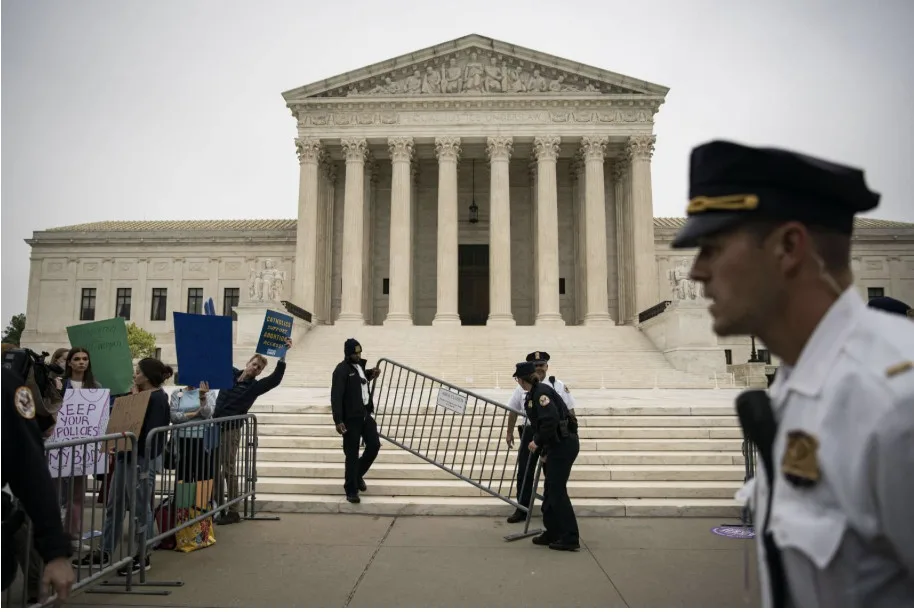
Abortion Rights Advocates and Antiabortion advocates demonstrate outside the Supreme Court in D.C. on May 3. Source: Jacob Botsford/The Washington Post, 2022.
The impact of Roe v. Wade is something that many people are misinformed about. Although people are aware that Roe v. Wade pertains to abortion, many people are unaware of the ramifications of overturning the decision (Crawford et al., 2021). If the Supreme Court overturns Roe v. Wade, more than 20 states will prohibit all forms of abortions. Half of these states have ‘trigger laws’ that ensure automatic reinstating pre-Roe abortion bans or limit them to the extent that the Supreme Court permits (Cohen et al., 2022). As a result, the medical procedure that has been developed over the years to protect a woman’s life will be outlawed in nearly half of the country. While the Biden administration has pledged to safeguard access to mail order pills for abortion, many anti-abortion states are attempting to restrict access to such drugs (Scott, 2022).
Despite the assumption, overturning Roe v. Wade does not mean ending abortion. It means that women and girls will not be able to access medically safe abortion procedures. As emphasised in many countries that ban abortion and pre-Roe days, women and girls’ deaths due to unsafe abortion practices will increase rapidly, creating a health issue in the United States. While many pro-choice activists may aim to help women get safe abortions, it is not always possible to help women in a hostile environment. Moreover, access to safe abortion will become a privilege for middle-class and wealthy women that can afford to travel to a state that offers legal abortion (Scott, 2022). Many vulnerable and marginalised women that live in anti-abortion states will be forced to adhere to rules set by the government or will be forced to opt for unsafe and illegal abortion procedures. Overturning Roe v. Wade only affects women as it takes their choices away.
Less publicised within this discussion is that contraceptive birth control pills are also under threat if the Supreme Court successfully overturns Roe v. Wade. As the foundation of Roe v. Wade is the ‘right to privacy’, if the decision is overturned, the precedent set forth by the Supreme Court that guarantees women protection from governmental interference regarding their reproductive choices will be under threat. Through Roe, it was decided that there were certain decisions like birth control and abortion that states could not interfere with (VanSickle-Ward & Wallsten, 2021). If Roe v. Wade is invalidated, then women’s contraceptive rights and, more broadly, their reproductive rights might be under threat. Therefore, many liberals, pro-choice and women’s rights activists fear that overturning Roe v. Wade would also overturn other social rights not explicitly mentioned in the Constitution (Wall, 2022). By overturning Roe v. Wade, the Supreme Court explicitly allows women’s bodies to be controlled by the government.
Conclusion
It is widely recognised that removing Roe v. Wade which decriminalises abortion and ensures safe access to abortion in the United States, will have severe consequences for women. As overturning Roe v. Wade would remove the constitutional protection the procedure has received, allowing states to ban abortion, many people that consider themselves against abortion and pro-life are pleased with the draft opinion. However, many fail to recognise the ramifications of overturning Roe v. Wade. After overturning Roe v. Wade, the biggest issue is that women’s health would be at serious risk. Restricting access to abortion, as many states have emphasised is their plan, would force the practice to go underground and become unmonitored. Restricting abortion will not mean eradicating abortion; it would compel women and girls to accept unsafe medical procedures by unskilled providers. As Filipovic (2022) asserts, overturning Roe v. Wade is the first step in a broader conservative effort to make abortion illegal that would have no exceptions, even for rape, incest, health, or the pregnant woman’s life. As pregnancy affects a woman more than anyone, abortion should be a personal and individual choice. Therefore, despite everyone’s personal opinions regarding abortion, women are under threat by overturning Roe v. Wade, both medically and socially. The United States’ progress in this regard in the past 50 years would be abated.
References:
Aiken, A. R. (2019). Erosion Of Women’s Reproductive Rights In The United States. BMJ, 366.
BBC News. (2022, May 3). Roe v. Wade: What is US Supreme Court Ruling on Abortion? BBC News. Retrieved May 4, 2022, from, https://www.bbc.com/news/world-us-canada-54513499
Botsford, J. (2022, May 3). The Supreme Court Might Never Recover from Overturning Roe v. Wade. The Washington Post. Retrieved May 4, 2022, from, https://www.washingtonpost.com/opinions/2022/05/03/supreme-court-might-never-recover-overturning-roe-v-wade/
Center for Reproductive Rights. (2003). Roe v. Wade and the Right to Privacy. Center for Reproductive Rights. Retrieved May 4, 2022, from, https://reproductiverights.org/sites/default/files/documents/roeprivacy_0.pdf
Cohen, I. G., Reingold, R. B., & Gostin, L. O. (2022). Supreme court ruling on the Texas abortion law: beginning to unravel Roe v Wade. JAMA, 327(7), 621-622.
Crawford, B. L., Jozkowski, K. N., Turner, R. C., & Lo, W. J. (2021). Examining The Relationship Between Roe V. Wade Knowledge and Sentiment Across Political Party And Abortion identity. Sexuality Research and Social Policy, 1-12.
De Vogue, A. (2021, November 30). Roe v. Wade has been the law of the land for nearly 50 Years. Will that Matter? CNN. Retrieved May 4, 2022, from, https://edition.cnn.com/2021/11/30/politics/roe-wade-stare-decisis-abortion-supreme-court/index.html
Faux, M. (2000). Roe V. Wade: The Untold Story of The Landmark Supreme Court Decision That Made Abortion Legal. Cooper Square Press.
Filipovic, J. (2022, May 3). The World’s Most Pro-Life Nations Offer a Grim Preview of America’s Future. Time Magazine. Retrieved May 4, 2022, from, https://time.com/6173258/pro-life-countries-roe-v-wade-future/
Politico. (2022, May 3). Read Justice Alito’s initial draft abortion opinion, which would overturn Roe v. Wade. Politico. Retrieved May 4, 2022, from https://www.politico.com/news/2022/05/02/read-justice-alito-initial-abortion-opinion-overturn-roe-v-wade-pdf-00029504
Scott, D. (2022, May 4). The Dire Health Consequences of Denying Abortion, Explained. Vox. Retrieved May 4, 2022, from, https://www.vox.com/policy-and-politics/23055300/supreme-court-overturn-roe-wade-abortion-bans-health-care
VanSickle-Ward, R. and Wallsten, K. (2021, December 11). If The Supreme Court Undermines Roe V. Wade, Contraception Could Be Banned. The Washington Post. Retrieved May 4, 2022, from, https://www.washingtonpost.com/politics/2021/12/11/if-supreme-court-undermines-roe-v-wade-contraception-could-be-banned-this-explains-how/
Wall, M. (2022, May 3). Overturning Roe V. Wade Would Have Major Legal, Social and Political Consequences. The Irish Times. Retrieved May 4, 2022, from https://www.irishtimes.com/news/world/us/overturning-roe-v-wade-would-have-major-legal-social-political-consequences-1.4868069
Williams, P. and Finn, T. (2021, December 1). Supreme Court Signals willingness to uphold abortion limits in Mississippi Case. NBC News. Retrieved May 4, 2022, from, https://www.nbcnews.com/politics/supreme-court/supreme-court-set-dive-mississippi-abortion-case-challenging-roe-v-n1285114
Ziegler, M. (2022, May 3). The Conservatives aren’t just ending Roe- They’re delighting in it. The Atlantic. Retrieved May 4, 2022, from https://www.theatlantic.com/ideas/archive/2022/05/supreme-court-leak-overturn-roe-polarization/629743/