
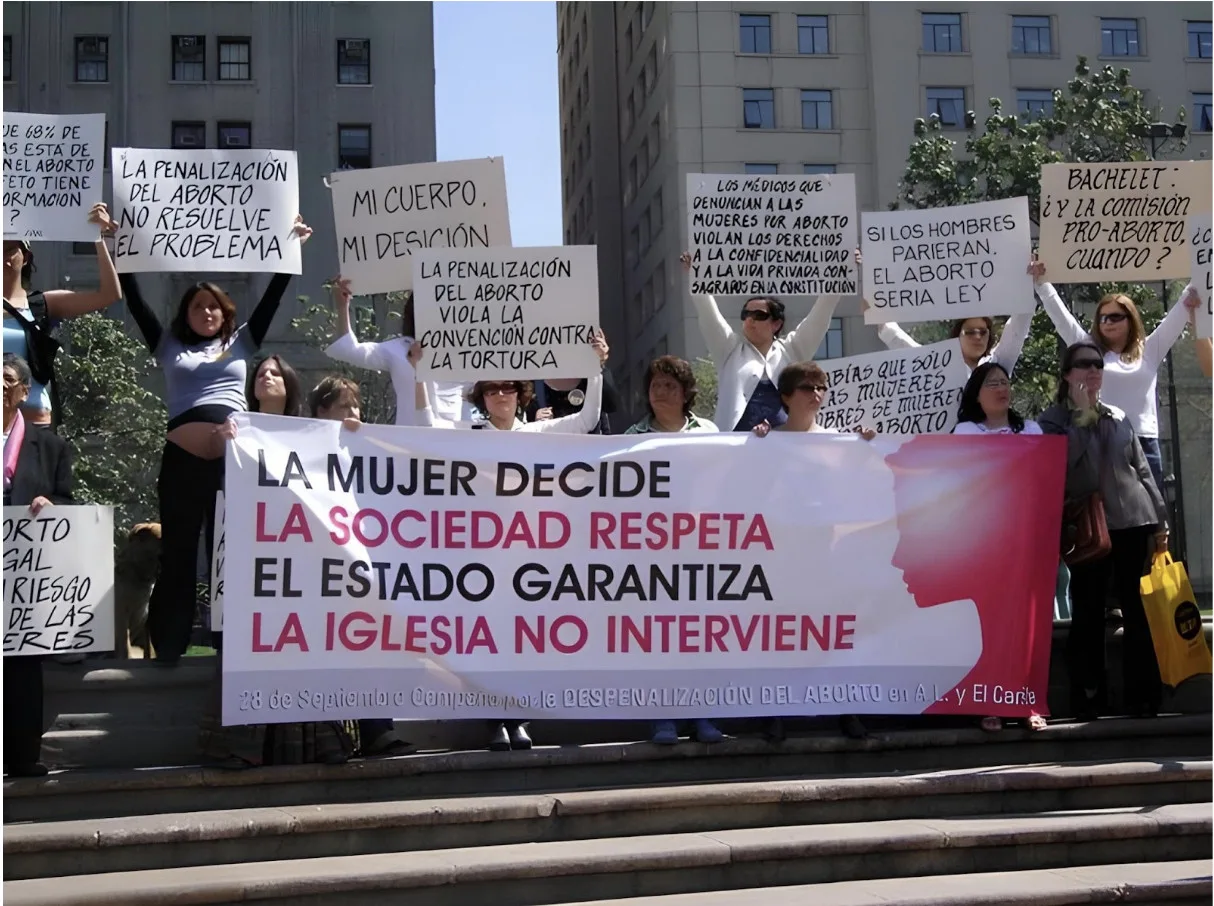
The growing discussion on the legalisation of abortion in Latin America in the past few years has resulted in the emergence of feminist movements fighting for women’s reproductive and human rights. These movements create mega-mobilisations with effects in several countries, challenging existing repressive laws and shaking up conservative dominance in the region. They challenge dogmatism and fundamentalism but emphasise the risks of illegal abortions and how the only alternatives for women are imprisonment, death or harm to health. Although the influence of the movement is limited, the feminist awakening has helped to influence the deliberation of new laws on the matter politically.
Termination of pregnancy as a fundamental right under International Human Rights Law
The current notion that there is a symmetrical balance between the right to life of the woman and the unborn baby is a strong political argument that obfuscates the pressing need to put women’s human rights at the centre of policy considerations regarding abortion (OHCHR, 2017). By analysing the Universal Declaration of Human Rights (UDHR) and the International Covenant on Civil and Political Rights (ICCPR), it is clear that such discussion on the supposed right to life of two entities does not find contestation in international human rights law, as the human rights accorded under this regime are for those who have been born.
In this sense, the discussion on whether the foetus is already a human person with rights from the moment of conception is a rather moot point from a human rights law perspective since a democratic State cannot have laws based on belief systems (OHCHR, 2017). Those who believe in this status regarding personhood are naturally free to act in accordance with their beliefs. However, as addressed by the Inter-American Court of Human Rights in the case of Artavia et al. v. Costa Rica, those beliefs cannot be imposed on others through the legal system.
The main focus of analysis should thus be the actual preservation of women’s human rights and physical integrity, instead of political debates that do not consider the female’s perspective throughout the whole process. Guaranteeing the proper care and procedure in terminating pregnancies relates not only to women’s autonomy, equality, health and safety as fundamental human rights, but also the protection of evolving systems in the fight against regressive trends.
Many developed countries liberalised abortion between 1950 and 1985 to protect women’s human rights, but countries in Latin America still pose several obstacles and a slow progress toward decriminalisation (OHCHR, 2017). However, progress is visible, especially with the growing surge of feminist movements in the region helping to fight this battle. Colombia’s Constitutional Court is one noteworthy example of this development, basing its
Article 1 of the UDHR states: “All human beings are born free and equal in dignity and rights. They are endowed with reason and conscience and should act towards one another in a spirit of brotherhood”.
decision on the legalisation of abortion on women’s human rights and an interesting distinction between the value of life and a legal right to life (Cook, 2007).
The Marea Verde Movement in Latin America
The Marea Verde (or Green Wave) is a feminist movement of reproductive rights activism that emerged in Argentina in 2003. Inspired by the Mothers of the Plaza de Mayo and their white scarves, the Marea Verde women wear green scarves and adopt the campaign of “sexual education to decide, contraception not to abort, legal abortion not to die” (King’s College London, 2020).
The movement has grown through Latin America over the years, influencing several national legal systems in the decision to decriminalise abortion, showing not only a strong local power but also a transnational dimension. Over the past decade, Marea Verde activists have driven historical change in a region with some of the most restrictive laws on the procedure in the world, and where the Catholic Church, with its anti-abortion stance, is hugely influential (Universa UOL, 2022).
For instance, Argentina had one of the most restrictive legislation on abortion in the region, where termination of pregnancy was only allowed in cases of rape or when the mother’s health was at risk. Even with many opposers to the legalisation, feminist movements such as Marea Verde helped tip the scale in favour of women’s human rights, and in 2020, the Argentine Senate approved the bill to legalise abortion in the first 14 weeks of pregnancy (BBC News, 2020). The Law n. 27.610, as it is known, provides that the public health services, the national and provincial social works, and the companies and entities of prepaid medicine incorporate the integral and free coverage of abortion for women. This is a huge step in offering the proper care and safety for women seeking to terminate their pregnancy.
The Mothers of the Plaza de Mayo is an Argentinian association of women who had lost their children and grandchildren to the Process of National Reorganisation, an infamous campaign waged from 1976 to 1983 by Argentina’s military dictatorship. They called international attention to the plight of the desaparecidos (“disappeared persons”) through weekly Thursday afternoon gatherings at the Plaza de Mayo in Buenos Aires, in front of the Casa Rosada presidential palace, in public defiance of the government’s law against mass assemblies. The women would wear white headscarves to symbolise the diapers of their lost children, embroidered with the names and dates of birth of their offspring.
The original text states: “La Ley Nº 27.610 dispone que los servicios públicos de salud, las obras sociales nacionales y provinciales y las empresas y entidades de medicina prepaga incorporen la cobertura integral y gratuita de la práctica”.
More recently, Colombia became the sixth country in Latin America to decriminalise abortion following the latest victory of the Marea Verde movement. The historic decision of the Colombian Constitutional Court in February 2022 now permits the termination of pregnancy up to 24 weeks of gestation (Al Jazeera, 2022). Despite the recent victory, the Marea Verde movement believes there is still a long way to go to ensure that the voluntary termination of pregnancy is a guaranteed right for women in the country (BBC News, 2022). Still, progress is being made in the direction of reducing the life-threatening risks previously endured by women during clandestine procedures.
It is clear that the discussion on the legalisation of the termination of life does not only concern women’s rights, but also health issues. According to the World Health Organisation (WHO), about 19 million clandestine abortions are performed annually, which would be the cause of 13 percent of female deaths (WHO, 2021). In Latin America, they account for one in ten maternal deaths, but with the constitutional changes seen, advocates and doctors claim it represents a major advance for women’s rights across the region, emphasising that it is essential for public policies to provide for abortion care with dignified treatment for women (Al Jazeera, 2022).
Proof of this is the legalisation process in Uruguay, where abortion has been permitted since 2012 for up to 12 weeks. According to an article produced by the University of the Republic of Uruguay, and published in the journal Health Economics, in 2018, babies born from unplanned pregnancies are born healthier than before the abortion law. The survey also points to an improvement in indicators related to prenatal controls. One of the explanations for evolution is a positive selection: with the possibility of interrupting the pregnancy, the mothers who carry the gestation forward are more willing to follow medical recommendations and undergo tests (UOL Notícias, 2018).
It is true that other Latin American States still follow a restrictive approach to termination of pregnancy in their legislations, and that makes things more complicated for the protection of women’s human rights. Peru is a notable example that does not allow abortion in any case. It has been called out by the Human Rights Committee in several instances due to its penal code provisions being “incompatible with the rights to equal enjoyment of other rights protected by the ICCPR” (HRC, 2000).
Brazil is another example where termination of pregnancy is only allowed in cases of rape or when the mother’s health is at risk. Most recently, the country decided to expand the scope to encompass cases of foetuses with anencephaly. However, the Brazilian Supreme Court seems to be following a more progressive path. In 2016, in Habeas Corpus case 124.306, it was decided that abortions in pregnancies up to 90 days are possible (Conjur, 2016). According to Minister Luís Roberto Barroso of the Supreme Court, Articles 124 to 126 of the Brazilian Penal Code, which criminalise abortion in the first trimester of pregnancy, violate women’s fundamental rights, such as the right to autonomy, physical and psychological integrity, their sexual and reproductive rights and gender equality (STF, 2016). The decision values the autonomy of women, but it does not create a precedent. Nevertheless, other judges can use it as an argument in situations involving abortion up to the third month of pregnancy.
Concluding Remarks
The right to legally terminate a pregnancy reduces the risk posed by clandestine interventions on women and allows them to make conscious and informed decisions. The law can also ensure that persons maintain their beliefs while preserving the health of women. For example, in the case of Argentina, the law authorises conscientious objection from doctors who do not want to participate in the abortion, as long as they quickly refer patients to other professionals to perform the procedure. Therefore, the purpose of this right is not to create arbitrary deprivation of life but to save the physical and mental integrity of women.
The fight of the Marea Verde movement in Latin America is to be applauded, given the major successes throughout the years in helping to influence States to change their laws and legalise abortion for all women. Even though the Center for Reproductive Rights estimates that 97 percent of Latin American women of reproductive age still live in countries with restrictive abortion laws, the evolution toward improving women’s human rights in the region is slowly growing.
Bibliography
- (2017). Women’s Autonomy, Equality and Reproductive Health in International Human Rights: Between Recognition, Backlash and Regressive Trends. Office of the United Nations High Commissioner for Human Rights. Retrieved April 20, 2022, from https://www.ohchr.org/sites/default/files/Documents/Issues/Women/WG/WomensAutonomyEqualityReproductiveHealth.pdf
Human Rights Committee. (2000, November 15). Consideration of Reports Submitted by States Parties under Article 40 of the Covenant. Retrieved April 23, 2022, from https://documents-dds-ny.un.org/doc/UNDOC/GEN/G00/458/17/PDF/G0045817.pdf?OpenElement
Inter-American Court of Human Rights. (2012, November 28). Case of Artavia Murillo et al. (“In Vitro Fertilization”) v. Costa Rica. Retrieved April 20, 2022, from https://www.corteidh.or.cr/docs/casos/articulos/seriec_257_ing.pdf
Cook, Rebecca J. (2007). Excerpts of the Constitutional Court’s Ruling that Liberalized Abortion in Colombia. Reproductive Health Matters Journal, 15(29), 160–162. https://www.jstor.org/stable/25475303?seq=1
King’s College London. (2020, September 17). The ‘Pañuelo Verde’ Across Latin America: a Symbol of Transnational and Local Feminist (Re)volution. Retrieved April 20, 2022, from https://www.kcl.ac.uk/the-panuelo-verde-across-latin-america
Universa UOL. (2022, March 6). Aborto na Colômbia: a ‘onda verde’ que está descriminalizando interrupção da gravidez na América Latina. Retrieved April 20, 2022, from https://www.uol.com.br/universa/noticias/bbc/2022/03/06/aborto-na-colombia-a-onda-verde-que-esta-descriminalizando-interrupcao-da-gravidez-na-america-latina.htm
Ley n. 27.610 de Acceso a la Interrupción Voluntaria del Embarazo. (2020). Argentina.
Al Jazeera. (2022, February 22). Colombia decriminalises abortion following regional ‘green wave’. Retrieved April 23, 2022, from https://www.aljazeera.com/news/2022/2/22/colombia-decriminalises-abortion-following-regional-green-wave
BBC News. (2022, March 6). Aborto na Colômbia: a ‘onda verde’ que está descriminalizando interrupção da gravidez na América Latina. Retrieved April 8, 2022, from https://www.bbc.com/portuguese/internacional-60501587
UOL Notícias. (2018, August 16). Após legalizar aborto, Uruguai vê melhora na saúde de bebês não planejados, segundo estudo. Retrieved April 23, 2022, from https://noticias.uol.com.br/internacional/ultimas-noticias/2018/08/16/com-aborto-legal-uruguai-diminuiu-gravidez-nao-planejada-e-melhorou-saude-de-bebes-diz-estudo.htm
Conjur. (2016, November 29). Interromper gestação até 3º mês não é crime, decide 1ª Turma do STF em HC. Retrieved April 23, 2022, from https://www.conjur.com.br/2016-nov-29/interromper-gestacao-mes-nao-aborto-turma-stf
Supremo Tribunal Federal. (2016, August 9). Habeas Corpus 124.306 Rio de Janeiro. Retrieved April 25, 2022, from https://www.conjur.com.br/dl/hc-voto-aborto-lrb.pdf
BBC News. (2020, December 30). Argentina aprova legalização do aborto: em que países da América Latina o procedimento já é legal. Retrieved April 25, 2022, from https://www.bbc.com/portuguese/geral-55476576