
Introduction
Myanmar is home to over 100 ethnic groups, languages, and dialects, making it one of the most ethnically diverse countries in Asia. Out of the country’s population of 56 million people, the largest minorities are Shan and Karen, who constitute two-thirds of the ethnic population, with Rakhine, Chin, Rohingya, Kachin, and others forming the other one-third. Since the military takeover in February 2021, Myanmar has become the ground for widespread violence, political instability, and humanitarian crises. The junta’s seizure of power has led to mass protests and rapid responses from opposition movements across the country, with ethnic minorities playing a central role. This report analyses the role of ethnic groups in the armed conflict, their role in the resistance against the military junta, and the grave violations of human rights they are subjected to arising from the civil war.
Historical Context
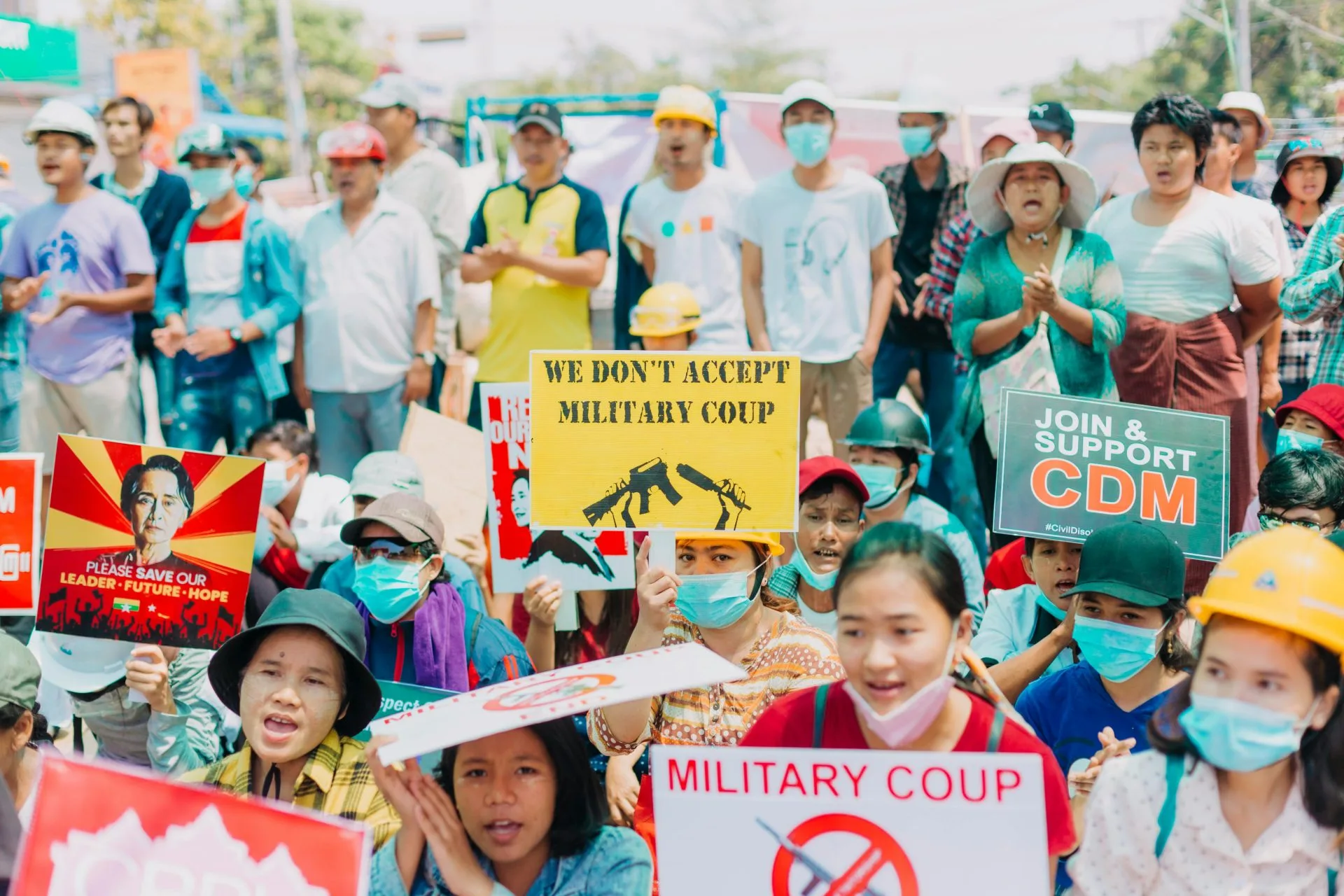
The military junta staged a coup on February 1st, 2021, following the victory of the National League for Democracy (NLD) in the 2020 elections, claiming that the elections were rigged and arresting President Win Myint, State Counsellor Aung San Suu Kyi, and other elected officials. The coup resulted in mass protests around cities and provincial areas, uniting NLD supporters, civil society, and ethnic minorities under what became known as the Spring Revolution. The resistance quickly expanded from dissatisfaction with the NLD leaders to a broader struggle that affected the ethnic minorities directly, who had already faced political exclusion and human rights violations thus far (Khan, 2025).
Minority communities have continued to play a crucial role in the resistance against the coup, sheltering displaced civilians and supporting the protest movement. The coup’s escalation of violence– including the killing of over 100 civilians in one day– marked a turning point. In response, the formation of the National Unity Government (NUG) established the People’s Defence Force (PDF) alongside ethnic armed organisations such as the Karen National Union, the Kachin Independence Organization, and the Three Brotherhood Alliance, who became crucial partners, providing both training and territory for the resistance. For the first time in decades, Myanmar’s majority groups formed alliances with minorities to combat the central military (Khan, 2025).
The conflict between the military coup and the NUG alliance has continued thus far, with multiple major offensive missions executed by the resistance for territory control. Despite the military’s call for a cease-fire and a proposed election in 2025, the NUG rejected the offer, vowing to continue fighting for a federal democracy. Since the coup, the military dictatorship has led to more than 6000 individuals being killed, 20,000 suffering injuries, and millions of people displaced. While the revolution represented a chance for minority groups to push for recognition, these same communities remain those most affected by civil war, bearing the brunt of humanitarian crises (Khan, 2025).
Role In Conflict
This section analyses the role of major ethnic minorities in Myanmar’s civil war, examining their historical background, geographic location, and involvement in the armed conflict. The analysis focuses on the interaction between ethnic armed organisations, the military’s involvement in each region, and humanitarian issues for the civilian population.
Karen
The Karen minority is an ethnic group with Tibetan-Central Asian origins, who speak a dozen distinct but related languages. They are mainly located in the southern parts of Myanmar, particularly in the Kayin State.
The Karen National Union (KNU) and the Karen National Liberation Army (KNLA) have played a major role in the frontline of the conflict against the military junta. The KNU, founded in 1949, is one of the oldest Ethnic Armed Organizations (EAOs) operating mainly in Kayin, Kayah, Taninthary, and other parts of southern Myanmar. Tensions between the KNLA and the military have existed even before the coup, due to the military’s expansion into their region in 2018. In August of 2023, the KNU officially declared its ceasefire ended after repeated and frequent violations by the Tatmadaw, and subsequently resumed both air and ground offensives. The KNU and KNLA also collaborate with the PDF, providing protection and defending key strategic border areas such as the Asian Highway 1, the most important link between Myanmar and Thailand. The KNLA provides supply routes and is constantly engaged in joint operations to fend off Tatmadaw offensives (Bundesamt für Migration und Flüchtlinge [BAMF], 2024). Such actions result in harsh responses, as the military junta has launched airstrikes on schools, hospitals, religious sites, refugee camps, and other zones suspected of harbouring resistance forces (Karen Human Rights Group [KHRG], 2025).
Shan
The Shan is the largest ethnic group in Myanmar. Most live in the Shan State, with smaller communities found in Kachin State. They speak a language close to the Tai language and are closely related to Thailand and Laos.
The conflict in the Shan State is one of the most complicated in Myanmar, with at least seven ethnic armed organisations, 20 militias, and seven border guard units active since the coup. The junta has been focused on maintaining control over the main cities, which led to the Northern Alliance of Myanmar National Democratic Alliance Army (MNDAA), KIA, Arakan Army (AA), and the Ta’ang National Liberation Army to form the Three Brotherhood Alliance and push back the Restoration Council of Shan State (RCSS) who after heavy losses, has aligned itself with the military (BAMF, 2024). In October of 2023, the Three Brotherhood Alliance launched Operation 1027, an offensive targeting Myanmar’s military outposts in the north of the Shan State. This operation triggered attacks on the opposition armed groups in other regions in the country and has displaced more than 600,000 individuals (Human Rights Watch [HRW], 2023). Another aspect of the conflict is China’s involvement, where the government negotiated a ceasefire between the junta and the Alliance, as it has economic interests in Myanmar, and ethnic armies are supporting China in fighting cybercrime in the Shan State near the border. The civilian population is the one mostly affected, as people continue to flee because of violence, loss or confiscation of property, fear of forced recruitment, and landmine incidents (BAMF, 2024).
Kachin
The Kachin ethnic group is formed by several related communities that are linked by clan systems and speak dialects from the Tibeto-Burman linguistic family. Most of the individuals live in the Kachin State, in the northern part of Myanmar.
The Kachin Independence Army (KIA), based in the state of Kachin in north-eastern Myanmar, has also played a substantial role since the military coup, refusing to recognise the military junta and aligning with the National Unity Government. The KIA openly announced that it would take measures to protect the population if the military started attacking civilians. As a result of military forces killing two protesters in the state’s capital, KIA began launching several offensives against the junta. The army provides organisational support and material support to local PDFs and cuts military supplies to Kachin. It also protects pro-democracy activists and former members of the parliament, and trains them in tactics of sabotage, ambushes, and mobility. Conflicts have since escalated to roadside attacks, airstrikes, and the use of heavy weapons, leading to retaliation tactics from the junta, causing widespread destruction and death of civilians. (BAMF, 2024)
Rakhine / Rohingya
The Rakhine State is home to the Sunni Muslims, who are divided into two categories. The Rohingya Muslims live in the northern part of the state and speak a language derived from Bengali language. The other half are the Arakanese Muslims who speak a dialect related to the Burmese language.
Before the military coup, there were already two active ongoing conflicts in the Rakhine State. The first is the conflict between the Arakan Rohingya Salvation Army and the Myanmar military due to the launch of a large-scale operation against the Rohingya Muslim population. The second is between the Arakan Army (AA) and the military, due to the military’s dissatisfaction with the AA fighting for self-determination. At the beginning of the coup, the situation was peaceful until the AA finally condemned the junta and called for an end to the violence. The AA was also part of Operation 1027, which led to immediate responses of bombardments, road blockages, and civilian deaths (BAMF, 2024). Since November 2023, the number of displaced civilians has reached 350,000 people within the region. Armed clashes have continued to escalate and have led to recent territory losses for the junta. This has led to forced recruitment among the Rohingya and Rakhine communities. Due to the military blockade, little to no aid has arrived in most parts of the state, prices are increasing, and healthcare has become less accessible due to the junta’s closing of several hospitals (BAMF, 2024), posing a serious humanitarian problem.
Chin
The Chin group, also called Zomi, is an ethnic minority of Tibeto-Burman origin and resides primarily in the Chin State. Out of the 135 officially recognised ethnicities in Myanmar, 53 of them are Chin ethnic groups.
The State of Chin is the least economically developed region in Myanmar, with no active conflicts present for decades before the coup of 2021. Since the junta took power, it has become a strong point for the resistance and the primary zone where peaceful protests have been suppressed. Opposing individuals of the coup founded the Chinland Defence Force (CDF), which trained almost 10,000 civilian fighters for the civil war (BAMF, 2024). The CDF, at first, had taken a peaceful stance, observing the ceasefires and not actively confronting the junta. Circumstances changed when the junta arrested seven peaceful protesters and refused to release them, leading to the CDF launching operations, fighting alongside post-coup resistance forces, and forming alliances. For most of this time period and to this day, the Chin opposition army has had most of the control over the state. Throughout the time, they have faced serious challenges, with women being marginalised among resistance forces, even if they played a big part at the start of the resistance. More than 160,000 people have been displaced, the delivery of aid or public services is not secure, and the civilian population continues to be at risk of airstrikes and attacks by the junta (International Crisis Group, 2025).
Impact on Human Rights
Due to the growing resistance and territory gains by the ethnic army groups and alliances, the military junta has resorted to destructive tactics. Since the beginning of the coup in 2021, the acts committed against the ethnic minorities amount to war crimes and crimes against humanity, with the Rohingya facing the gravest threats to their existence.
The launch of Operation 1027 has led to an escalated fight between the military and the ethnic armed groups in the country. The junta has carried out aerial and artillery attacks against not just the armed groups, but also against civilians and their property. In January 2024, a military airstrike on Kanan village killed 17 civilians, of whom nine were children. In the latter part of the year, the military would launch another airstrike on a school in the Karenni State, killing four students and injuring 27 individuals, and bomb a camp for displaced persons, killing eight children and two women (HRW, 2024). Subsequently, at the beginning of 2025, the State Administration Council of Myanmar (SAC) launched another strike in villages in the Karen region, causing the death of 4 civilians, the destruction of homes and communal spaces, and leading to the displacement of several civilians. The villagers are now struggling to find food, shelter, and health care, and live in fear of further attacks (KHRG, 2025). Communal spaces, religious institutions, and cultural centres have also become targets of the military junta. A report shows that between January 2025 and June 2025, SAC destroyed or damaged churches, monasteries, and schools in south-east Myanmar, claiming it was for security operations. The junta has destroyed spaces protected under international humanitarian law, and civilians’ cultural and religious identities are under threat.
Multiple sources have also reported broader patterns of constraints and violence against civilians under the SAC regime. The junta has carried out widespread unlawful killings, with one incident occurring in the Rakhine State, where soldiers rounded up hundreds of villagers, who were interrogated, tortured, and some even shot (HRW, 2024). A report by the United Nations Office of the High Commissioner for Human Rights (UNHRC) estimated that an average of 4810 people had been killed by the military between February 2021 and March 2024, including 700 women and 500 children, in such instances of violence, and over 20,000 individuals were detained without process (UNHRC, 2024). More than 1900 people have died while in custody. Additionally, reports show that the imprisoned suffer from torture, sexual violence, and other ill-treatment, and are constantly deprived of food, water, and sleep. Journalists, humanitarian workers, and activists have also been arrested arbitrarily. More than 1800 individuals have been arrested for supporting the ethnic armed groups and criticising the military, going as far as arresting someone for simply liking a social media post. A large number of detainees have been sentenced to death by specialised courts established by the junta (HRW, 2024).
One of the biggest concerns to humanitarian law is the severe systematic displacement of civilians across Myanmar. A United Nations Office for the Coordinator of Humanitarian Affairs (UN OCHA) report shows that as of March 2025, over 3.5 million people are estimated to be displaced since February 2021, with 19.9 million people in need of assistance and aid. Displaced populations face shortages of essential supplies such as food, water, and shelter. Global funding reductions have had a widespread impact on humanitarian responses in Myanmar, hindering aid workers from providing medicine and healthcare services to the civilians. A lot of life-saving operations had to be cancelled or scaled down, leaving displaced populations in a vulnerable state (OCHA, 2025). The lack of access to medical care has led to growing numbers of cases of malnutrition, illness, and preventable deaths. As of 2024, 1.6 million civilians have been cut off from hospital access in the Rakhine State (HRW, 2024).
Sexual and gender-based crimes are widespread throughout Myanmar, with women and girls being at high risk of suffering from crimes committed by the junta and non-state actors who do not face accountability. Military forces subject civilians to rape, sexualised torture and mutilation, and sexual assault as a way to punish the population and the resistance. The number of incidents is increasing, with gender-based violence being a common practice used against detainees (HRW, 2024).
In the Shan State, civilians are often subjected to forced recruitment, abductions, and extortion by both the military junta and ethnic armed group organisations. The Myanmar National Democratic Alliance Army (MNDAA), a party to Operation 1027, has been reported to abduct and force civilians to recruit. In November 2023, the MNDAA had abducted seven men who were fleeing from Laukkai due to the violence that was occurring in the area. Multiple witnesses stated that the group was pulling over young men, rounding them up, and forcibly taking them somewhere else. Ethnic armed groups, such as the MNDAA, often impose quotas requiring villages to supply a recruit who may be willing to serve. The military and pro-junta groups have the same practices, often forcibly recruiting children for their army groups or other posts within the organisations (HRW, 2023).
The Rohingya population continues to be one of the most unprotected minorities in Myanmar. About 630,000 Rohingya are subject to systematic abuses, crimes against humanity, persecution, and deprivation of liberty as of 2024 by both the military junta and the ethnic armed group, the Arakan Army. More than 380,000 individuals in the Rakhine State have been displaced, with 11,000 who have attempted to escape from Myanmar and go to Bangladesh (HRW, 2024). Since the coup, the Rohingya have remained stateless and confined to displacement camps, where they suffer grave violations of humanitarian law, from both the military and the resistance.
Reports and videographic evidence show that men were forcibly taken out of camps and villages by the junta under the claim that their service was compulsory, and sent to training before they would be deployed and forced to fight. Sources say that those who joined were promised benefits such as money or citizenship, which ultimately did not happen. The Arakan Army has also targeted the Rohingya, killing, abducting, recruiting, and extorting them. They are often denied access to life-saving resources and are being forced into labour. Such conditions have often led the minority to attempt to flee, resulting in landmine incidents, arbitrary arrests and prosecution, sexual exploitation, gender-based violence, and human trafficking. Restriction of free movement and the lack of humanitarian aid have left the Rohingya in grave living conditions, making them vulnerable to further impacts of the civil war (UNHRC, 2024).
Conclusion
The civil war in Myanmar illustrates the resistance and resilience that ethnic minority groups possess against the military authoritarian rule, despite the disproportionate suffering they continue to endure. The actions committed against civilians by the junta or other non-state actors amount to grave breaches of international humanitarian and human rights law and create a vulnerable space for ethnic minorities and marginalised populations. The need for international action and involvement is urgent. Without proper judicial process, appropriate sanctions, and accountability frameworks, ethnic minorities’ rights will continue to be undermined and forgotten. Ensuring justice for the grave violations of crimes against humanity and war crimes is a necessary condition for ending the civil war.
Bibliography
Bundesamt für Migration und Flüchtlinge (BAMF) (2024). Länderreport 70. Retrieved on 17 September 2025 from https://www.bamf.de/SharedDocs/Anlagen/EN/Behoerde/Informationszentrum/Laenderreporte/2024/laenderreport-70-Myanmar.html?nn=456610.
International Crisis Group. (2025, March). Divided resistance: Chin State. Retrieved on 17 September 2025 from https://www.crisisgroup.org/asia/south-east-asia/myanmar/b181-divided-resistance-myanmars-chin-state.
Human Rights Watch (HRW). (2023, December 21). Myanmar: Armed group abuses in Shan State. Retrieved on 17 September 2025 from https://www.hrw.org/news/2023/12/21/myanmar-armed-group-abuses-shan-state.
Human Rights Watch (HRW). (2024, September). Myanmar: Events of 2024. Retrieved on 18 September from https://www.hrw.org/world-report/2025/country-chapters/myanmar.
Karen Human Rights Group (KHRG) (2025, July) Mu Traw District incident report: SAC air strikes cause death, injuries, displacement. Retrieved on 17 September 2025 from https://khrg.org/2025/07/25-58-i2/mu-traw-district-incident-report-sac-air-strikes-cause-death-injuries-displacement.
Karen Human Rights Group (KHRG) (2025, August) Community spaces under fire: Attacks and destruction of community buildings. Retrieved on 18 September 2025 from https://khrg.org/2025/08/25-3-bp1/community-spaces-under-fire-attacks-and-destruction-community-buildings-and.
Khan, Z. T. (2025, April). The Dynamics and Implications of the Myanmar Civil War: A Conceptual Analysis, Academic Journal of Humanities and Social Sciences, 2(1). https://doi.org/10.3126/ajhss.v2i1.83193
Minority Rights Group. (2007, October). Minorities in Burma. Retrieved on 17 September 2025 from https://minorityrights.org/resources/minorities-in-burma/.
United Nations Human Rights Council (UNHRC). (2024, June 18). Situation of human rights of Rohingya Muslims and other minorities in Myanmar: Report of the United Nations High Commissioner for Human Rights (A/HRC/56/23)
United Nations Office for the Coordination of Humanitarian Affairs (OCHA). (2025, March 28). Myanmar humanitarian update No. 45. Retrieved 17 September 2025 from https://www.unocha.org/publications/report/myanmar/myanmar-humanitarian-update-no-45-28-march-2025.