
Lead: Two years after Sudan’s war began, the country stands on the edge of collapse. The power struggle between the Sudanese Armed Forces (SAF) and the Rapid Support Forces (RSF) has unleashed atrocities, famine, and one of the world’s worst humanitarian crises.
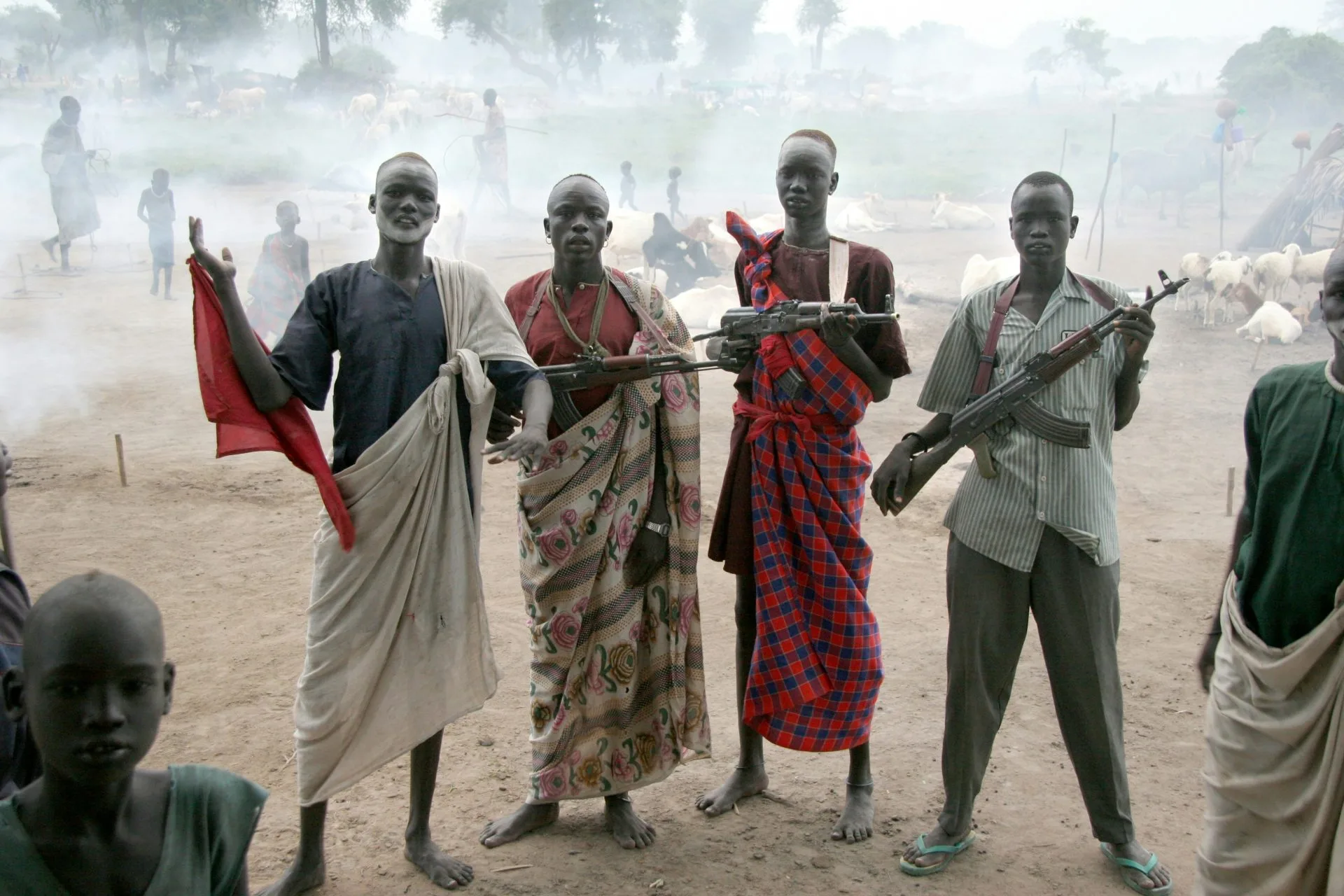
Young men heavily armed in the middle of a village. Source: © Randy Fath, Unsplash (August 2018).
04-11-2025
Alejandra Martinez Otero-Saavedra
UN Team Researcher,
Global Human Rights Defence.
INTRODUCTION
It has been two years since the outbreak of civil war in Sudan, a conflict pitting the Sudanese Armed Forces (SAF), and the paramilitary Rapid Support Forces (RSF), and shaped by international allies, regional interests and armed groups. This internal conflict has led to the death of thousands and the forced displacement of 12 million people since 2023 (United Nations High Commissioner for Refugees, 2025). Since then, the country has become one of the most insecure places in the world, with targeted violence against civilians, sexual assaults, attacks on hospitals and humanitarian workers, and a high proportion of the population facing the risk of severe hunger.
These acts constitute grave violations of the Geneva Conventions, the International Covenant on Civil and Political Rights (ICCPR), the Convention Against Torture, and the Convention on the Elimination of All Forms of Discrimination against Women (CEDAW), all of which prohibit mentioned crimes.
CONTEXT
The roots of Sudan’s instability lie in decades of authoritarian rule under Omar al-Bashir, whose fall in 2019 left a fragile power vacuum (Stiftung Wissenschaft und Politik, 2024). The promise of a civilian transition soon collapsed under competing military and paramilitary interests. Although the overthrow of al-Bashir marked the start of the establishment of a joint civilian-military council, formally established to facilitate Sudan’s transition to elections, it was not long before the military and its paramilitary allies gained the upper hand in the power struggle. Civilian authorities were pushed aside, and the military coup of 2021, conducted by General Abdel Fattah al-Burhan, brought the transition to a halt. Sudan was again under military control, which opened the path for the present clash of the SAF and the RSF to take place.
HUMANITARIAN, ECONOMIC, AND POLITICAL COLLAPSE
This situation worsened after El Fasher was taken by paramilitary groups on October 23rd. Since then, summary executions, mass killings, sexual violence, robberies, kidnappings, and even attacks against humanitarian workers have been reported in and around the city (OHCHR, 2025a; OHCHR, 2025b). Open-source investigations and satellite imagery by Yale University’s Humanitarian Research Lab, as well as reporting by international media and NGOs, have further corroborated evidence of mass graves and large-scale killings (Yale HRL, 2025; Amnesty International, 2025; The Guardian, 2025; Associated Press, 2025).
These findings provide evidence of the atrocities committed during and after the city’s fall, all of which constitute grave violations of international humanitarian law and human rights.
3.1 War crimes
3.1.1. Attacks on hospitals, medical personnel, and medical units
More than 460 people have been killed in hospitals, according to the World Health Organisation (WHO), and several hospital workers have been kidnapped. Forty percent of medical centres in Sudan have stopped functioning completely.
Under the Geneva Convention IV (Arts. 18–20), civilian hospitals, medical personnel and medical units enjoy special protection; attacks against them are strictly prohibited. Additional Protocol II (Art. 11) also explicitly bans attacks, threats, and reprisals against medical facilities. Intentionally directing attacks against hospitals or humanitarian personnel amounts to a war crime under the Rome Statute of the International Criminal Court (Art. 8(2)(b)(ix); Art. 8(2)(e)(ii)).
3.1.2. Conflict-related sexual violence
Women and girls have been raped under the threat of death, and many others have been forcibly displaced, with testimonies collected by UN experts and international NGOs. “There were many bodies on the roads, dead people everywhere, and many children in the streets who had lost their families,” said Amina. “Rape happened before our eyes, and killings too” (Uddin, 2025). Conflict-related sexual violence, including rape, sexual torture, abduction, and sexual enslavement, is prohibited under multiple binding legal instruments.
The Geneva Conventions (Common Article 3) and Additional Protocol II (Art. 4(2)(e)) prohibit outrages upon personal dignity and specifically ban rape. These acts also constitute war crimes under the Rome Statute (Art. 8(2)(e)(vi)) and, when widespread or systematic, may amount to crimes against humanity (Art. 7(1)(g)). They further violate Sudan’s obligations under CEDAW (Arts. 1, 2, 5), which requires states to protect women and girls from gender-based violence.
3.1.3. Starvation and obstruction of humanitarian aid
Over 30 million people now require urgent humanitarian aid (United Nations Office for the Coordination of Humanitarian Affairs [OCHA], 2025). Entire communities have lost access to medicine and food, but also to schooling. Camps for displaced people are overcrowded, and humanitarian corridors remain under attack or blocked by armed actors. UN agencies warn that acute malnutrition and starvation are spreading rapidly, with deliveries of humanitarian aid frequently obstructed or looted.
The deliberate restriction of humanitarian access and the use of starvation as a method of warfare violate Additional Protocol II (Art. 14), which prohibits starving civilians as a tactic in conflict. The Rome Statute classifies the intentional deprivation of food, water or essential aid as a war crime (Art. 8(2)(b)(xxv)). Geneva Convention IV (Art. 23) further requires free passage of humanitarian relief for civilians.
3.2 Economic collapse and violations of social, cultural and economic rights
The conflict has decimated Sudan’s economy. In many areas, electricity and internet access have disappeared entirely, and trade through Port Sudan has been severely disrupted. Markets operate sporadically, and families rely on smuggling routes or humanitarian air drops to survive. Aid convoys have been looted or blocked, and dozens of humanitarian workers have been detained, forcing several international agencies to suspend operations. These factors have fueled inflation and the devaluation of the national currency.
Due to the destruction of agricultural areas and fuel scarcity, food prices have risen dramatically, pushing large parts of the population toward extreme poverty (OHCHR, 2025c).
These conditions violate core socio-economic rights, including the right to an adequate standard of living, the right to food, and the right to health, guaranteed under the International Covenant on Economic, Social and Cultural Rights (ICESCR) (Arts. 11–12). The targeting of productive infrastructure and the obstruction of trade routes, when not justified by military necessity, may breach Geneva Convention IV (Art. 53), which prohibits destroying civilian property. These actions might also lead to violations of Customary International Humanitarian Law (IHL) Rule 54, which protects objects indispensable to civilian survival, including agricultural areas, food stocks, crops, livestock, water systems, and markets.
GEOPOLITICAL CONSIDERATIONS
The conflict has far-reaching implications for regional stability. In the Red Sea corridor, growing insecurity threatens maritime trade routes and international energy supplies, while in the Sahel, weapons and fighters move freely across porous borders, fueling existing insurgencies. Neighbouring countries, such as Chad and South Sudan, face growing humanitarian pressure as refugee populations increase daily (UNHCR, 2025).
International and regional actors have also contributed, directly or indirectly, to the prolongation of the conflict. The United Arab Emirates has been repeatedly accused by UN experts of supplying weapons and logistical support to the Rapid Support Forces (RSF), enabling their expansion in Darfur and their takeover of El Fasher. Investigations by human-rights groups show “sophisticated Chinese weaponry re-exported by the United Arab Emirates” used by the RSF in Darfur and Khartoum (Amnesty International, 2025).
Egypt has historically supported the Sudanese Armed Forces (SAF), motivated by security concerns in the Red Sea and the Nile Basin. Russia’s Wagner Group, and later its successor structures, have been active in Sudan since 2017 through security cooperation, mining concessions and arms transfers, strengthening paramilitary actors and deepening the militarisation of the country (Foreign Policy Research Institute, 2025).
Chad has also served as a rear base for RSF movements, either deliberately or through lack of state control over its borders. Leaked UN reports identify flights from the UAE to bases in Chad used to supply the RSF (Washington Centre for Human Rights, 2025). The involvement of border states multiplies the conflict’s regional spill-over potential and weakens control of arms flows.
CONCLUSION
Both the High Commissioner for Human Rights, Volker Türk and the UN Secretary António Guterres, among other international leaders, have continually urged member states to use their influence to halt the sale of weapons, and to immediately protect the civilian population. “Something essential to stopping the fighting is ensuring that no more weapons enter Sudan,” said António Guterres. “We need to create mechanisms of accountability, because the crimes being committed are horrendous.” (Deutsche Welle, 2024).
Sudan’s geographic position, linking the Sahel, the Horn of Africa and the Red Sea, explains its geopolitical significance, and, as a result, external interests in the conflict have been intensified. Without a coordinated arms embargo and real pressure for accountability, The country risks total collapse. The fate of millions of Sudanese civilians now rests on the moral choices of those outside Sudan.
BIBLIOGRAPHY
Amnesty International. (May 2025). Sudan: Advanced Chinese weaponry provided by UAE identified in breach of arms embargo [Investigation]. https://www.amnesty.org/en/latest/news/2025/05/sudan-advanced-chinese-weaponry-provided-by-uae-identified/
Amnesty International. (October 2025). Sudan: RSF must end attacks and further suffering of civilians in El Fasher. https://www.amnesty.org/en/latest/news/2025/10/sudan-el-fasher/
Associated Press. (November 2025). Satellite images suggest evidence of mass burials ongoing in Sudan’s El-Fasher. https://apnews.com/article/181c12ded100933c2ec9ce23a89f97b5 AP News
Deutsche Welle. (2024, November 22). Guterres pide poner fin a la pesadilla de violencia en Sudán. https://www.dw.com/es/guterres-pide-poner-fin-a-la-pesadilla-de-violencia-en-sud%C3%A1n/a-74611087
France 24. (2025, October 11). Sudan: Drone attack attributed to the army kills at least 60 people in El Fasher. https://www.france24.com/es/%C3%A1frica/20251011-sud%C3%A1n-un-ataque-con-drones-atribuido-a-las-far-deja-al-menos-60-muertos-en-el-fasher
FPRI (Foreign Policy Research Institute). (2025, July 21). Foreign influence is fueling the war in Sudan. https://www.fpri.org/article/2025/07/foreign-influence-is-fueling-the-war-in-sudan/ Foreign
López, V. (2025, November 3). Massacre in Darfur: The latest atrocities in Sudan’s endless war. The New York Times (Spanish edition). https://www.nytimes.com/es/2025/11/03/espanol/mundo/masacre-darfur-sudan.html
Office of the United Nations High Commissioner for Human Rights. (October 2025a). Sudan: El Fasher atrocities must be investigated and perpetrators held to account. https://www.ohchr.org/en/press-briefing-notes/2025/10/sudan-el-fasher-atrocities-must-be-investigated-and-perpetrators-held
Office of the United Nations High Commissioner for Human Rights. (November 2025b). Sudan: UN experts appalled by reports of mass atrocities, unlawful killings and sexual violence in El Fasher. https://www.ohchr.org/en/press-releases/2025/11/sudan-un-experts-appalled-reports-mass-atrocities-unlawful-killings-and
Office of the United Nations High Commissioner for Human Rights. (April, 2025c). Sudan faces worsening humanitarian catastrophe as famine and conflict escalate: UN experts. https://www.ohchr.org/en/press-releases/2025/04/sudan-faces-worsening-humanitarian-catastrophe-famine-and-conflict-escalate
Protocol Additional to the Geneva Conventions of 12 August 1949, and relating to the Protection of Victims of Non-International Armed Conflicts (Protocol II), 1125 U.N.T.S. 609. (1977, June 8). Article 11: Protection of medical units and transports. https://ihl-databases.icrc.org/en/ihl-treaties/apii-1977/article-11
Stiftung Wissenschaft und Politik. (2024). Power relations in Sudan after the fall of Bashir (Research Paper RP 05). https://www.swp-berlin.org/10.18449/2024RP05/
The Guardian. (October 2025). Mass killings reported in Sudanese city seized by paramilitary group. https://www.theguardian.com/world/2025/oct/28/mass-killings-reported-el-fasher-sudan-paramilitary-group-rapid-support-forces
Uddin, R. (2025, November 11). Sudanese women describe sexual violence and beatings while escaping El Fasher. Middle East Eye. https://www.middleeasteye.net/news/women-describe-scenes-sexual-violence-and-beatings-while-escaping-el-fasher
United Nations. (1979). Convention on the Elimination of All Forms of Discrimination against Women. 1249 U.N.T.S. 13. https://www.un.org/womenwatch/daw/cedaw/text/econvention.htm
United Nations High Commissioner for Refugees. (2025, May). Sudan emergency. https://www.unhcr.org/emergencies/sudan-emergency
United Nations Office at Geneva. (October 2025). Tens of thousands fleeing on foot amid atrocities in Sudan’s El Fasher. https://www.ungeneva.org/en/news-media/news/2025/10/112366/tens-thousands-fleeing-foot-amid-atrocities-sudans-el-fasher
United Nations Office for the Coordination of Humanitarian Affairs. (2025). Sudan: Humanitarian Needs and Response Plan Overview (2025). https://www.unocha.org/publications/report/sudan/sudan-humanitarian-needs-and-response-plan-2025-overview
World Health Organization. (October 2025). WHO condemns killings of patients and civilians amid escalating violence in El Fasher, Sudan.
Yale Humanitarian Research Lab. (November 2025). Satellite imagery analysis of mass killings and attempted escapes from El Fasher, Sudan [OSINT brief]. (Reported in Middle East Eye/Arab News/AP). Arab News+2middleeasteye.net+2