
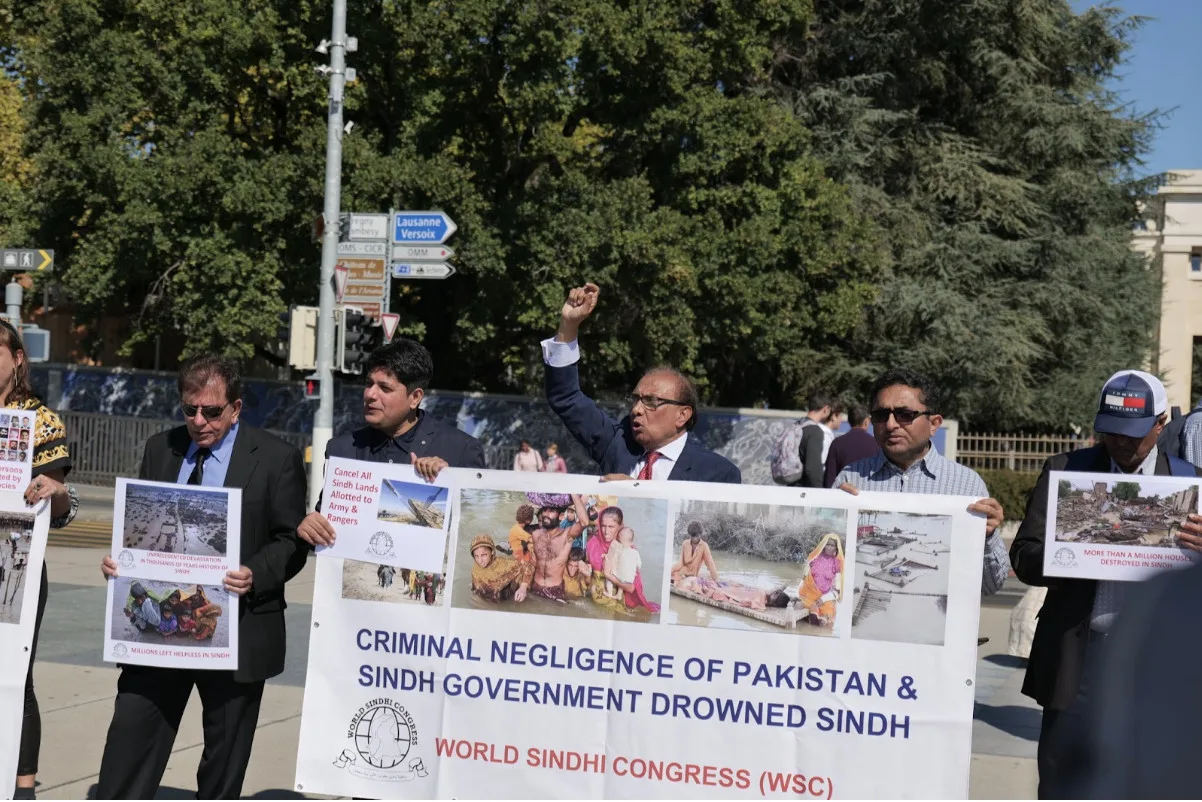
On the 22nd of September, the World Sindhi Congress organized a protest at the Broken Chair monument in Geneva to show the world all these human rights violations in Sindh. The major topics of the protests focused on the enforced disappearance, criminal negligence of Pakistani governments, and arbitrary Sindh land allotment.
Enforced Disappearance
Enforced disappearances have long been a stain on Pakistan’s human rights record. Despite the pledges of successive governments to criminalize the practice, there has been slow movement on legislation while people continue to be forcibly disappeared with impunity (Amnesty, 2019). The UN Working Group on Enforced or Involuntary Disappearance has hundreds of cases pending from Pakistan. The number of cases of victims of enforced disappearance recorded by victim groups is much higher (Amnesty, 2019).
In Sindh, enforced disappearances mainly happen to political activists, human rights defenders, members and supporters of religious and nationalist groups suspected members of armed groups. They proscribed religious and political organizations in Pakistan (Balcaso, 2022). However, according to Mary Aileen D. Bacalso, the chairperson of ICAED, young students in Sindh also face the same threat, many of whom have been taken away from examination centers and forcibly disappeared. (Balcaso, 2022). In some cases, individuals are openly taken into custody by the police or intelligence agencies, and families are trying to find out where they are held and are denied information by the authorities (Amnesty, 2019). Some victims are eventually released, or their whereabouts are disclosed to their families, but they continue to be held in arbitrary detention, including in internment camps. Those who forcibly disappeared are also at risk of torture and death during captivity (Amnesty, 2019).
It is not only the missing persons who are victims but also their families who suffer significant harm during the tragedies. They live with continuous uncertainty about the fate or whereabouts of their loved ones, and their lives are often utterly disrupted by the disappearance (Amnesty, 2019). Besides losing an everyday life, family members are often threatened, harassed, and intimidated, especially those who have been more public with their protests and have campaigned openly for justice for their loved ones (Amnesty, 2019). However, the government failed to take effective measures to prevent enforced disappearances or provide adequate remedies for the families but also helped cover up the crimes and prevent families from finding missing persons.
Criminal Negligence of Pakistan Governments
One of the biggest problems in the Pakistani government is corruption and criminal negligence, especially during the flood disaster in 2022. According to the speakers during the protest, the Pakistani government turned this natural disaster into a weapon against Sindh. The government did not provide enough disaster relief supplies and funds to the local area, and the residents in Sindh had to rely on themselves and rescue from some NGOs to survive the disaster. There is a severe shortage of food and drinking water in Sindh, and people struggle with survival instead of their more advanced rights. As of September 20, all that standing water combined with at least 7.6 million displaced people who lack food and clean drinking water is a recipe for outbreaks of diseases caused by dirty water and mosquitoes (Walton, 2022). At least 1,569 people died in floods this season. Most of them lived in Sindh and Balochistan, as well as in Khyber Pakhtunkhwa, along the Afghanistan border (Walton, 2022). “Families have no food, safe water, or medicines,” said Gerida Birukila, a UNICEF official in Pakistan. Stoked by a third consecutive La Niña, Pakistan’s monsoon season has been exceptionally harsh. Sindh and Balochistan saw the worst of it (Walton, 2022). It was pointed out that it was no coincidence that Balochistan and Sindh were the most affected areas. This is a combination of natural disasters and government neglect and inaction.
Not only the flood disaster but the long-term oppression of the government authorities, the local economic development in Sindh is very backward, and local children are generally malnourished and have various kinds of chronic diseases. Moreover, the inability of the next generation to develop in the highly scarce educational and medical resources also directly affects Sindh’s future. Unfortunately, the Pakistani government has not taken adequate measures to help local children but chose to ignore the problem’s existence.
Call for International Support
During the protest, it was emphasized that the situation in Sindh needs the world’s attention. The international community needs to pay more attention to the various human rights violations that are taking place in Sindh. Although it is complicated for Sindh to gain its freedom and development without international support, the UN must listen to and work upon these calls for action. The Working groups and NGOs should try all the possible measures to help the people of Sindh have an everyday life. It is time for the global community to focus on the impact of climate change and flood disasters in Sindh and to identify the authorities’ unjust approaches that are believed to lead to further aggravation.
Most importantly, the Pakistani government must immediately stop human rights violations and consciously abide by international law and relevant treaties. It is also urgent for the Pakistani government to take practical approaches to provide the necessary support for those who suffer from flood disasters in Sindh. Safeguarding freedom and security should become the consensus of the international community. The United Nations and other organizations should prioritize the human rights violations in Sindh, and practical approaches should be adopted to support people in need.
Bibliography
Bacalso, M. (June 27 2022). ICAED chair expresses grave concerns over the enforced disappearances in Sindh. Sindhi Foundation.
Amnesty International. (March 17 2022). Pakistan: Enduring Enforced Disappearances.
https://www.amnesty.org/en/latest/press-release/2019/03/pakistan-enduring-enforced-disappearances/
Walton, B. (September 21 2022). As Flood Waters Recede in Pakistan, ‘Second Wave’ of Disaster Strikes. Circle of Blue.