International Justice Team

Corporate Responsibility and Accountability: Environmental Crimes and Human Rights Atrocities Chapter 1: Environmental Crimes

In the 21st century, environmental degradation has become one of the most pressing challenges facing humanity, with multinational corporations frequently positioned at the center of this crisis. Activities such as large-scale deforestation, oil and chemical spills, unsustainable mining, industrial pollution and greenhouse gas emissions have caused widespread and often irreversible damage to ecosystems. Beyond environmental harm, these practices profoundly affect human communities, compromising health, food security, water access and the cultural integrity of populations particularly those in the Global South and indigenous territories.
Poverty and IHL

International humanitarian law (IHL), also known as the law of armed conflict or the guidelines that govern the conduct of war, was established to mitigate suffering and human rights abuses for persons who are not directly involved in the conflict and to regulate the methods of warfare. As part of the wider framework of international law, IHL is binding for states that have ratified the various conventions and treaties in which the regulations are enshrined (ICRC, 2004).

Modern Slavery

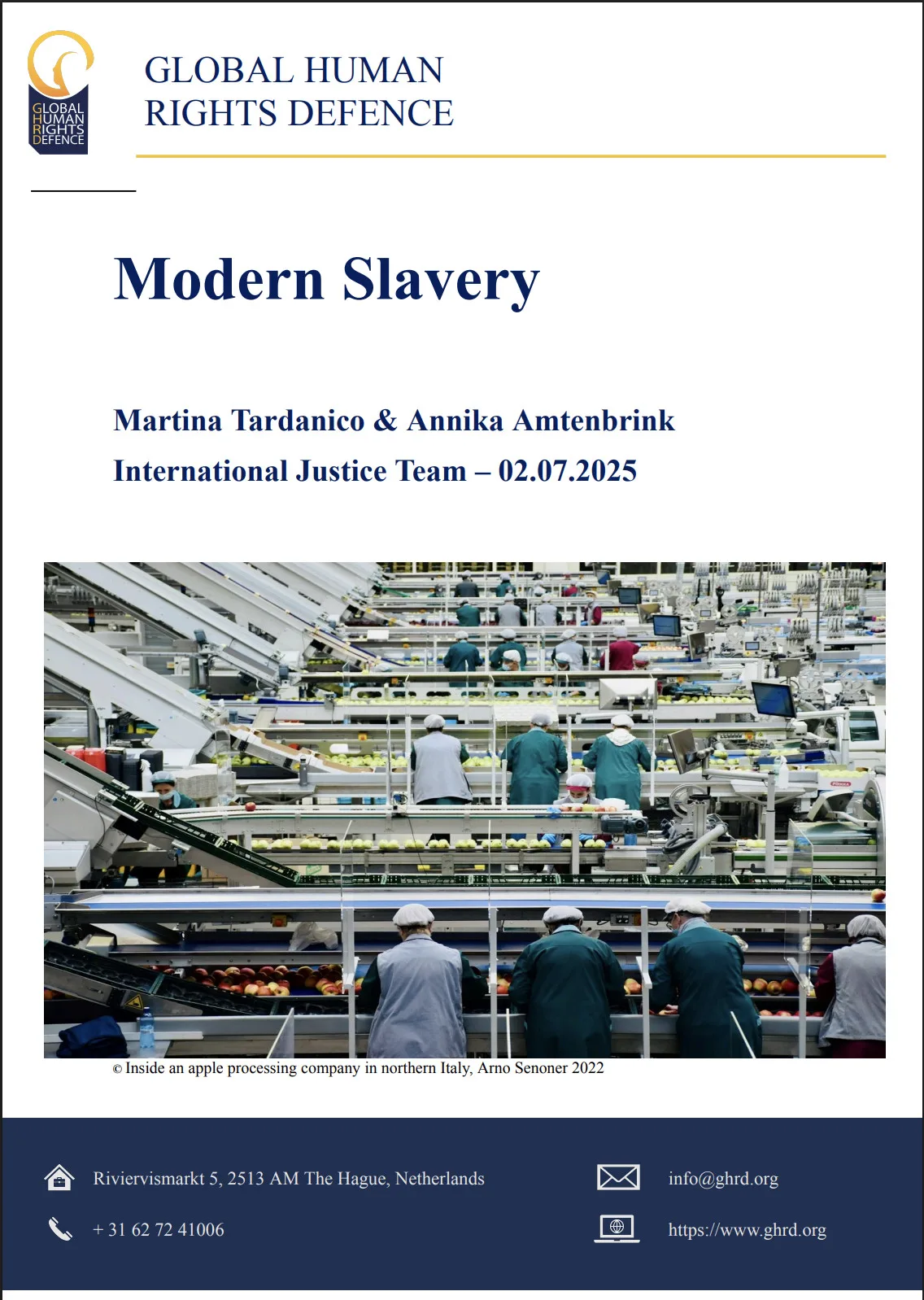
Modern slavery, a term often associated with past times, remains a pervasive and omnipresent prevailing issue in our contemporary world. Despite its often invisible nature in the Western world, modern slavery keeps being an issue for many people worldwide, depriving individuals of their fundamental freedom, human rights, and dignity. This complex issue appears in various forms like forced labor, debt bondage, forced marriage, and human trafficking, sexual slavery and forced prostitution, adapting and evolving with global economic and social shifts.

Climate/ Environmental Justice and Indigenous Peoples

Indigenous peoples represent some of the world’s most historically marginalized communities. They are generally understood as groups with ancestral connections to specific territories, maintaining distinct cultural, linguistic, and spiritual traditions that set them apart from dominant societies. Today, the United Nations estimates that there are more than 476 million indigenous people across over 90 countries, comprising about 6% of the global population. Despite their diversity, they share common experiences of dispossession, marginalization, and resilience in defending their ways of life.

Intersectional justice

Intersectionality, first articulated by Kimberlé Crenshaw in 1989, is a conceptual framework that recognizes how multiple forms of discrimination, such as race, gender, class, and sexuality, interact and reinforce one another, shaping unique experiences of marginalization and harm. Crenshaw’s work, particularly in “Mapping the Margins: Intersectionality, Identity Politics, and Violence Against Women of Color,” highlighted the necessity of accounting for multiple, intersecting identities to understand how social structures produce and perpetuate inequality fully.

Transitional Justice in the New World Order – Maintaining the Path to Peace and Justice

In recent years, geopolitical polarization and eroded multilateralism have drastically altered the international legal and political landscape, weakening the influence of global norms and institutions. The decline is especially pronounced in conflict settings, where civilian casualties have reached a decade high in the Ukraine and Gaza wars. These events signal more than just institutional failure, they suggest that the very boundaries of what is considered politically and legally permissible are shifting.
Practices once deemed clear violations of international law, such as collective punishment, annexation of territory, or targeting of civilian infrastructure, are now openly contested or even normalized.

Invisible Behind Borders: The Limits of International Justice in Addressing Minority Oppression within Sovereign States

International justice refers to a body of legal norms, institutions and processes developed to uphold fundamental human rights, prevent impunity and enforce accountability for gross violations of international law, particularly during armed conflict or periods of systemic repression. Emerging robustly after the horrors of World War II and the Holocaust, international justice found institutional expression in the Nuremberg and Tokyo Trials and more recently, through the establishment of permanent and ad hoc tribunals such as the International Criminal Court (ICC), International Court of Justice (ICJ), the tribunals for the former Yugoslavia (ICTY) and Rwanda (ICTR) and various hybrid courts. These structures are tasked with adjudicating war crimes, crimes against humanity, genocide and other serious breaches of international humanitarian law (Schabas, 2017). At the heart of this legal framework is the commitment to uphold universal human rights irrespective of geography, culture or regime type.

Who Rules the World? The Crisis and Reinvention of International Law in a Fractured Global Order

In an era marked by armed conflict, mass displacement, climate collapse, and techno governance, international law finds itself in a profound identity crisis. Once hailed as the normative framework to prevent war, protect rights, and uphold global order, it now faces accusations of irrelevance, hypocrisy, and impotence. In 2025, what do we mean by “international law”? Is it a coherent legal system grounded in shared values, or a patchwork of norms invoked selectively by powerful actors? Traditionally, international law referred to treaties, conventions, and principles governing the conduct of sovereign states. But today, that definition feels increasingly inadequate. The global stage is no longer shaped solely by nation-states. Multinational corporations, billionaire technocrats, and transnational platforms exert influence that challenges the foundations of state-centric legal systems.
And states, even those states breaching international law, employ its logic to defend themselves against accusations (Bertamini, 2024). As power becomes more fragmented and legal norms more contested, International Law appears to oscillate between symbolic invocation and strategic manipulation. This paradox is particularly evident in how states and non-state actors alike selectively embrace legal language: not as a commitment to shared principles, but as a tool for legitimacy or deflection. The result is a global legal order marked by fragmentation, contested authority, and growing cynicism.

Balancing Freedom of Religion and Right to Education in the Americas

In the field of study and practice of human rights, the interplay between the right to freedom of religion and belief and the right to sexual education presents a compelling narrative, especially within the dynamic and culturally rich backdrop of the Americas. The Inter-American Court of Human Rights (IAtCHR), a pivotal arbiter in this complex dialogue, endeavours to balance these seemingly divergent rights under International Human Rights Law.

6th GHRD International Film Festival: Human Trafficking Edition
Submission Deadline: 9th August 2026